
Flooring Tips
Waterproof vs. Water-Resistant Flooring: What It Means in Florida
Waterproof and water-resistant are not the same word twice. Here is what each label really protects against, and how to choose the right one room by room in a Florida home.
- Published
- October 25, 2026
- Author
- Blackburn's Interiors, Winter Haven, FL
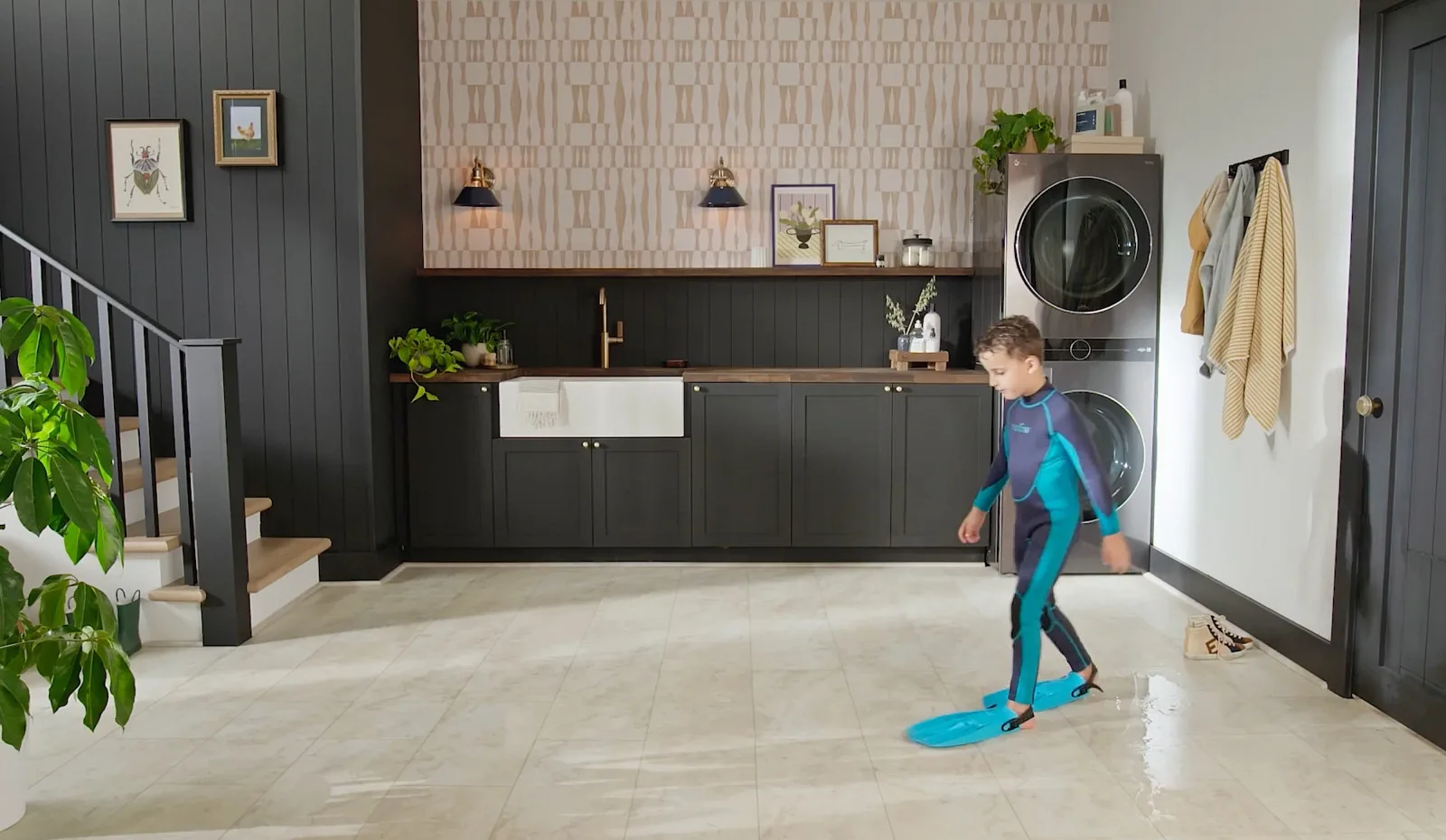
Here is the short answer. Waterproof means the material itself will not be damaged by standing water. Water-resistant means it fights off a spill for a little while, then fails if the water sits or seeps into the seams. One label protects the floor from a real puddle. The other only buys you time to grab a towel. Buyers mix these up more than any other pair of words on a showroom tag, and in Florida that mix-up gets expensive.
It matters more here than almost anywhere. Most Polk County homes sit on a concrete slab, so ground moisture is a constant, not a rare event. Our air stays humid half the year. Then features common to Florida homes, enclosed lanais, ground-floor rooms by the back door, laundry rooms with washing-machine hoses, put standing water in spots that would be low-risk up north. Let us draw the line clearly, then walk your house room by room.
Waterproof vs. Water-Resistant: The Definitions That Actually Matter
A national retailer, Floor & Decor, puts it about as cleanly as anyone. Waterproof means moisture cannot get into the surface, the seams, or the core, so the floor holds up under prolonged exposure without swelling, warping, or damage. Water-resistant is the weaker promise. The material simply slows absorption, and if water is left standing it will eventually soak in. Read that twice. Waterproof is about standing water. Water-resistant is about a spill you clean up quickly.
So these are not marketing synonyms. Manufacturers use each word to mean a specific thing, backed by specific warranty language. The tricky part is that there is no single referee. The flooring trade publication Floor Focus notes there is no established industry standard that classifies a floor as waterproof. That means the words are defined by the maker and by the warranty, not by one certified test. This is the same honesty problem we untangle when readers ask whether laminate or vinyl flooring is better. The label is a starting point, not a guarantee.
Wear Layer vs. Core: Why the Surface Is Not the Whole Story
Most floors are built in layers. On the very top sits a thin, clear wear layer. Its job is to fight scratches, scuffs, and stains, and to shed a surface spill. A tough wear layer is great, but it is not what makes a floor waterproof. Water rarely attacks a plank from straight above. It sneaks in at the joints and edges and works on the layer underneath.
That layer underneath is the core, and the core decides the category. A core that cannot absorb water gives you a waterproof floor. A core made of wood fiber or real wood can swell, and once it swells the plank is done. So when a salesperson taps the shiny top and says waterproof, the honest question is simple. What is the core, and what happens to it when water sits on the seam for an hour?
The Waterproof Tier: Rigid-Core Vinyl and Tile With a Membrane
Two materials earn the waterproof label honestly. The first is rigid-core luxury vinyl plank, sold as SPC (stone-plastic composite) or WPC (wood-plastic composite). The core is plastic and mineral, not wood, so standing water does not swell it. Brands market these cores as fully waterproof, and for the material itself that holds up. It is why LVP has taken over so many Florida floors. Our full guide to luxury vinyl plank covers how the layers stack up and where LVP shines.
The second is tile, with one big asterisk. Tile and stone are hard and dense, but they are not waterproof on their own. The grout lines and the substrate under them can still take on water. The membrane manufacturer Schluter says it plainly: these coverings are not inherently waterproof and must be installed with a separate waterproofing system that protects the material underneath. The Tile Council of North America, the industry's own standards body, backs this up. Its accepted shower methods call for a waterproof membrane applied over the backing across the entire tiled area. In other words, in a real wet spot it is the membrane doing the waterproofing, not the tile. That is why a proper installation matters as much as the product you pick.
The Water-Resistant Tier: Laminate and Water-Resistant Hardwood
Laminate is the classic water-resistant floor. It looks like wood, wears well, and handles daily spills, but its core is high-density fiberboard, which is basically compressed wood. Wet fiberboard swells. Better laminates treat the seams to hold water out for a set window. One retail brand, Select Surfaces (sold at Sam's Club), warrants its laminate seams to resist water penetration for up to 24 hours. That is real protection for a spill. It is not protection for a leak you do not notice until morning. If you are weighing this trade-off, our look at whether LVP beats laminate in Florida digs into exactly this point.
Water-resistant hardwood is the other member of this tier, and it is the most oversold. Treated real wood still has a wood core, so there is a ceiling on what a finish can do. These floors resist a quick spill better than plain wood, but not by much, and standing water still gets in. It is a splashproof finish that helps with a fast wipe-up, nothing more. Real wood belongs in dry rooms, handled with care. If water and rot are your worry, read our guide on which hardwood resists water and rot before you commit.
A Waterproof Floor Is Not a Waterproof Room
This is the trap that catches good, careful buyers. You can pick a truly waterproof plank and still get water damage. A flooring company, Urban Surfaces, says it straight: installing waterproof flooring will never make a room waterproof, because only the flooring material is waterproof. Water that pools on top can run to the edges, slip under the planks at transitions and seams, and reach the subfloor. The plank survives. The slab, the trim, and the drywall may not.
In Florida that subfloor is almost always a concrete slab, and slabs hold and release moisture for years. A waterproof floor sitting on a wet slab can trap that moisture and grow mold beneath it. So the floor is only half the job. The prep under it is the other half. Our piece on slab moisture mitigation in Florida explains why we test and treat the concrete before anything goes down. Waterproof product plus a bad slab still equals a callback.
Florida Room Guide: Where You Need True Waterproof
Now the practical part. Not every room needs the same floor. Match the material to the real water risk in that space, and you get a floor that lasts without overspending on rooms that stay dry.
Bathrooms and laundry rooms
These get true waterproof, no shortcuts. Tile over a waterproofing membrane is the safest call for a full bath, because it handles constant splashing and the occasional overflow. Laundry rooms deserve the same respect. A washing-machine hose can burst while you are at work and pour water for hours. That kind of failure is a leading cause of serious home water damage in Florida, so this is not the room to save a few dollars with water-resistant laminate.
Kitchens, entryways, and enclosed lanais
Waterproof again, and here rigid-core LVP shines. Kitchens see dropped glasses and slow dishwasher leaks. Entryways take in rain and wet shoes. Enclosed lanais sit at the edge of conditioned space, so they swing wide on humidity and sometimes catch blowing rain. A waterproof core takes all of that in stride. If you have already been through a storm, our guide on flooring after a flood or hurricane covers what survives and what has to go.
Bedrooms, closets, and formal living rooms
These are the low-risk rooms. The worst you usually see is a knocked-over glass of water, wiped up in a minute. Water-resistant laminate or engineered hardwood is a fine, budget-smart choice here. You get the look you want without paying for waterproof performance you will not use. Wipe up spills, keep the AC steady, and these floors last for years.
Here is the quick version for a typical Polk County home:
- Full bathrooms: tile over a waterproofing membrane.
- Laundry and mudrooms: waterproof tile or rigid-core LVP, never water-resistant only.
- Kitchens and entryways: rigid-core LVP or tile with a membrane.
- Enclosed or half-conditioned lanais: waterproof rigid-core LVP.
- Bedrooms, closets, living and dining rooms: water-resistant laminate or engineered hardwood is fine.
Read the Warranty, Not Just the Shelf Label
The shelf tag sells you. The warranty tells you the truth. Even when a maker uses the word waterproof, the fine print often carves out the disasters you would most want covered. Select Surfaces spells this out on both its laminate and its rigid-core products: the water warranty does not apply to damage from flooding or standing water tied to leaking pipes, mechanical failures, or appliance leaks. It covers everyday household spills, and only for a stated time. Floor Focus reports this is the norm, not the exception. Most warranties cover only surface moisture and exclude flood damage, standing water, and subfloor moisture.
So before you buy, get clear on what is actually promised. Ask the questions that the label will not answer for you:
- Does the warranty cover standing water, or only wiped-up spills?
- Is there a time limit, like 24 or 72 hours, before coverage ends?
- Are floods, pipe leaks, and appliance failures excluded?
- Does it require professional installation and a moisture-tested slab to stay valid?
None of this means waterproof flooring is a gimmick. It is a real, useful category. It just is not a force field against a plumbing disaster, and no honest floor is. Knowing that up front keeps your expectations and your warranty on the same page.
Frequently Asked Questions
Is waterproof flooring really 100% waterproof?
The material is, in the sense that the core will not swell from standing water. The room is not. Water can still reach your subfloor through seams, edges, and transitions, and most warranties still exclude floods and pipe leaks. Treat waterproof as strong protection for the floor itself, not a promise that a leak can do no harm.
Can I put water-resistant laminate in a bathroom?
We do not recommend it for a full bath. Laminate's fiberboard core swells once water sits long enough, and bathrooms see standing water often. Save water-resistant laminate for bedrooms and living areas, and use tile over a membrane or rigid-core vinyl where water pools.
Is tile waterproof by itself?
Not on its own. Tile and stone are dense, but grout and the substrate under them can take on water. In a shower or a wet floor, a separate waterproofing membrane under the tile is what actually protects the room. The industry's own standards call for that membrane across the entire tiled area. The install matters as much as the tile.
Does waterproof flooring let me skip slab prep in Florida?
No. A waterproof floor over a wet slab can trap moisture and grow mold beneath it. Florida slabs release moisture for years, so we test and, when needed, treat the concrete before we install anything. The product and the prep are two halves of the same job.
The Bottom Line
Waterproof and water-resistant are not the same word twice. Waterproof means the core survives standing water. Water-resistant means you have a few minutes to wipe up a spill before the core is at risk. Rigid-core vinyl and tile-with-a-membrane are your waterproof workhorses. Laminate and treated hardwood are water-resistant, fine for dry rooms, and no floor makes the room itself waterproof. Match the material to the real risk in each space, read the warranty, and prep the slab. Do those three things and you will not be surprised later.
If your head is spinning, that is normal, and it is exactly what we are here for. Come see samples side by side in our 8,000-square-foot Winter Haven showroom, or call us at (863) 294-7355 for a free in-home measure. We will test your slab, point you to the right floor for each room, and talk through special financing, subject to credit approval, if that helps. Ask us for details. Blackburn's Interiors has been family-owned in Winter Haven since 1962. You have plenty of places you could buy a floor, and we are grateful you would consider ours. We would love to help you get this one right.
Sources
- Floor & Decor, Waterproof vs. Water-Resistant Flooring Buying Guide (the plain-language definitions: waterproof means moisture cannot penetrate the surface, seams, or core even under prolonged exposure, while water-resistant only slows absorption and eventually fails if water is left standing)
- Urban Surfaces, Waterproof vs. Water-Resistant Flooring (knowledge base) (even genuinely waterproof flooring never makes the room itself waterproof, because only the material is protected and water can still reach the subfloor at seams and edges)
- Schluter Systems, Tiled Shower Waterproofing (tile and stone are not inherently waterproof on their own and must be installed with a separate waterproofing system to protect the material underneath)
- Tile Council of North America (TCNA), Showers FAQ (the accepted TCNA shower methods require a waterproof membrane applied over the backing across the entire tiled area, so the tile is not what waterproofs the assembly)
- Select Surfaces (Sam's Club brand), Warranty (the laminate warranty resisting water penetration at the seams for up to 24 hours, and both the laminate and rigid-core warranties excluding standing water from flooding, leaking pipes, and appliance failures)
- Floor Focus / FloorDaily, Flooring Forensics: What Is Waterproof Really Worth? (there being no established industry standard that classifies flooring as waterproof, and most warranties covering only topical moisture while excluding flood damage, standing water, and subfloor moisture)
More flooring tips
Have a project of your own?
Free in-home estimates across Polk County.