
Flooring Tips
Vinyl Plank Flooring in a Florida Room: What to Know
Can vinyl plank flooring go in a Florida room? Yes, if the room stays within the maker's limits. What to know about heat, sun, slab prep and warranty.
- Published
- November 11, 2026
- Author
- Blackburn's Interiors, Winter Haven, FL

Can you put vinyl plank flooring in a Florida room? It is one of the first things people ask when they want to turn a tired lanai into a real room. The answer is yes, in the right room, with the right prep. But a Florida room is harder on a floor than a bedroom. It gets more sun, more heat and often an old porch slab underneath.
We are Blackburn's Interiors, a family-owned flooring store in Winter Haven since 1962, and we install luxury vinyl plank in Florida rooms both ways, floating and glue-down. Here is what we check, using the makers' own install guides, their warranties and the ASTM standards for concrete. If you are still choosing between tile and vinyl, start with our guide to the best flooring for a Florida lanai.
The Short Answer
Yes, vinyl plank works in a Florida room when the room stays within the limits of the plank you pick. Conditions have to stay stable for the time the manufacturer sets, before, during and after the install. Most makers want the room held somewhere between 55 and 85 degrees while the floor goes in. So a Florida room cooled by the home's AC or its own unit is the easy case. A closed-up room with no AC is where most products draw the line.
- Room is cooled by the home's AC or its own unit: most vinyl plank can work.
- Room goes without AC for long stretches: only a floating product the maker allows there.
- Room has a lot of glass: plan on blinds or drapes, because the sun is the hardest part.
Will the Room Stay Within the Maker's Limits?
Every vinyl plank comes with an install guide, and the temperature range in it is not a suggestion. The warranty is written around it. Here is what the guides say for brands we carry:
| Product | Room temperature | Florida room note |
|---|---|---|
| Shaw SPC rigid core | 55 to 85°F to install, 55 to 100°F after | Climate-controlled space to install |
| Shaw glue-down vinyl | AC at 65 to 85°F, no higher than 85°F after | Wait until the room can be temperature controlled |
| COREtec Scratchless | 55 to 85°F to install | Floating allowed in a three-season room, -25 to 155°F |
| Karndean glue-down | 65 to 85°F, 24 hours before to 24 hours after | Names sunrooms and floor-to-ceiling glass |
One line goes further than the rest. COREtec Scratchless is a floating floor, and its guide allows a three-season room, one without climate control for long stretches. It is still a closed, glassed-in room. A screened lanai is open to the outdoors, and the warranty excludes outdoor use. The room still has to hold 55 to 85°F while the floor goes in. After the install, it can run from minus 25 to 155°F. The guide is clear that this allowance is for floating floors only. Other COREtec lines set tighter ranges, so we check the guide for the exact product.
Our rule is simple. Whatever the maker says the room needs, and for however long, the room has to hold it. A Florida room that runs its AC all summer passes easily. A room that sits closed and hot from May to October needs a product built for it, or a different floor. Some planks also need time in the room before the install, and our post on whether vinyl plank needs to acclimate covers that.
Sun, Heat and Big Windows
A Florida room is mostly glass, and that is the point of it. It is also the hardest part on vinyl. Direct sun through glass heats the floor, and strong sun fades it.
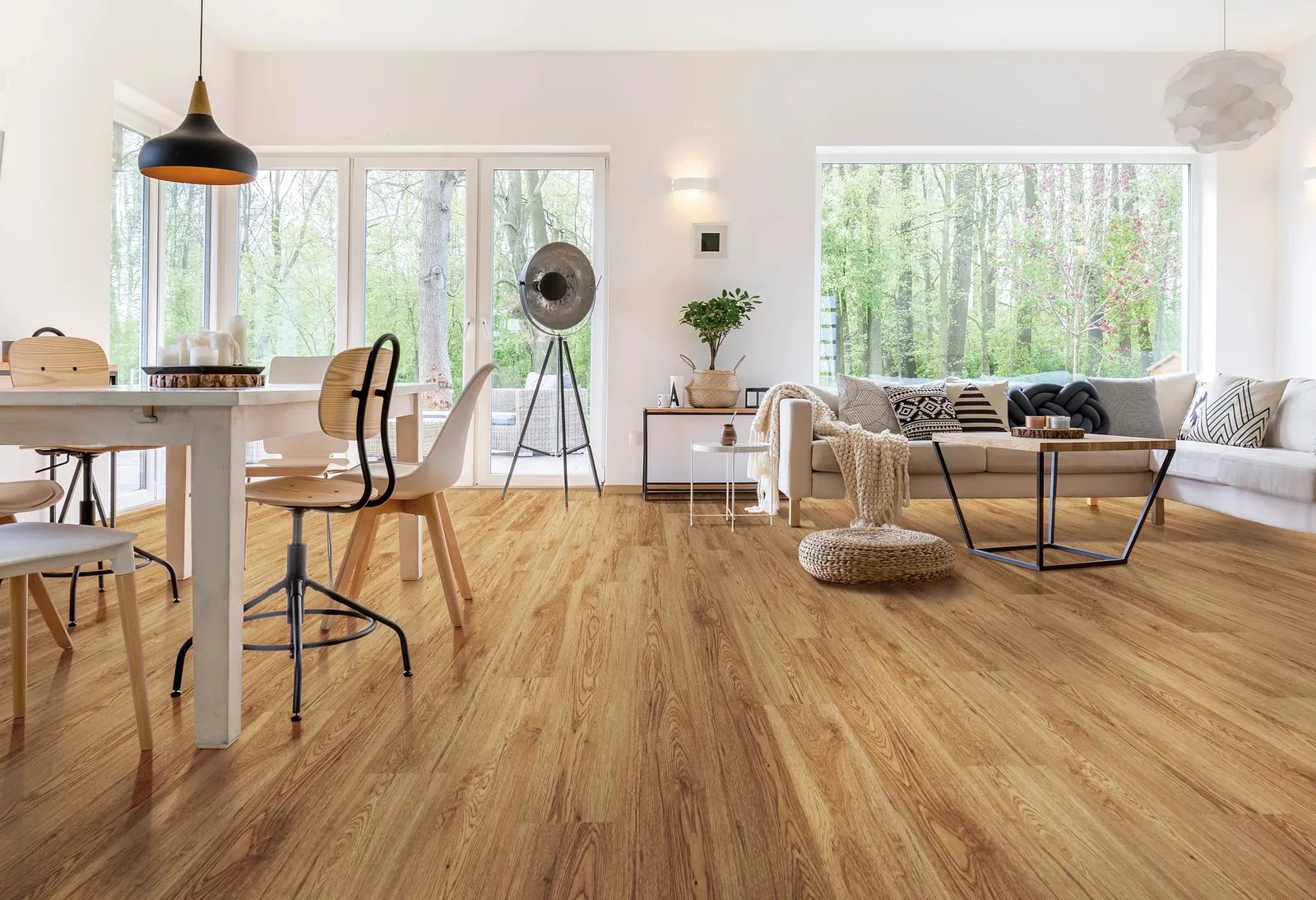
Shaw and COREtec both say to avoid long periods of direct sun and to use drapes or blinds during peak sun hours. Shaw adds that excess heat from direct sun can cause thermal expansion and UV fading. Karndean's glue-down guide names sunrooms, conservatories and floor-to-ceiling glass by name. It says to shade the windows before the install and for at least 48 hours after. Its recommended adhesive covers floor surfaces up to 122°F. Where the surface can get hotter than that, Karndean calls for its two-part epoxy.
A floating floor also needs room to move. Shaw's SPC guide calls for a gap at every wall, 1/4 inch for areas under 2,500 square feet and 1/2 inch above that. Baseboards or quarter round hide it. That gap is what lets the floor move when the sun heats it.
Floating or Glue-Down?
We do both. The choice comes down to two things: what you prefer, and whether the maker of the floor you pick allows that method in a Florida room.
- Floating: the planks lock together and rest on the slab. In the guides we checked, it is the only method allowed in a room without steady AC, and only for a product like COREtec Scratchless whose guide says so.
- Glue-down: the planks are glued to the slab, so the floor stays low and does not shift. It needs a room the maker approves, plus the right adhesive.
The adhesive matters more in a Florida room than anywhere else in the house. We use the one the flooring maker recommends for that product and that room, like Karndean's epoxy for its hottest, sunniest rooms.
Warranty Fine Print
This is the part most people skip, and it matters most if something goes wrong. The Shaw residential resilient warranty, which also covers COREtec Scratchless, has lines that apply straight to Florida rooms:
- It covers indoor residential use. Outdoor use is excluded.
- Changes in color or appearance from sunlight or heat are excluded.
- The floor has to be installed per the maker's install guide, and damage from slab moisture is excluded.
So fading from sun is not a defect the warranty pays for, and blinds are cheap protection. An install outside the guide's conditions can put your coverage at risk. That is why we follow the guide to the letter, and we confirm the exact terms for the collection you choose.
Prepping an Old Lanai Slab
Many Florida rooms were once screened lanais, so the floor is often an old porch slab. It gets a close look before any vinyl goes down. Here is what we check, and the standards behind it:
- Moisture and pH: ASTM F710 is the standard practice for getting a concrete floor ready for resilient flooring. It calls for moisture and pH tests on every slab, and a permanent vapor retarder under slabs on or below grade.
- Moisture limits: moisture is measured with a calcium chloride test (ASTM F1869) or a relative humidity probe set into the slab (ASTM F2170). We use the probe. Shaw SPC and COREtec Scratchless allow up to 8 pounds by calcium chloride or 90% relative humidity, with a pH of 7 to 10. For glue-down, the limits follow the adhesive.
- Flatness: Shaw and COREtec both want the slab flat within 3/16 inch in 10 feet, or 1/8 inch in 6 feet. If the floor slopes off a little, we level it to the maker's flatness spec before the plank goes down.
- Paint: Shaw wants paint cleaned off the concrete. Karndean says to mechanically remove all paint back to the original base. An old painted porch floor gets ground clean.
F710 does not override the flooring maker's own instructions. So we test the slab, then hold the numbers up to the guide for the floor you picked. For more on testing and fixes, see our slab moisture guide.
The Step Down From the House
There is typically a step down from the house into a Florida room. That edge needs a plan before the flooring is ordered.
We finish it with stair nosing or stair treads that match the floor. COREtec Scratchless shows how makers treat this spot. It is a floating floor, but its guide allows gluing at a flush stair nose. For how we handle steps in general, see best flooring for stairs.
Choosing Vinyl Plank for a Florida Room in Polk County
On the free measure, we walk the room with you and answer a few questions:
- Does the room have AC, and will it stay that way all year?
- How much direct sun hits the floor, and when?
- What does the slab test show, and is the slab flat, painted or sloped?
- How tall is the step down from the house?
Then we match the product and the method to the room, floating or glue-down, and follow that maker's guide. If the room will not stay within any vinyl maker's limits, we will tell you, and porcelain tile is usually the better call there. The installers we train and certify handle the prep, because prep is what keeps the floor flat and the warranty intact.
Questions We Get About Vinyl Plank in a Florida Room
Can vinyl plank go in a Florida room without AC?
Only some can, and only as a floating floor in a closed, glassed-in room. COREtec Scratchless allows a floating install in a three-season room, but the room still has to hold 55 to 85°F while the floor goes in. Shaw SPC and glue-down vinyl need a climate-controlled room. Check the guide for the exact product before you buy.
Will vinyl plank fade in a Florida room?
Strong sun can fade vinyl, and Shaw's warranty excludes color change from sun or heat. The makers recommend drapes or blinds during peak sun hours, and they are the easiest way to protect the floor.
Should vinyl plank float or be glued down in a Florida room?
Either can work, and we do both. It comes down to what you prefer and what the maker of your floor allows in that room. A glue-down floor needs the adhesive the maker calls for. Karndean, for example, switches to its two-part epoxy when the floor can get hotter than 122°F.
Do you have to test the concrete before installing vinyl plank?
Yes. ASTM F710 calls for moisture and pH tests on every slab, and each maker sets its own limits. We test before we install, because Shaw's warranty excludes damage from slab moisture.
The Bottom Line
Vinyl plank can be a great floor for a Florida room. The room has to stay within the maker's limits, the windows need blinds or drapes, and the old slab needs testing, leveling and a clean surface. We do floating and glue-down, and we follow the maker's guide for the product you pick. Come walk the samples at our Winter Haven showroom or request a free estimate, and ask about our special financing available, subject to credit approval.
Sources
- Shaw Floors, Resilient Installation Guidelines for SPC Products (rev. 06/13/2024) (the 55 to 85°F install and 55 to 100°F after-install ranges, drapes or blinds at peak sun, heat from direct sun causing thermal expansion and UV fading, the 1/4 and 1/2 inch gaps, the 8 lb calcium chloride (ASTM F1869), 90% RH (ASTM F2170) and pH 7 to 10 limits, the flatness limit and removing paint from the slab)
- Shaw Floors, Installation Guidelines for Residential Resilient Direct Glue (running the HVAC at 65 to 85°F, not installing until the room can be temperature controlled, keeping it no higher than 85°F after, and moisture limits that follow the adhesive)
- COREtec (Shaw), COREtec Scratchless Installation (rev. 05/01/2023) (the 55 to 85°F install range, the minus 25 to 155°F three-season allowance for floating floors only, gluing only under cabinets and at flush stair nosing, drapes or blinds at peak sun, and the moisture, pH and flatness limits)
- Karndean Designflooring, Gluedown Installation Guidelines (USA), KD80333GLO (holding sunrooms and rooms by floor-to-ceiling glass at 65 to 85°F for 24 hours before, during and after the install, shading windows before and at least 48 hours after, the recommended adhesive up to a 122°F surface and 2-part epoxy above it, and mechanically removing all paint)
- COREtec Scratchless Warranty (Shaw Residential Resilient Limited Warranty) (coverage for indoor residential use, excluding outdoor use, color or appearance change from sunlight or heat, installs outside the guidelines and damage from subfloor moisture)
- ASTM International, F710 Standard Practice for Preparing Concrete Floors to Receive Resilient Flooring (testing every concrete slab for moisture and pH before resilient flooring, a permanent vapor retarder under slabs on or below grade, and the practice not overriding the flooring maker's instructions)
More flooring tips
Have a project of your own?
Free in-home estimates across Polk County.