
Flooring Tips
Can You Put Vinyl Plank Flooring in a Bathroom?
Yes. Waterproof rigid-core vinyl plank works in a bathroom if the edges get sealed. Here is what protects the subfloor, what warranties cover, and when tile wins.
- Published
- November 9, 2026
- Author
- Blackburn's Interiors, Winter Haven, FL
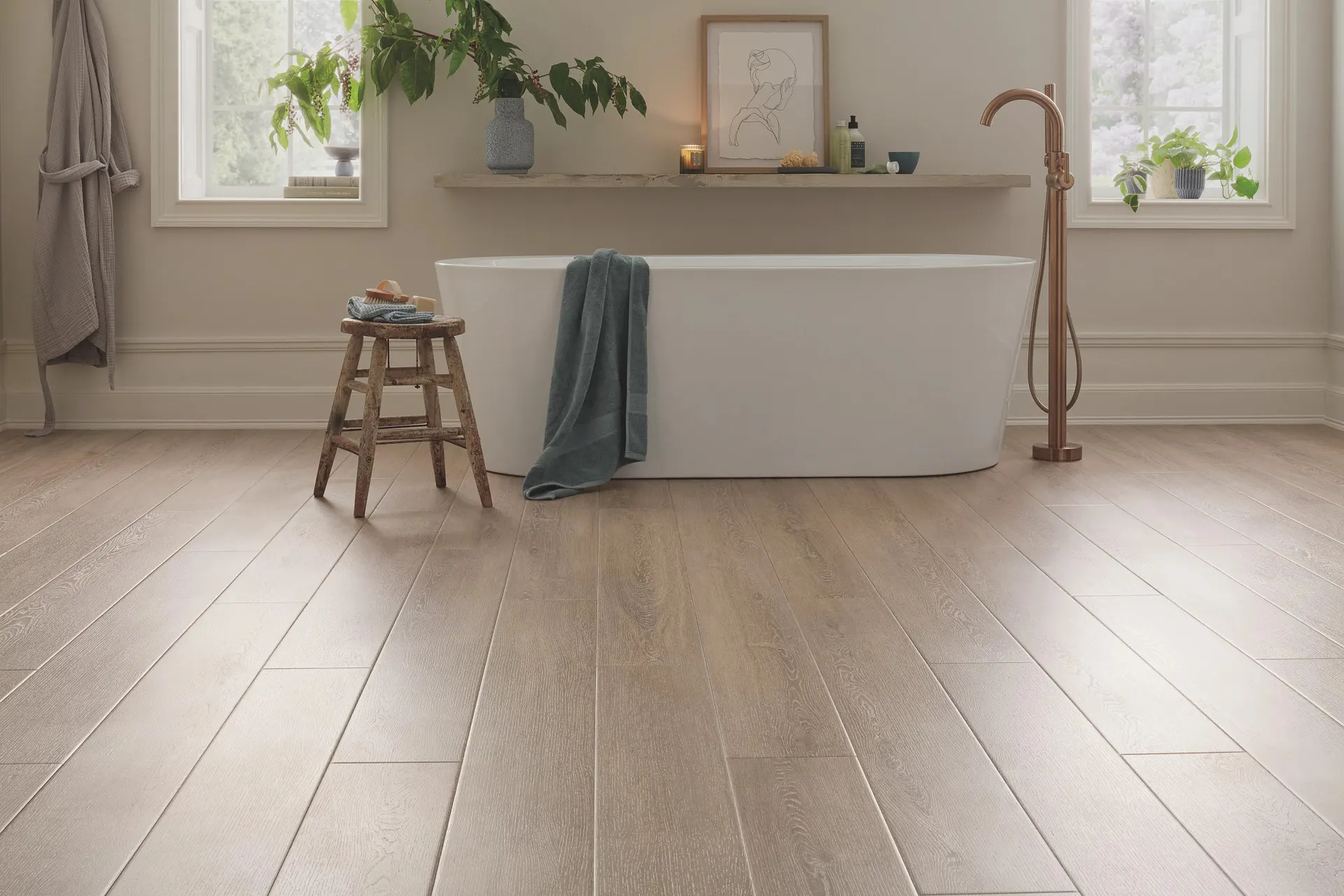
Yes. You can put vinyl plank flooring in a bathroom. Waterproof rigid-core LVP is built for rooms that get wet, and it sits in plenty of Polk County bathrooms doing exactly what it should. But the yes comes with conditions, and the conditions are where bathroom vinyl floors live or die.
This post is about those conditions. If you are still weighing every material against every other, start with our full bathroom flooring guide, because ranking the options is its job, not ours here. This post assumes vinyl is already on your short list and answers the question we hear at the counter: will it actually hold up in there?
The Short Answer: Yes, If It Is Rigid-Core and Sealed Right
Start with the right plank. Luxury vinyl plank with a rigid core, sold as SPC or WPC, is built around a dense waterproof core. Standing water cannot swell it. That is the floor this whole post is about. A plank sold as water resistant is a different product making a weaker promise, and the difference between those two words is exactly why we wrote waterproof versus water-resistant flooring. Read that one before you read a shelf tag.
With the right plank in hand, the yes depends on four things:
- A true waterproof rigid core, not a water-resistant one.
- Sealed edges: the perimeter, the tub or shower edge, and the toilet flange.
- The right bathroom. A half bath, a tub bath, and a wet room are three different questions.
- A warranty you have actually read, because the fine print is where waterproof gets defined.
A Waterproof Plank Is Not a Waterproof Floor
Here is the trap that catches careful buyers. The plank survives water. The floor, as a system, can still fail. Urban Surfaces, a flooring maker, says it straight: installing waterproof flooring will never make a room waterproof, because only the flooring material is waterproof. Water that pools on top does not just sit there and wait for a towel. It runs to the edges of the room, slips into seams and transitions, and travels under the planks.
Under the planks is the part you cannot see. In most Polk County homes that is a concrete slab, and trapped water on a slab breeds mold in the dark. In an older home with a wood subfloor, it is worse, because wood rots. Either way the plank on top looks fine while the floor underneath it goes bad. Nobody notices until the smell shows up. That is why every condition in this post is really about one thing: keeping water on top of the floor, where vinyl wins, and out from underneath it, where nothing wins.
Not All Bathrooms Ask the Same Question
The Half Bath
This is the easiest yes in the house. No tub, no shower, no standing water. The floor sees hand-washing splashes and a mopping, and waterproof LVP handles that without breaking a sweat. Seal the toilet flange, run the normal perimeter caulk, and enjoy it.
The Kids' Tub Bath
Still a yes, and honestly one of LVP's best rooms, but this is where the full seal job earns its keep. Water leaves a kids' tub in every direction, nobody dries their feet, and the floor gets soaked a few nights a week. Vinyl brings real gifts here: it runs warmer than tile, it is softer under your knees at bath time, and it is forgiving of a dropped shampoo bottle. Just treat the sealing as part of the floor, not an extra.
The Walk-In Shower and the Wet Room
Here the honest answer changes. A bathroom built around a big walk-in shower, or a true wet room where the whole floor is designed to get wet and drain, is asking for a floor that can be soaked on purpose. That is not what a floating vinyl floor is built for, and it is where we steer you toward porcelain. More on that below.
The Sealing That Actually Protects the Subfloor
This is the heart of the yes-with-conditions. Manufacturers do not treat sealing as optional in a bathroom. COREtec's own installation guidelines for its WPC floors say it plainly: for wet areas such as bathrooms, caulk the perimeter of the floor with a flexible silicone caulk. The word flexible matters. A floating floor needs to move with temperature swings, and flexible silicone seals the gap at the wall without pinning the floor in place.
The fixtures need the same respect. MSI, another vinyl maker, is just as direct: vinyl edges exposed at the toilet flange or the shower edge must be sealed with silicone caulk, because water that builds up underneath leads to mold and to flooring weakened by saturation. So the seal list for a full bath looks like this:
- The perimeter of the room, sealed with flexible silicone under the baseboard line.
- The tub and shower edge, where dripping water lands every single day.
- The toilet flange, the leak spot nobody sees until it is a repair job.
- Doorway transitions, so a mopped-over puddle cannot slide underneath.
None of this is hard work. It is just work that has to happen, in the right order, with the right caulk. The installers we train and certify seal these edges as part of the job, because a skipped tube of silicone is the cheapest way to ruin an expensive floor.
What the Warranty Really Says About Bathrooms
Vinyl makers do stand behind their floors in bathrooms. But the word waterproof in a warranty is narrower than the word waterproof in an ad, and it pays to read the actual terms. Take one real example from a line we carry. A COREtec residential warranty states that its waterproof coverage applies to topical moisture as long as the water does not flow over the edge of the surface, meaning the edge of the room or a cut board. The same document excludes problems arising from floods, from water pressure coming up through the subfloor, and from damage where the floor was not installed to the company's guidelines.
Read that back slowly. The warranty covers the everyday life of a bathroom floor: splashes, drips, wet feet, a towel that missed the bar. It does not cover the disaster scenarios, and it can walk away entirely if the install skipped the rules, including the caulk. That is not COREtec being sneaky. It is the honest shape of every waterproof flooring warranty we have read. Terms vary by brand and by collection, so we confirm the exact terms for the collection you choose before you buy. If you want to see the line that example comes from, our COREtec floors page covers what we stock.
When Porcelain Is Still the Smarter Call
We sell a lot of vinyl into bathrooms, and we still tell some customers to buy tile. A walk-in shower footprint, a curbless design, or a steamy wet room belongs to porcelain, and the reason is what sits under it. The Tile Council of North America's accepted shower methods call for a waterproof membrane covering the solid backing under the entire tiled area. That floor is an assembly engineered to be soaked and to drain, top to bottom. A floating vinyl floor is engineered to shed water off its surface. Those are different jobs, and pretending otherwise is how subfloors die.
One quick word on slip, whichever way you go. Wet floors and bare feet are an unforgiving pair. On tile, ask for the number: Daltile lists a wet DCOF of at least 0.42 for interior floors walked on wet, and 0.60 or better for barefoot wet areas like shower floors, and it recommends against polished surfaces anywhere water lands. Vinyl makers rarely publish a slip number, so use your hands and feet in the showroom. Pick a plank with real surface texture and skip anything with a glossy face. Your bare feet at 6 a.m. will thank you.
Frequently Asked Questions
Can vinyl plank go inside a walk-in shower?
No. The shower floor itself needs a sloped, membraned, drained assembly, and that is tile territory. Vinyl plank belongs on the bathroom floor outside the shower glass, with its edge at the shower sealed in silicone.
Can I put vinyl plank over my old bathroom tile?
Often, yes. It depends on whether the tile is sound and flat, and whether the added height still clears the door, the vanity toe kick, and the toilet flange. That last one matters most. We check all of it on the free measure and tell you straight, because guessing at a flange height is how a toilet ends up rocking.
Do you warranty the installation itself?
Yes. Our residential labor warranty backs the workmanship on residential jobs, separate from the manufacturer's product warranty, and the installers doing the work are subcontractors we train and certify. Commercial and trade work is different: those warranty terms are set job by job, in writing, with the bid.
The Bottom Line
Yes, vinyl plank belongs in a bathroom, as long as you buy a waterproof rigid core, seal the perimeter and the fixtures with silicone, and keep it out of the shower itself. The plank will never be the thing that fails. The edges will, if they are left open, so treat the seal job as part of the floor. And when the room is a wet room, let porcelain do what porcelain does.
If you want to feel the difference before you decide, come stand on the samples. Our showroom at 1507 Havendale Blvd NW in Winter Haven runs 8,000 square feet, and we will pull waterproof planks side by side so you can judge the texture barefoot. Call (863) 294-7355 or request a free estimate, and if spreading the project out helps, ask about our special financing, subject to credit approval. Family-owned in Winter Haven since 1962, and grateful you thought of us.
Sources
- US Floors / COREtec (Shaw), Resilient Installation Guidelines for WPC Products (the manufacturer's own instruction that wet areas such as bathrooms get the floor perimeter caulked with a flexible silicone caulk, and that excess subfloor moisture can promote mold and mildew under the flooring)
- COREtec (Shaw), COREtec Galaxy 30 Year Residential Warranty (the waterproof warranty covering topical moisture only as long as water does not flow over the edge of the surface, excluding floods and water pressure from the subfloor, and requiring installation per the company's guidelines to stay valid)
- MSI Surfaces, Installing Luxury Vinyl Flooring in the Bathroom (sealing vinyl edges at the toilet flange and shower edge with silicone caulk to keep water from building up underneath and causing mold and flooring weakened by saturation)
- Urban Surfaces, Waterproof vs. Water-Resistant Flooring (knowledge base) (installing waterproof flooring never makes the room itself waterproof, because only the material is waterproof and water can still travel under the flooring at seams and edges)
- Tile Council of North America (TCNA), Showers FAQ (accepted shower methods requiring a waterproof membrane that covers the solid backing under the entire area to be tiled, which is why a wet room is built as a soakable assembly)
- Daltile, DCOF AcuTest: Reading Slip Resistance Test Results (the wet DCOF minimum of 0.42 for interior tile floors walked on wet, 0.60 or greater for barefoot wet areas such as shower floors, and the recommendation against polished surfaces where water lands)
More flooring tips
Have a project of your own?
Free in-home estimates across Polk County.