
Flooring Tips
Is LVP Better Than Laminate in Florida? Our Installer's Take
Florida slabs, summer humidity, and afternoon storms push the choice one way. Why LVP wins almost every Polk County install, and where laminate still fits.
- Published
- April 30, 2026
- Author
- Blackburn's Interiors, Winter Haven, FL
- Updated
- September 26, 2026
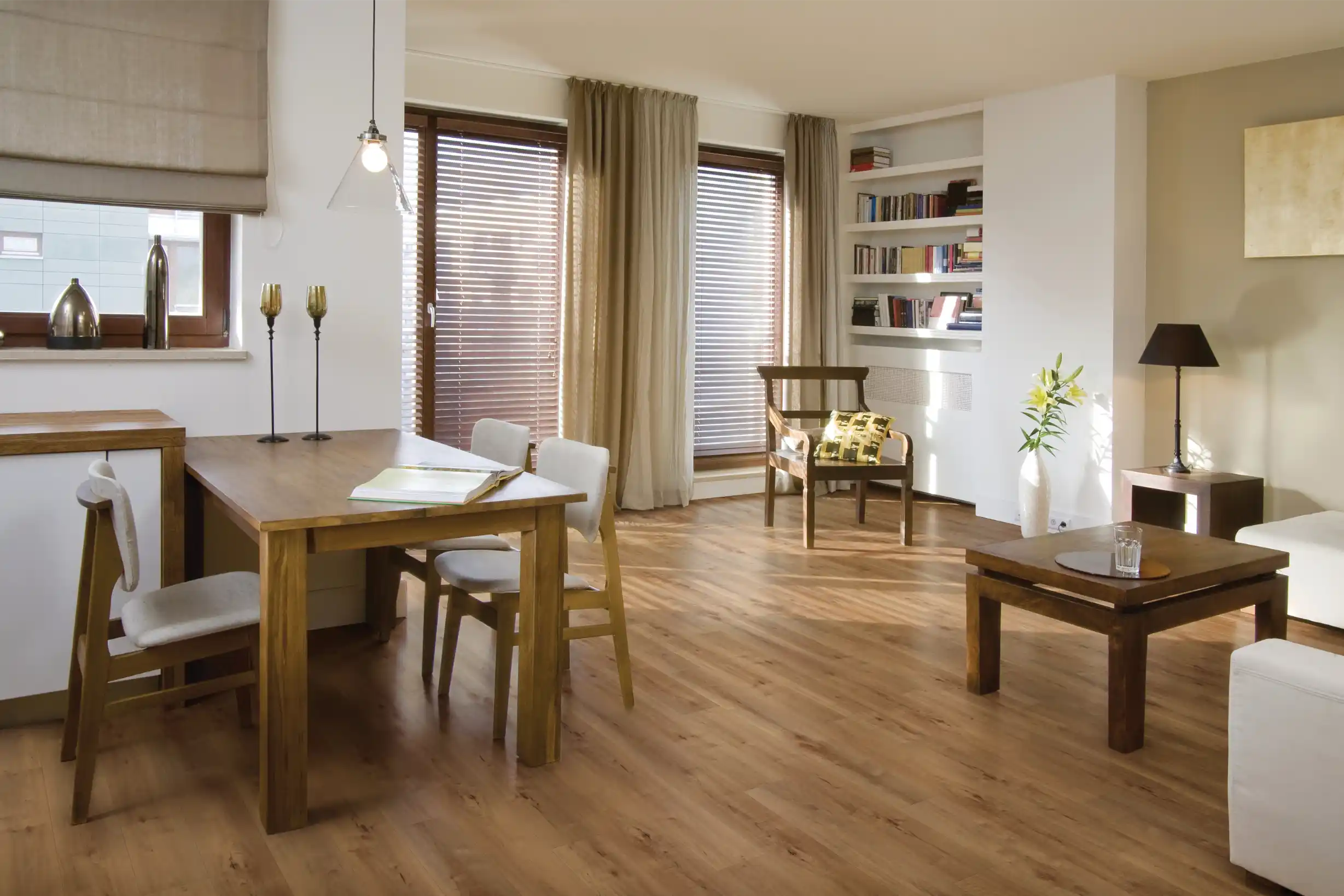
Both products click together. Both look like wood. Both cost less than real hardwood. On paper, choosing between laminate and luxury vinyl plank looks like a toss-up. In Florida, it isn't. The two floors are built around completely different cores, and those cores respond to this climate in completely different ways.
We install both across Polk County and have since well before either product existed in its current form. Here's the honest breakdown, including where laminate still makes sense, because it does, in the right situation.
The Core Is Everything
Laminate's core is high-density fiberboard, compressed wood pulp. That's the same base material as MDF. It's dense and stable in dry conditions. In Florida conditions, it has one fatal weakness: it absorbs moisture and swells, and once it swells, the damage is permanent.
LVP's core is either WPC (wood-plastic composite) or SPC (stone-plastic composite). Both are plastic-based. Plastic does not absorb moisture. Period. You can pour a bucket of water on a quality LVP floor, wipe it up twelve hours later, and the floor won't show a mark.
Everything else flows from that core difference: the click-lock geometry, the seam behavior, the warranty language, the real-world failure patterns we see. Our complete LVP guide covers the full construction breakdown if you want to go deeper on layers, cores, and wear-layer specs before deciding.
What Florida Adds to the Equation
Slab Construction
Most homes built in Winter Haven, Lakeland, and Auburndale after 1960 sit on poured concrete. Concrete holds ground moisture year-round and releases it as vapor into whatever you install on top. That vapor drive is slow, but it's constant, and it never stops.
LVP doesn't care. SPC cores, which we recommend for slab installs, have a density around 20 pounds per cubic foot. No vapor passes through. Laminate over a slab is a different story. The laminate industry's own rule is a fully cured slab plus a 6-mil vapor barrier and underlayment padding. That barrier helps, but it's a mitigation, not a solution. We test every slab before a laminate install and still get callbacks that we don't get from LVP installs.
Our slab moisture mitigation guide covers the testing process in detail. The short version: ASTM F2170 probe tests should show under 75% RH before any laminate goes down. We hit that threshold less often than you'd expect in Central Florida.
Humidity Swings
Polk County rarely drops below 50% relative humidity. In summer, especially if the AC is off for a few days after a storm, indoor humidity climbs to 70–90%. HDF absorbs ambient moisture just like solid wood. It expands and contracts with every humidity cycle.
Over three or four years of Florida summers, that movement opens seams, creates the slight ridge you feel under bare feet between planks, and eventually delaminates the decorative layer at the edges. LVP's SPC core is dimensionally stable across the full humidity range. It doesn't move measurably whether the humidity is 40% or 90%.
The Sudden Water Event
Every week we install for families who've lost a floor to a washing machine overflow, a hot water heater failure, or a slow dishwasher leak that went undetected for a month. In a slab home with LVP, those events are expensive in time but cheap in materials. Pull back furniture, dry the area, the floor is fine. In a slab home with laminate, the floor goes in the dumpster. The HDF core swells from the bottom up and the planks buckle out of plane. There's no saving it.
What the Warranty Fine Print Actually Says
This is where homeowners get burned. Most laminate warranties exclude moisture damage. Read the exclusion list on any major laminate brand: flooding, appliance leaks, subfloor hydrostatic pressure, and conditions resulting in moisture through the flooring are all listed as non-covered events. That's not a technicality. It's the most common way laminate fails in Florida, and manufacturers won't pay for it.
Some premium laminate lines now add water-resistant surfaces and sealed edges, and a few warranties cover spill damage by name. But "spill" and "standing water from a washing machine overflow" read differently to a warranty adjuster. The HDF core still has limits that no coating fully eliminates.
LVP warranties are written line by line, and the length varies from one line to the next. Check the warranty for the line you choose, and read what it says about water. The physics of a plastic core do the rest.
The Seam Is the Weak Point in Laminate
The click-lock joint on laminate is milled into HDF. It's a precise cut, tight and strong in dry conditions. Get water at that joint and the HDF wicks moisture laterally through the seam and swells from the inside out. Manufacturers have added wax coatings to the tongue-and-groove edges over the last decade, and it helps. But the physics of an HDF core absorbing water through any seam gap hasn't changed.
Premium LVP click-locks are extruded plastic. The seam is waterproof. COREtec uses a tight-geometry click system across its catalog; Karndean's Korlok Reserve uses a similar rigid-core system. Water can sit on the floor surface, but it can't enter the joint and attack the core.
Where Laminate Still Makes Sense in Florida
We're not anti-laminate. There's a real case for it in these situations:
- Raised wood subfloors: older homes near the lakes or in historic Bartow sometimes have crawlspaces. Without a concrete slab driving vapor upward, laminate's moisture risk drops significantly. This is still Florida, so we test, but the failure mode is different.
- Dry bedrooms in low-humidity homes: if you run the AC year-round without interruption, a bedroom with no plumbing nearby is a defensible laminate install.
- Short-term floor before a sale: if you need to replace carpet in two or three rooms before listing a house and budget is tight, mid-grade laminate looks presentable and costs a dollar or two less per square foot installed. Just disclose it and price accordingly.
- Specific visual looks: high-end European laminate with embossed-in-register textures still beats mid-tier LVP on hardwood realism in certain wide-plank formats. If you need that specific look and the room is dry, the case is reasonable.
That last window is narrowing every year. Premium LVP from Karndean and COREtec has closed most of the visual gap while keeping the waterproof advantage.
The Specs, Side by Side
- Core material: LVP is SPC or WPC (plastic-based). Laminate is HDF (wood-based). This single difference drives everything else.
- Slab install: LVP installs directly over concrete with a standard vapor retarder. Laminate requires moisture testing to ASTM F2170, a moisture barrier, and results under 75% RH.
- Waterproofing: LVP is 100% waterproof through the core. Laminate is water-resistant at the surface; the core swells with prolonged moisture.
- Click-lock seam: LVP seam is plastic, waterproof. Laminate seam is HDF, and it can swell if moisture reaches it.
- Humidity tolerance: LVP is dimensionally stable from 40–90% RH. Laminate expands and contracts noticeably across that range.
- Warranty moisture coverage: Many LVP warranties cover waterproof performance, so check the one for your line. Most laminate warranties exclude moisture damage. Even premium lines have limits.
- Cost installed in Polk County: Quality LVP runs $5–$11 per sq ft installed. Quality laminate runs $4–$8. The gap has narrowed to $1–$2 per sq ft on comparable products.
- Lifespan: LVP varies by line, so go by the maker's warranty for the one you pick. Quality laminate lasts 10–20 years in Florida conditions, less if it sees water.
- Foot feel: SPC LVP is harder underfoot than WPC. Laminate without a premium underlayment has a slightly hollow sound. COREtec's built-in cork underlayment addresses this better than bare SPC.
Why We Install Five Times More LVP Than Laminate
That ratio isn't because we prefer one product commercially. It's because five out of six Polk County homes we walk into have slab construction, a history of at least one water event, and a desire for a floor that doesn't require babysitting. LVP fits that profile. Laminate doesn't.
The customers who chose laminate when we gave them the choice sometimes call us back. Not always. A dry raised subfloor, a careful homeowner, and a quality product is a perfectly good install. But when they call, it's almost always a moisture story.
Brand Picks If You've Decided
If LVP is the call, our best LVP brands for Florida homes guide covers COREtec, Shaw, Karndean, Mohawk, and Mannington in full. The short version: COREtec for whole-home installs where you want built-in cork comfort; Shaw Paragon (20-mil SPC) or Mohawk SolidTech for competitive mid-tier value; Karndean Korlok for the best visual realism if design is the priority.
If laminate is the right call for your specific install, we carry Shaw Floors and Mannington laminate, the Restoration Collection included. It is still laminate, with an HDF core, so keep it in the dry rooms. Pergo and Mohawk RevWood are not lines we stock, but we can special-order and install either one.
Common Questions
Can I Install LVP Over Existing Laminate?
Sometimes. If the old laminate is flat, intact, and not moisture-damaged, a floating LVP can go over it. We usually recommend pulling the old floor. It adds $1–$2 per sq ft in demo labor but removes the risk of a callback if the underlying laminate fails and telegraphs through the new floor.
Does Any Laminate Beat LVP on Looks?
Yes, at the premium end. Wide-plank European laminate with true embossed-in-register wood texture can still beat mid-tier LVP on visual realism from close range. The visual gap has narrowed every year, but it hasn't fully closed. If that look matters enough to accept the moisture tradeoff, the case exists.
What Wear Layer Matters in LVP?
12 mil minimum for residential. 20 mil for homes with large dogs, active kids, or heavy furniture. Wear layer is the top clear film that takes all the abuse: scratching, scuffing, foot traffic. Drop below 12 mil and you're looking at a floor that shows wear early under real use. See our LVP brands guide for the full spec breakdown.
The Bottom Line
In a Florida slab home, LVP is the safer, more forgiving choice. The $1–$2 per sq ft premium over comparable laminate buys you a floor that actually fits the climate. It tolerates far more slab moisture than laminate, its core doesn't swell when the dishwasher leaks, and it doesn't move every summer.
Laminate has a real place: raised subfloors, dry rooms, and short-term budgets. Modern laminate looks better than most people expect. Just go in knowing what the core tradeoff is. In our experience, the homeowners who understand the core difference don't second-guess the choice they make. For the room-by-room scorecard without the Florida lens, our complete laminate vs vinyl comparison covers cost, lifespan, and feel side by side.
Walk both materials side by side in our Winter Haven showroom. The texture difference doesn't show in photos, and the seam behavior is something you have to feel. Contact us for a free in-home measure. We'll bring samples to your house, read your slab, and tell you honestly which product fits your install.
Sources
- North American Laminate Flooring Association (NALFA), Laminate Flooring FAQs (the 6-mil vapor barrier required for laminate over concrete, and laminate's moisture resistance being a surface coating)
More flooring tips
Have a project of your own?
Free in-home estimates across Polk County.