
Flooring Tips
What Goes Under Vinyl Plank Flooring?
What goes under vinyl plank flooring on a Florida slab? Underlayment, vapor barriers, and subfloor prep. Here's what a Winter Haven installer checks first.
- Published
- June 26, 2026
- Author
- Blackburn's Interiors, Winter Haven, FL
- Updated
- August 6, 2026
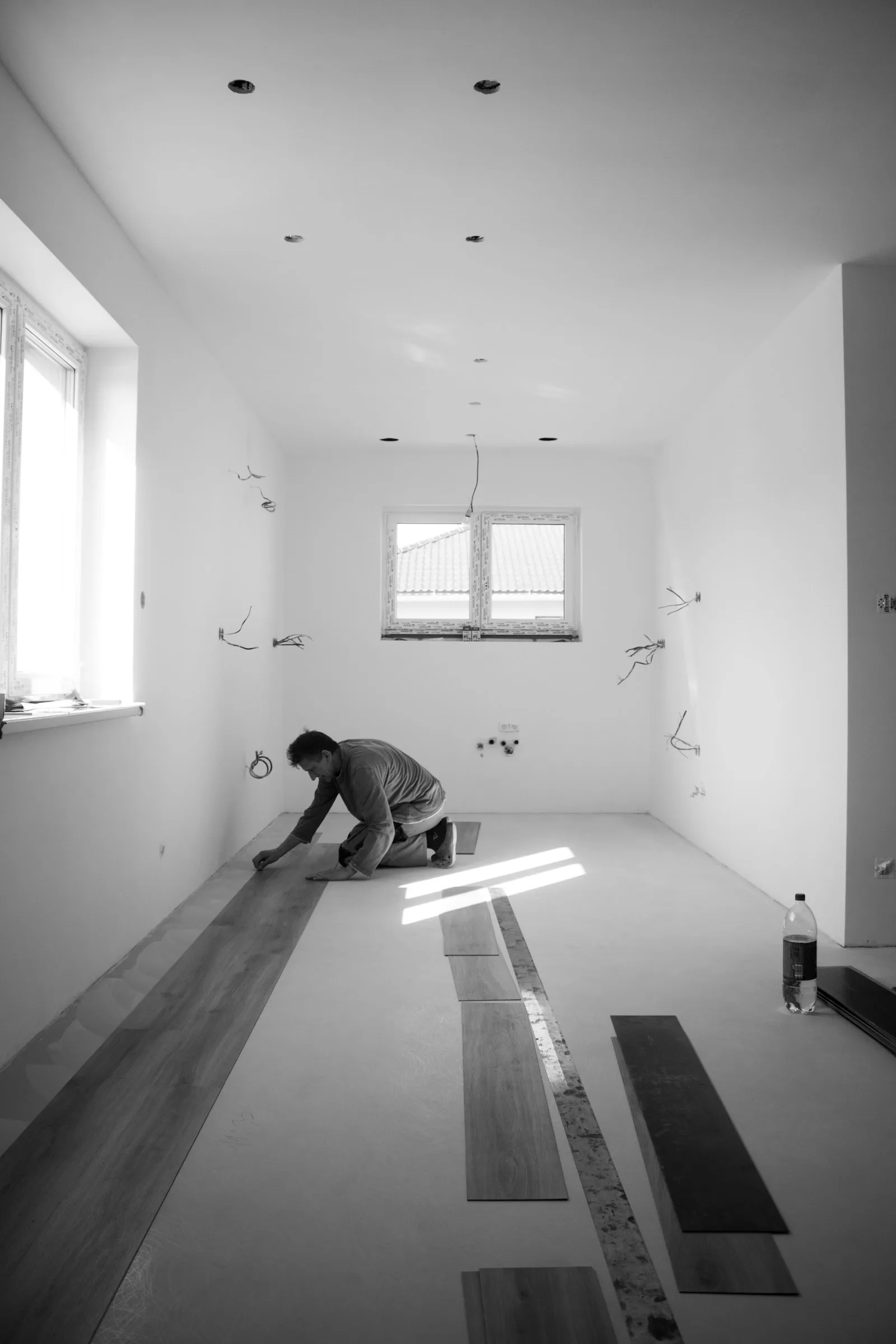
What goes under vinyl plank flooring is the question we wish more folks asked before they bought the floor. Most people pick the color, the width, the wood look they love. Few think about the layers hiding under the planks. But here in Polk County, those hidden layers decide whether your floor lasts twenty years or buckles in two. We've installed luxury vinyl plank on Winter Haven slabs since the category existed, and the floor under the floor is where most jobs are won or lost.
This is the installer's answer, not the marketing one. We'll walk through underlayment, vapor barriers, and subfloor prep: when you need each one, when you don't, and what happens if you skip the step. Our homes almost all sit on concrete slab, so we'll start there. But the bones of this apply whether you live in Lakeland or Maine.
The short answer: it depends on three things
There's no single thing that goes under vinyl plank. What belongs under your floor depends on three questions. We ask them on every in-home measure.
- What's your subfloor? Concrete slab, plywood, or an old floor you're going over changes everything.
- Does your plank have a pad already attached? Many do. Adding a second pad is a mistake.
- How much moisture is in the slab? In Florida this is the big one, and you can't eyeball it.
Answer those three and the right build-up almost picks itself. Get one wrong and you've set up a callback. We'd rather spend an extra hour at the measure than pull up a failed floor a year later. If you want the full overview of the product before we get into what sits beneath it, our complete guide to luxury vinyl plank covers core types, wear layers, and where LVP fits best.
Underlayment: when you need it and when the pad is already there
Underlayment is the thin cushioning layer between your subfloor and your planks. It does a few jobs. It smooths small imperfections. It softens the step underfoot. It quiets the hollow click that cheap floating floors make. Some underlayments also add a vapor barrier, which matters a lot down here.
Most modern LVP comes with the pad attached
Here's the part the big-box stores gloss over. A lot of today's rigid-core vinyl plank, SPC and WPC cores, ships with a foam or cork pad already bonded to the back. The plank you carry in the box is the plank and the pad, fused together at the factory. When that's the case, you do not add more underlayment.
Stacking a second pad under a pre-attached one feels like extra protection. It's the opposite. Too much cushion lets the planks flex. That flex works the locking joints loose over time. Seams pop. Edges peak. The floor that felt plush on day one starts to gap by month six. We see it most in rooms where a homeowner or a quick-hire crew doubled up the pad to 'be safe.'
When a separate underlayment does make sense
- Your planks have a bare back with no pad attached, which is common on thinner glue-down and some budget click-lock lines.
- You're floating the floor over a subfloor that's flat but a little noisy, like an upstairs room over a living space.
- You need a standalone vapor barrier over concrete and your plank's attached pad isn't rated as one (more on that next).
When you do buy underlayment, match it to the floor. The plank's manufacturer spells out what's allowed in the install sheet. Use the wrong foam and you can void the warranty. That warranty is a big reason to choose vinyl in the first place. Our advantages and disadvantages of luxury vinyl plank breakdown is honest about where the product shines and where it doesn't.
Vapor barriers over a concrete slab: the Florida step you can't skip
This is the one that gets Florida homes in trouble. Almost every house we touch in Winter Haven, Auburndale, and Bartow sits on a concrete slab. No basement, no crawl space. Slab is the Florida default. And concrete is never as dry as it looks.
Concrete is porous. It pulls moisture up from the ground and pushes it out as vapor for years after the pour. 'Dry to the touch' tells you nothing. What matters is the relative humidity deep inside the slab. A vapor barrier is the sheet, or the rated pad, that stops that vapor from reaching the back of your planks.
Why our slabs need more attention than most
Two reasons. First, new construction. Concrete dries about one inch a month, and a fresh slab can take the better part of a year to settle down, which is slower here where the air is soaked half the year. We've tested new-build slabs in Davenport and Haines City that were months old and still way too wet for a floor. Second, our humidity swings with the seasons. A slab that reads safe in February can climb past the limit during the summer rains. Moisture is the quiet killer of vinyl, laminate, and wood floors, and it's the whole reason we wrote a deeper Florida slab moisture mitigation guide.
How the barrier actually gets handled
If your rigid-core plank has a pad rated as a vapor barrier, and the slab tests within the manufacturer's limit, that attached layer can be enough. If the plank's pad isn't rated for it, we roll out a 6-mil polyethylene sheet first, lapped at least 4 inches and taped at the seams, then float the floor on top. That is the build Shaw's COREtec Advanced+ install guide calls for on a floating install, and it makes taping those seams a must over concrete. When a slab tests high, neither sheet is enough on its own. Then we move to a topical barrier, a two-part epoxy shot-blasted into the slab and rolled on as a sealed membrane, before the floor goes down.
The honest part: plank warranties put a ceiling on slab moisture, and that guide is typical. It calls the testing required and caps the slab at 90 percent in-situ relative humidity, or 8 pounds on a calcium chloride test. Read higher than that and it wants a moisture remediation system under the floor. Manufacturers only stand behind a moisture failure if the slab was tested first. No test, no claim. That's why every slab job we install gets an RH probe read before the floor goes down.
Subfloor prep and flatness: the step everybody underestimates
Even with the right pad and a sealed slab, a floor will fail if the surface under it isn't flat. Vinyl plank is thin and it follows whatever it's laid on. A dip in the slab becomes a dip in your floor. A high spot becomes a rock under the planks where the joints flex and crack.
The flatness number installers live by
The industry standard most manufacturers print is flatness within 3/16 inch over a 10-foot span, and 1/8 inch over 6 feet. COREtec's Advanced+ install guide prints that exact tolerance. That sounds fussy. It isn't. A slab that's off by half an inch across a room, which is common in older Lake Wales and Lakeland houses, will telegraph every wave through a floating floor and stress the locking system until it gives.
We check flatness with a long straightedge across the whole room, not just a level in one spot. Where the slab dips, we fill with a cementitious self-leveling compound. Where it humps, we grind it down. On wood subfloors we re-set loose screws, replace soft panels, and sand high seams. It's not glamorous work. It's the work that makes the finished floor look poured-in-place.
A clean, dry, solid base, every time
- Clean: every speck of old adhesive, paint, and drywall mud scraped off. A pebble under vinyl shows for years.
- Dry: tested and within the plank's moisture limit before a single plank goes down.
- Flat: inside the manufacturer's tolerance, leveled or ground where it isn't.
- Solid: no flex, no squeak, no loose panels. The base can't move under the floor.
We treat prep as its own line on the quote so nothing hides. If your slab needs leveling, you'll see it and we'll explain why. And every slab job runs through our FIDO subfloor odor treatment before the new floor closes it in, a small step that keeps old smells from getting sealed under your home.
Can you put vinyl plank over an existing floor?
Sometimes yes, and it's one of the things people love about vinyl. Rigid-core LVP can float over tile, sheet vinyl, or another hard surface if that surface is flat, solid, and bonded down tight. COREtec's install guide allows most existing hard-surface floors on those terms, and it holds sheet vinyl to one layer that isn't heavily cushioned. It saves a demo day and the dust that comes with it.
But there are real limits. Don't float new vinyl over carpet. The manufacturer bans it outright, and the reason is simple: it's too soft and the floor will flex apart. Don't go over a tile floor with deep grout lines or loose, hollow tiles without filling and securing them first; the plank will dish into every joint. And going over an old floor raises your finished height, which can foul up door clearances and transitions to other rooms. We measure all of that at the visit so there are no surprises at the thresholds.
What happens if you skip these layers
We get the service calls. The floor went in fast and cheap, and a year or two later something's wrong. The pattern is almost always one of these, and almost always a layer that got skipped.
- Seam lift and peaking: too much cushion or an uneven base works the locking joints apart until edges rise.
- Cupping and trapped moisture: no vapor barrier on a slab that needed one, so vapor pushes into the planks and warps them.
- Telegraphing: a dip or a high spot in the subfloor shows as a wave or a worn line right through the floor.
- Tacky, shifting glue-down: a wet slab emulsifies the adhesive under glue-down plank and the floor moves underfoot.
- Hidden mold: moisture trapped under a non-breathable floor that nobody finds until the planks come up.
The cruel part is the cost. Redoing a failed floor isn't just buying the planks again. It's the demo, the disposal, moving the furniture twice, and the days of disruption, on top of a warranty the manufacturer won't honor because the slab was never tested. Doing it right the first time is almost always the cheaper road. If you're still weighing materials for a slab home, our LVP versus laminate in Florida comparison and our hardwood versus luxury vinyl plank piece both dig into how each one handles our moisture.
How we handle what goes under your floor
Every Blackburn's vinyl plank job on a slab gets a moisture test after the work is sold and before we install. The installers we work with are trained and certified to our standard, among the best in Florida, so the person prepping your slab answers to us and stands behind the residential labor warranty we add on top of the manufacturer's.
At the showroom on Havendale we'll show you the actual products, the attached pads, and the install sheets that say what each one needs underneath. We've been doing this in Polk County since 1973, three generations in, and the layers under the floor are where that experience pays off. Not sure which plank fits your rooms yet? Our quick flooring quiz is a good first pass, and the flooring calculator gives you a rough size and budget before you ever come in.
The Bottom Line
What goes under vinyl plank flooring isn't an upsell. It's the difference between a floor that lasts and a floor that fails. The right pad (or no extra pad at all), a vapor barrier sized to your slab, and a base that's clean, dry, flat, and solid. Skip a layer to save a few dollars and you usually pay for it twice. We'd love to get it right the first time for you. Schedule a free in-home measure or call us at (863) 294-7355, and we'll walk every layer with you. Stop by the 8,000-square-foot showroom at 1507 Havendale Blvd NW in Winter Haven anytime, and ask about special financing. It's subject to credit approval and lets you pay for the whole project over time. Thank you for considering us. We know you have other choices, and we don't take that lightly.
Sources
- Shaw Industries (COREtec), COREtec Advanced+ Installation Guide (rev. 03182021, hosted by CFI) (the 3/16-inch-in-10-feet flatness spec, the required slab moisture test and 90 percent humidity ceiling, the 6-mil poly sheet lapped and taped under floating installs, and the ban on installing over carpet)
More flooring tips
Have a project of your own?
Free in-home estimates across Polk County.