Flooring Tips
Hardwood vs Luxury Vinyl Plank for Florida Homes
Hardwood vs LVP in Florida: how slab construction, humidity, and family life shape the right choice for Polk County homes.
- Published
- April 12, 2026
- Author
- Blackburn's Interiors, Winter Haven, FL
- Updated
- August 3, 2026
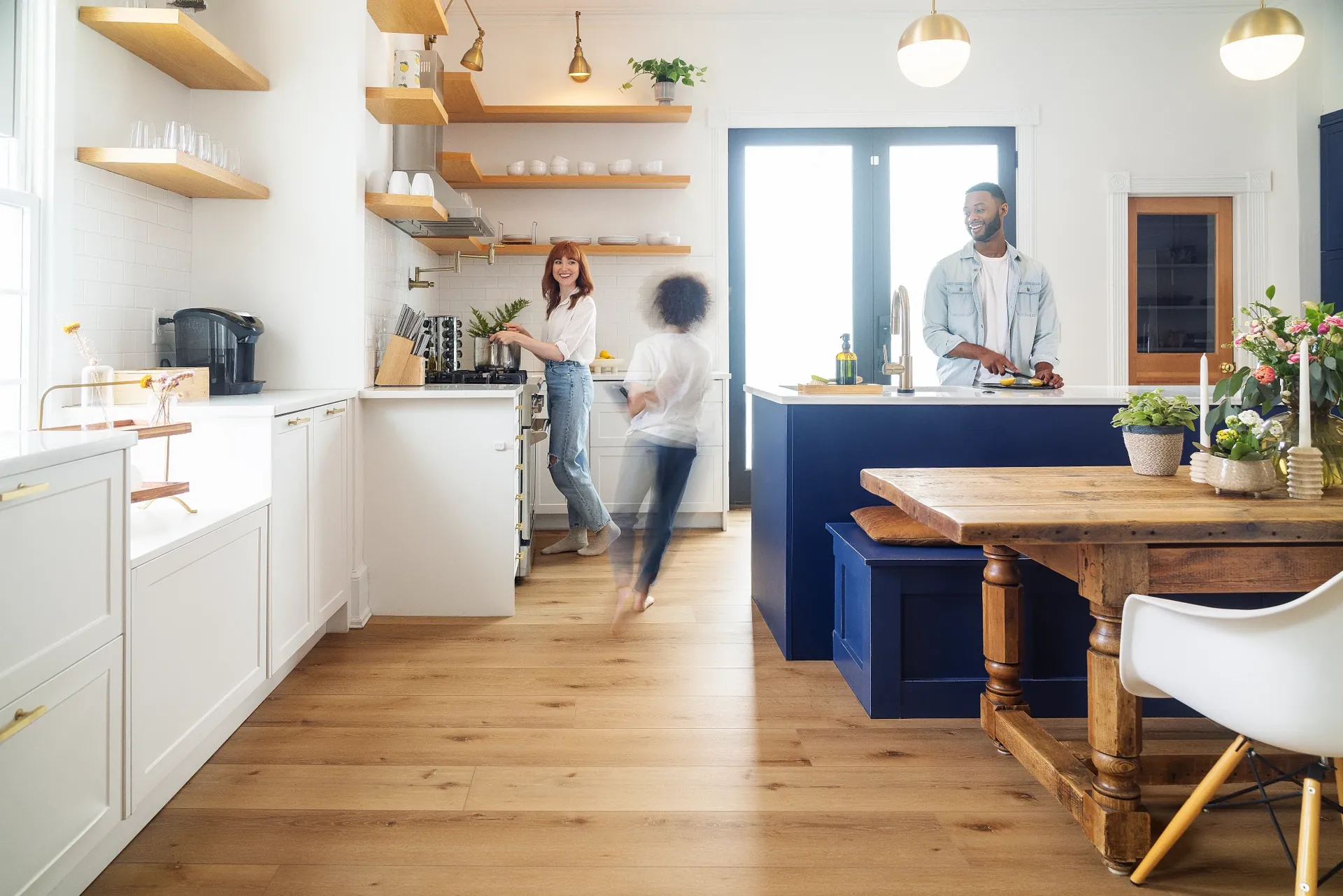
This is the question we hear more than any other in the showroom. A family walks in, points at a wide-plank oak sample, and asks if it will hold up in their Winter Haven home. Then they point at a luxury vinyl sample that looks almost identical and ask which one is the smarter buy.
The honest answer depends on three things: how your house is built, how you actually live, and what you want the floor to be in twenty years. Florida adds a few wrinkles you won't find in a national buying guide. Below is how we walk our Polk County customers through the choice.
The Quick Answer
If your home sits on a concrete slab, which most homes built in Florida after 1960 do, luxury vinyl plank is the easier, safer, more forgiving choice. It is fully waterproof, it doesn't care about humidity, and it installs directly over the slab without a subfloor build-up.
If your home has a raised wood subfloor, or you want a floor that can be sanded and refinished for the next forty years, real hardwood still wins on character, resale, and longevity. It just requires more planning in our climate.
Florida's Two Big Variables
Slab vs Raised Subfloor
Most homes in Winter Haven, Lakeland, and Auburndale are built on a poured concrete slab. Slabs hold moisture from the ground, and that moisture vapor rises into anything you install on top.
Solid hardwood and concrete don't get along. The wood absorbs moisture, expands, and cups or buckles. That's why solid hardwood is rarely installed directly on a slab in Florida. Engineered hardwood and luxury vinyl plank are both built to handle slab installations. They're dimensionally stable and won't warp the same way.
Humidity Year-Round
Polk County rarely drops below 50% relative humidity, and summer days routinely sit in the 70–90% range indoors if the AC is off for a weekend. Solid hardwood is hygroscopic. It gains and loses moisture with the air around it. That movement is why floors gap in winter and cup in summer.
Engineered hardwood handles this better because its plywood-style core resists expansion. LVP doesn't care at all. It's plastic, and humidity is a non-issue.
Hardwood: What You Get
Hardwood is the real thing. Every plank is a slice of an actual tree, with grain that's unique and a depth no print layer can match. A good hardwood floor lasts 50 to 100 years and can be sanded and refinished three to five times depending on the wear-layer thickness.
In Florida, your two practical choices are:
- Engineered hardwood: a real wood veneer over a multi-ply plywood core. Stable on slabs, glues or floats over concrete, and the top layer is the same species and finish as solid wood.
- Solid hardwood: only if you have a raised wood subfloor (rare in newer Florida construction). Nail-down install, full thickness solid wood from top to bottom.
Best Species for Florida
Hickory has a Janka hardness of about 1820 and handles humidity swings well. White oak sits at about 1360 on the Janka scale. It is the most popular choice nationally and works beautifully here. Avoid imported exotics with no Florida track record. Some species crack badly in our climate.
Luxury Vinyl Plank: What You Get
LVP is a multi-layer engineered floor with a printed wood-look surface, a waterproof core (WPC or SPC), and a wear layer on top. The best products today are nearly indistinguishable from real wood at arm's length. They click together over a slab in a single day, and they're completely indifferent to moisture, spills, pet accidents, and humidity.
Wear layer is the spec that matters most. For residential use we recommend 12 mil or thicker. For homes with big dogs or active kids, 20 mil holds up far longer.
What LVP Won't Give You
LVP can't be refinished. When the wear layer wears through, usually 15 to 25 years for a quality product, the floor gets replaced, not sanded. It also lacks the deep character of real wood when you look closely. Real grain has texture and depth that a print layer can imitate but never match.
Side-by-Side for Florida Living
- Slab installation: LVP wins. It installs directly. Engineered hardwood works with a moisture barrier and glue-down. Solid hardwood is a no.
- Waterproofing: LVP is 100% waterproof. Hardwood is not. Dishwasher leaks and pet accidents are real risks.
- Humidity tolerance: LVP doesn't move. Engineered hardwood moves slightly. Solid hardwood moves the most.
- Pets and kids: LVP wins on stain and scratch resistance. Hickory hardwood is the next best. Its natural grain hides scratches.
- Resale value: Real hardwood still adds more to appraised value than LVP, especially in higher-end homes.
- Longevity: Hardwood can last 50+ years and be refinished. Quality LVP lasts 15–25 years before replacement.
- Refinishing: Only hardwood can be sanded and refinished. LVP is one and done.
- Cost installed: Engineered hardwood typically runs $9–$18 per sq ft installed. Quality LVP runs $5–$11 per sq ft installed. Solid hardwood (where suitable) runs $12–$22.
These ranges depend on species, brand, and site conditions. The flooring calculator gives you a quick ballpark for your room dimensions.
Which Rooms Suit Each Floor
LVP: The Easy Yes
- Kitchens: dishwasher leaks and dropped glasses are non-events
- Bathrooms: the only wood-look floor you should put in a full bath
- Laundry rooms: washing machine overflow is a when, not an if
- Mudrooms and entryways: wet shoes after summer storms
- Slab-on-grade homes throughout the whole house if you want one floor everywhere
Hardwood: Where It Shines
- Living rooms and dining rooms: character and warmth matter most
- Bedrooms: quiet, low-spill rooms where wood ages beautifully
- Home offices and dens: adds visible quality to the room
- Formal entryways: the first impression of the home
- Homes where resale value or buyer perception is a priority
What About Installation Time?
LVP is faster. A 1,000 sq ft slab install typically takes one to two days. Engineered hardwood over a slab takes three to four days because of the glue cure and acclimation period. Acclimation alone runs 48–72 hours minimum. Wood needs to sit in the room and reach equilibrium with the humidity before installation. See our pre-installation tips for what we ask homeowners to do before install day.
Can You Mix the Two in One House?
Yes, and a lot of our customers do. A common Polk County floor plan: hardwood in the main living areas and master bedroom, LVP in the kitchen, mudroom, and any bathrooms that don't get tile. Done well, the transition is invisible if the wood-look colors are matched and the planks are similar widths.
We use T-molding or low-profile transition strips at the seams between rooms. With careful color selection, guests rarely notice where one floor ends and the next begins.
How Each Floor Handles Pet Accidents
Anyone with a dog or a cat knows accidents happen. LVP doesn't care. Wipe it up, sanitize the spot, move on. The seams between planks are tight enough that liquid doesn't migrate to the subfloor in normal puddle situations.
Hardwood is far less forgiving. A puddle left for a couple of hours can cup the boards or stain the finish. Engineered hardwood with a high-quality polyurethane finish holds up better than older oil-finished floors, but the risk is real. If your pet is older, on medication, or still being house-trained, LVP is the practical choice. Our guide to the best flooring for dogs goes deeper on claws, traction, and accidents.
Repair and Replacement Reality
Both floors can be repaired, but the process differs. With hardwood, an experienced installer can replace a single damaged board by carefully cutting it out and slipping in a new piece. The new board can be sanded and finished to blend with the surrounding floor. Over many years, the whole floor can be sanded to bare wood and refinished, making it effectively new again.
LVP is harder to repair plank by plank because of the click-lock geometry. Usually you have to disconnect from the nearest wall back to the damaged plank. Floating installations make this easier than glue-down. The trade-off: when the wear layer eventually fails after 15–25 years, you replace the whole floor rather than refinishing it.
Frequently Asked Questions
Which Is More Durable in a Family Home?
For most Florida family homes with kids, pets, and busy weekends, LVP wins on day-to-day durability. It handles spills, scratches, and water without flinching. Hardwood lasts longer in the absolute sense (50+ years vs 15–25), but "durable" depends on what you're measuring.
Can I Install Either One Over My Existing Tile?
LVP can often go over existing tile if the grout lines aren't too deep and the floor is flat. Hardwood typically requires the tile to be removed first. We assess each install during the free in-home measure.
Does LVP Add Value to a Home?
Quality LVP absolutely adds value compared to old carpet or worn flooring. Real hardwood typically adds slightly more to appraised value in higher-end Polk County homes, but well-installed LVP is a strong selling feature in any home under $500K.
The Bottom Line
For most Florida slab homes with kids, pets, or both, luxury vinyl plank is the practical winner. It handles our climate, it handles real family life, and it costs less to put in.
If you have a raised subfloor, or you're building a forever home, or resale is a major factor, real hardwood is still the floor with the deepest character and the longest life. Engineered hardwood gives you most of that benefit even on a slab.
If LVP is pulling ahead and you're also weighing laminate as a budget option, our LVP vs laminate in Florida guide covers exactly why slab construction changes that comparison. And if you're weighing every option for our climate, our best flooring for Florida homes guide breaks them all down.
Come walk both materials side by side in the showroom. Pictures don't capture the texture difference. Contact us to schedule a free in-home measure. We'll bring samples to your house so you can see them in your own light. Ask about special financing, subject to credit approval, if you want to pay over time.
Sources
- USDA Forest Products Laboratory, Quercus spp. (Oak) Technical Species Data Sheet (the 1,360-pound Janka hardness of dry white oak, not the national-popularity claim)
More flooring tips
Have a project of your own?
Free in-home estimates across Polk County.