
Flooring Tips
Can You Put a Refrigerator on Vinyl Plank Flooring?
Can you put a refrigerator on vinyl plank flooring? Yes, with a few rules. A Florida installer explains floating vs glue-down, dents, and how to roll it in.
- Published
- July 8, 2026
- Author
- Blackburn's Interiors, Winter Haven, FL
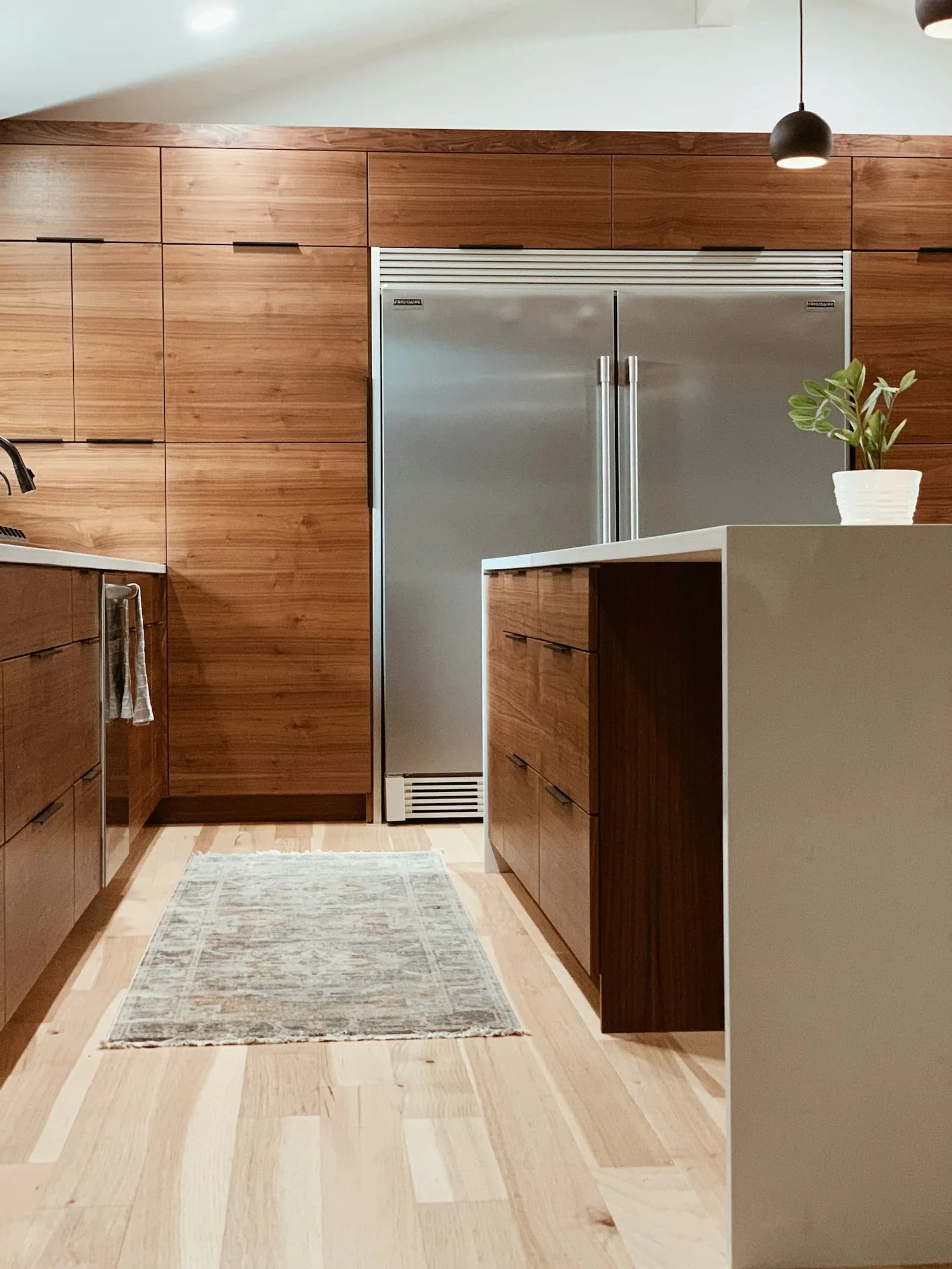
Can you put a refrigerator on vinyl plank flooring? Yes, you can, and people do it every day across Polk County. We have installed luxury vinyl plank in thousands of Winter Haven and Lakeland kitchens, and almost every one of them holds a full-size fridge. The yes comes with a few caveats. How the floor is installed, how you move the appliance in, and the shape of the feet under it all matter. Get those right and the floor lasts for decades. Get them wrong and you can dent or buckle a brand-new floor in an afternoon.
Most homes down here sit on a concrete slab, so the floor under your fridge has solid support. That helps. But vinyl plank is a thin, layered material, and a refrigerator is one of the heaviest things in the house. This guide walks through what really happens under that weight, the difference between a floating floor and a glue-down floor, and the simple rules we give every customer for fridges, ranges, and big kitchen islands. The science is the same whether you live in Florida or Maine. The Florida part just makes the slab and the humidity worth a closer look.
The Short Answer: Yes, With a Few Rules
A standard kitchen refrigerator weighs 250 to 400 pounds full. That sounds like a lot, but it spreads across four feet or wheels and the floor below them. Vinyl plank handles that static load fine in nearly every home. The trouble is never the resting weight. It is the moving, the dragging, and the narrow points where all that weight pushes down on one tiny spot.
Think of it this way. A person standing still on a plank is no problem. A person in stiletto heels can dent it, because the same body weight now presses through a point the size of a dime. A fridge works the same way. Spread the load and roll it gently and you are fine. Concentrate the load on a sharp foot or drag it across the planks and you create a problem. The rest of this article is really about avoiding those two mistakes.
- Yes, a refrigerator can sit on vinyl plank flooring in almost any home.
- Never drag or push it across the floor. Roll it on a mat or dolly.
- Watch out for narrow metal feet and leveling legs that focus the weight.
- Floating floors need a little breathing room so heavy items do not pinch them.
- Glue-down vinyl handles heavy point loads with the least worry.
Floating LVP vs Glue-Down: Why the Install Method Changes Everything
Here is the single biggest factor, and it surprises most homeowners. Two floors can use the exact same plank from the exact same box and behave very differently under a fridge. The reason is how they are attached to the slab. There are two main ways to install vinyl plank, and the advantages and disadvantages of luxury vinyl plank shift depending on which one you choose.
Floating Floors (Click-Lock)
A floating floor is not glued or nailed down. The planks click together edge to edge and form one big sheet that rests on top of the slab. The whole field can expand and contract with temperature swings, which is why it works so well over Florida concrete. Most click-lock LVP is the floating type. It is fast to install and easy to repair.
The catch is that a floating floor needs to move freely. A heavy fridge sitting on top of it usually is not a problem on its own. The problem comes when the appliance pins the floor in one place while the rest of it wants to expand. That is called a pinch point, and it can cause the seams nearby to lift or peak. We will cover how to handle that in a minute.
Glue-Down LVP
Glue-down vinyl is bonded straight to the slab with adhesive. Every plank is locked in place and cannot shift. This is the better choice under very heavy point loads, big islands, and rolling appliances, because nothing can move, pinch, or peak. The trade-off is a longer install, a slab that must be tested for moisture first, and a harder repair down the road. In a kitchen with a heavy fridge and a stone-top island, glue-down is often the smarter call, and it is one of the things we talk through during a free in-home measure.
- Floating: easiest install, great over slab, repairs easily, but needs room to move around heavy items.
- Glue-down: best under fridges, ranges, and heavy islands, but needs a moisture-tested slab and is harder to fix.
- Both are 100% waterproof at the surface, which matters in a kitchen.
How Heavy Is Too Heavy for Vinyl Plank?
Vinyl plank is tougher than people think. Quality LVP carries a static load rating, and most residential planks handle several hundred pounds per square inch before the surface gives. A refrigerator that spreads 350 pounds across four broad feet puts far less pressure on any single spot than that. So under normal use, weight alone is rarely the issue.
The real risk is point load. Point load is weight pushing through a small area. A wide, flat foot spreads the weight and the floor shrugs it off. A narrow, sharp metal foot does the opposite. It funnels the entire corner of the fridge into a contact patch smaller than a quarter, and that is where dents and dimples show up. This is the same reason we tell people to use felt pads under chair and table legs. Spread the load, save the floor.
Where Dents Really Come From
- Narrow leveling legs screwed down on a fridge or range.
- Small, hard plastic or metal feet on a heavy island or cabinet.
- Thin furniture legs with no felt pad.
- A dolly with a hard, narrow wheel rolled over a single plank.
- Anything that puts a heavy load through a small, hard point.
Thicker planks with a stronger core resist dents better. If a kitchen sees heavy appliances and a busy family, a denser core and a thicker wear layer are worth the small upcharge. Our full guide to luxury vinyl plank breaks down wear layers, core types, and which specs matter for a hardworking room, and the best LVP brands for Florida homes guide compares the lines we trust most.
The Right Way to Move a Refrigerator Onto LVP
This is where most floor damage happens, and it is the easiest to prevent. The number one rule is simple. Never drag a fridge across vinyl plank. Dragging scratches the wear layer, gouges the surface, and on a floating floor it can shove planks apart and pop the seams. We have walked into more than one home where a beautiful new floor got a long scuff the day the appliance came in.
Roll it instead. Lift the fridge just enough to slide an appliance dolly or a hard plastic glide mat underneath, then walk it slowly into place. The mat spreads the weight and gives the wheels a smooth path so they never bite into a single plank. Take your time on the turns. A fridge that fights you is telling you the wheels are digging in, and that is your cue to lift and reset, not push harder.
- Empty the fridge first to drop the weight as low as you can.
- Lift, do not drag. Tip it gently and slide a mat or dolly underneath.
- Use a wide, soft surface under the load, never a bare hard wheel.
- Lay a sheet of thin plywood or hardboard as a path for long runs.
- Move slowly and keep the turns wide so nothing twists a plank.
- Once it is in place, lower it onto pads or coasters, not bare metal feet.
If your fridge has a water line, leave a little slack so you can slide it out for cleaning later without dragging it. The same gentle approach applies every time it comes out and goes back. Most kitchen floor dents we see did not happen on install day. They happened the third or fourth time someone yanked the fridge out to sweep behind it.
Expansion Gaps and Pinch Points: The Floating-Floor Trap
Floating floors live and breathe. Vinyl expands a little when it warms up and shrinks when it cools, so every floating install needs an expansion gap around the room. That is the small space, usually a quarter inch to three eighths of an inch, left between the floor and every wall, post, and cabinet. The baseboard or quarter round hides it. Without that gap, a warm afternoon can push the planks against the wall and make them peak in the middle of the room.
Here is how a fridge fits in. If a heavy appliance sits on top of a floating floor and the planks under it cannot slide, the appliance becomes an anchor. The rest of the floor tries to expand, the anchored part cannot, and the seams near the fridge lift or buckle. This is the pinch point we mentioned earlier. It is the most common floating-floor complaint we get, and it is almost always preventable.
How We Avoid Pinch Points
- Keep the proper expansion gap at every wall, even behind the fridge nook.
- Do not pin a floating floor under a built-in or a load-bearing island.
- For very heavy fixed items, glue-down or a hard-surface base under them removes the worry.
- In a sunny kitchen, mind the temperature. Big swings move the floor more.
Florida adds a wrinkle here. Our humidity and heat cycle hard between the rainy summer and the dry winter, so floating floors move a touch more than they would up north. That is one reason a kitchen full of heavy appliances is sometimes a better candidate for glue-down. It is also why testing the slab first matters so much, which we cover in our piece on slab moisture in Florida homes.
Practical Rules for Fridges, Ranges, and Heavy Islands
Different heavy items need slightly different handling. The weight is similar, but how they sit and whether they move changes the plan. Here is the short version we share at the showroom.
Refrigerators
A fridge has rollers and adjustable feet. Roll it in on a mat, then level it. Once it is set, the feet rest in place and the floor is happy. Slide-out drawers and big French doors add no extra floor risk. Just remember the no-drag rule every time you clean behind it. Some folks like a thin floor protector mat under the fridge for peace of mind, and that is fine, though good LVP rarely needs it.
Ranges and Ovens
A freestanding range is heavy and runs hot. The weight is handled the same way as a fridge, roll it, do not drag it. The extra concern is heat. Keep the floor right at the base out of long, direct contact with a hot oven door or a heat vent, since steady high heat can soften vinyl over the years. A small gap and a heat shield, where the manufacturer calls for one, handle it. Tile is the most heat-proof choice right at a cooking zone, and we install plenty of tile kitchens for exactly that reason.
Heavy Islands and Built-Ins
A big island with a stone top is the heaviest single load in many kitchens, and it never moves. On a floating floor, that fixed weight can pin the planks and cause peaking. The cleaner approach is to set heavy, permanent fixtures on the subfloor and float the vinyl around them, or to use glue-down under the whole space. When we design a kitchen with our custom cabinet team, we plan the floor and the island together so neither one fights the other later.
- Fridge: roll in on a mat, level the feet, never drag for cleaning.
- Range: roll it, then mind direct heat at the base over time.
- Island: do not pin a floating floor under it. Glue down or float around it.
What Goes Under the Floor Matters Too
A floor is only as solid as what it sits on. Vinyl plank is thin, so it follows the shape of the surface below it. A flat, sound subfloor spreads a fridge's weight evenly and keeps the planks from flexing. A wavy or hollow subfloor concentrates the load and invites dents and squeaks, no matter how good the plank is.
On Florida slabs, flatness and moisture are the two big checks. The slab needs to be level within tolerance and tested for moisture before glue-down goes anywhere near it. We bring a moisture probe to every measure and never quote a kitchen blind. Our pre-installation tips cover the prep we do before a single plank goes down, and they are the same steps that keep a heavy appliance from ever becoming a problem.
Underlayment plays a role as well. A thin, firm pad supports the planks under heavy loads. A thick, soft pad feels nice underfoot but can let a fridge foot sink in and dimple the surface. For a kitchen with big appliances, firmer is better. This is one more spot where a quick conversation beats guessing, and it is exactly the kind of thing we sort out during the process of buying new flooring.
When Vinyl Plank Is the Wrong Call Under Heavy Appliances
We sell a lot of LVP, but we will tell you straight when something else fits better. Honesty has kept this family in business since 1962, and it beats a callback every time. There are a few cases where we steer customers toward another material under heavy loads.
- A commercial kitchen or shop with pallet jacks and rolling carts. That calls for commercial-grade flooring or tile.
- A spot with constant high heat right at the floor, where tile holds up best.
- A homeowner who wants zero movement under a massive fixed island and does not want glue-down. Tile or stone may suit them better.
- A buyer comparing thin budget vinyl. Cheap planks dent far easier under appliances than a quality LVP line.
For most Polk County kitchens, though, a good glue-down or a properly gapped floating LVP handles a fridge, a range, and an island without complaint. If you are still weighing your options, our guide for choosing the right flooring lays out how each material performs in real homes, and the flooring quiz can point you toward a starting place in a couple of minutes.
The Bottom Line
So, can you put a refrigerator on vinyl plank flooring? Yes, and you should feel good about it. Pick a quality plank, get the right install method for your kitchen, roll the appliance in instead of dragging it, watch for narrow feet, and respect the expansion gap on a floating floor. Do those things and your floor will outlast the fridge sitting on it. We are grateful you are even thinking it through, and we know you had other shops to choose from. If you want a hand getting it right, our family would love to help. Stop by the 8,000 square foot showroom at 1507 Havendale Blvd NW in Winter Haven, call us at (863) 294-7355, or schedule a free in-home measure and we will look at your slab, your subfloor, and your appliances before we quote a thing. Ask about our financing options, available with approved credit, and we will help you find a floor that handles real life.
Sources
- COREtec, Durable, Waterproof, Stylish LVP and LVT Flooring Solutions (the 100% waterproof LVP claim)
More flooring tips
Have a project of your own?
Free in-home estimates across Polk County.