
Cabinet Tips
Kitchen Drawers vs. Cabinets: What Goes in the Lower Cabinets?
Deep drawers, doors with shelves, or doors with roll-out trays. What each lower cabinet holds well, how the prices compare, and a zone-by-zone plan.
- Published
- October 19, 2026
- Author
- Blackburn's Interiors, Winter Haven, FL
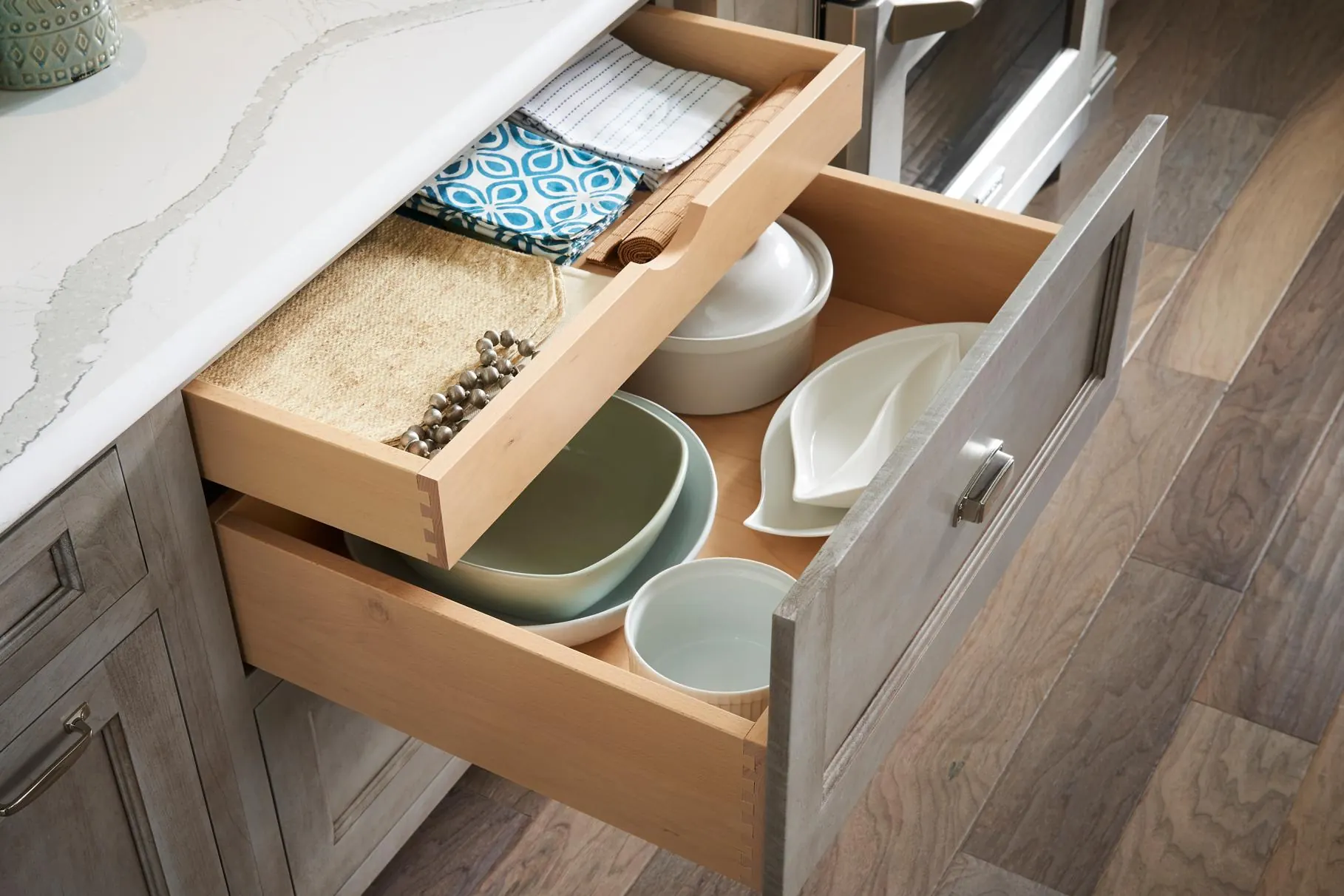
You are on your knees on the kitchen floor again. Half of you is inside a lower cabinet, and you are moving three pans to reach the fourth. Somewhere in the back is the lid. You have not seen it since spring.
That moment is the real question behind drawers versus cabinets. At Blackburn's Interiors, we plan and sell kitchen cabinets across Polk County, and this choice comes up on nearly every drawing. Here is how to make it, one lower cabinet at a time.
The Short Answer
Use deep drawers for most of your lower cabinets, and keep doors where a drawer cannot work. A drawer brings its whole load out to you in one pull. A door with a shelf makes you go in after it.
- Deep drawers: best for pots, pans, dishes, and food containers.
- Doors with shelves: best under the sink, in the corner, and for tall things.
- Doors with roll-out trays: a middle road, and a fix for cabinets you already own.
First, the Three Choices
People search for drawers versus cabinets, but a drawer base is a cabinet too. The real choice is what the front of each lower box does. There are three answers.
A drawer base is a stack of drawers with no doors. The common version has one shallow drawer on top and two deep ones below it. A door base has one or two doors with a shelf inside, and often a single shallow drawer above the doors. A roll-out base looks like a door base from the outside. Behind the doors, the shelves are trays on slides.
| Lower cabinet | Holds best | The trade-off |
|---|---|---|
| Deep drawers | Pots, pans, dishes, containers | Costs more than doors. Tall items will not fit. |
| Doors with shelves | Tall or bulky things, the sink | Lowest price. The back row is hard to reach. |
| Doors with roll-out trays | Pantry goods, small appliances | Two steps to open. Tray is narrower than a drawer. |
What Deep Drawers Do Well
A drawer turns the cabinet inside out. You pull once, and you are looking straight down at everything in it. You bend at the waist, not at the knees, which matters more every year.
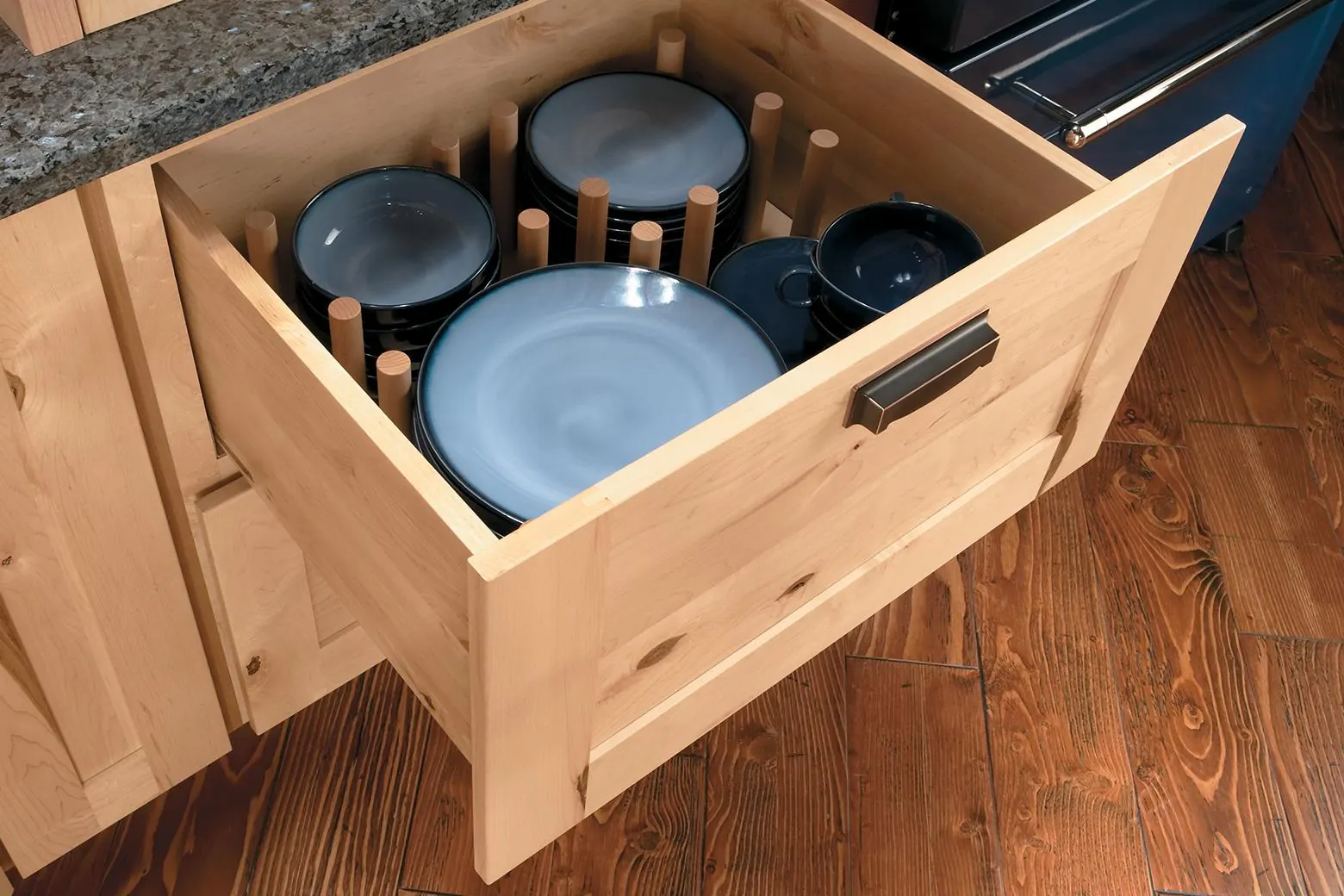
Deep drawers earn their keep with heavy, stackable things. Think pots and pans, mixing bowls, and food containers with their lids. Everyday plates and bowls work too. A lot of families like dishes in a drawer beside the dishwasher, because unloading takes no reaching overhead.
Width helps. A wide drawer holds a skillet flat with its lid beside it. A narrow one mostly holds regret. Cabinet widths come in set steps, so our guide to standard cabinet sizes is worth a look before you sketch a drawer bank.
Check the weight rating
A good drawer holds more than most people fear. The number belongs to the slide, so ask for it. Medallion, a line we carry, says its standard drawer guides hold up to 75 pounds, and its optional heavy-duty guides support up to 110 pounds. If you plan to fill a wide drawer with cast iron, that upgrade is the one to ask about.
Medallion builds the drawer box with dovetail joints, 5/8-inch hardwood sides, and a fully captured 1/4-inch plywood bottom. Quiet-close guides are standard on all of its lines. Those are one maker's numbers. Other lines differ, so read the spec for the cabinets you are pricing.
Ask for full extension
Full extension means the drawer box comes all the way out of the cabinet. Blum, a maker of drawer hardware, puts it simply: full extension gives you access to the very back of the drawer. Blum lists a 100-pound static load rating for its TANDEM full-extension runners. A deep drawer that stops three-quarters of the way out is a shelf with extra steps.
Where Doors Still Win
The sink base
The sink bowl, the drain, the disposal, and the water lines all live in this cabinet. A full stack of drawers has nowhere to go. Doors also let a plumber get in, and they let you spot a drip early. Our post on a swollen cabinet under the sink explains how to build that zone tougher than the rest of the kitchen.
There is one small exception. Medallion makes a sink base with a pull-out drawer for cleaning tools, and pull-out trays that sit under the sink. Those are add-ons to a sink base. They do not turn it into a drawer bank.
Tall and awkward things
A drawer has a ceiling. The drawer above it, or the countertop, sets the limit. A tall stockpot, a stand mixer, or a slow cooker may not clear it. Behind a door, you can take a shelf out and stand tall things upright.
Baking sheets and cutting boards are the classic case. They store best on edge. Medallion makes tray dividers that keep baking sheets, pans, and cutting boards upright in a base cabinet. That is a door cabinet doing a job a drawer does poorly.
The corner
Where two runs of cabinets meet, a plain drawer stack will not fit. The corner has its own set of answers, each with its own price. We compare a lazy Susan, a blind-corner pull-out, and a blocked-off corner in corner cabinet solutions, so we will leave the corner there.
Very narrow cabinets
Sometimes a run ends with a skinny leftover space. A drawer that narrow holds very little once you subtract the box and the slides. A door with a tray divider, or a narrow pull-out, usually makes better use of it.
Doors With Roll-Out Trays: The Middle Road
A roll-out tray is a shelf on slides. You open the door, pull the tray, and the back row comes forward. Medallion describes its roll-out trays as a way to easily reach items stored in base cabinets. It also builds a base cabinet with deep roll-out trays for pots, pans, or pantry items.
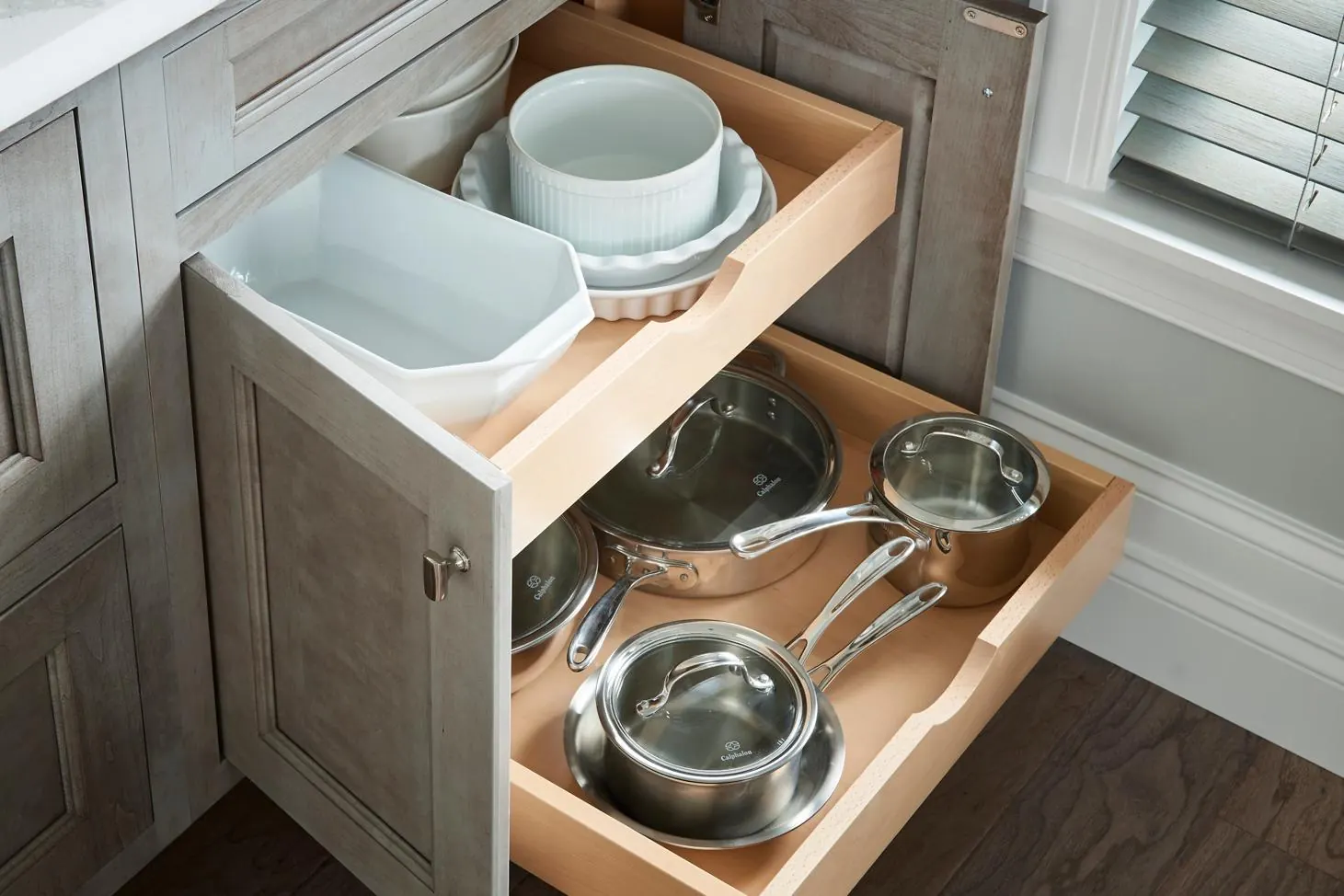
Next to a true drawer, roll-outs have three drawbacks.
- Two motions. You open the door, then pull the tray. With two doors, both have to be open and out of the way.
- Less width. The tray has to slide past the door and its hinges, so it is narrower than a drawer in the same size cabinet.
- Lower sides. Many trays have a short lip, so a stack of bowls can tip on the way out.
They also have real strengths. A roll-out base keeps doors on the outside, which some people prefer on a long run. A low-sided tray suits pantry goods and small appliances, where you want to see labels and lift things off the side. And trays can sometimes be added to cabinets you already own, which a drawer base cannot.
Our kitchen cabinet storage ideas post walks through the organizers that go inside drawers and roll-outs. This post is only about which cabinet to order.
What Each One Costs, Compared
We will not print a dollar figure here, because the gap changes with the cabinet line, the width, and the hardware. The order is steady enough to plan around.
- Doors with shelves cost the least. It is one box, one or two doors, and a shelf.
- Drawers cost more. A three-drawer base means three drawer boxes, three sets of slides, and three fronts in place of two doors.
- Roll-out trays also cost more than plain shelves. Each tray is a box on slides, and you still pay for the doors.
Whether drawers or roll-outs come out higher depends on the line and on how many trays you add. Ask for both prices on the same cabinet.
Keep the scale in mind too. Swapping a few door bases for drawer bases changes a line or two on the quote, while the cabinet tier and the box construction set most of the total. Our guide to how much kitchen cabinets cost shows where the big money goes. If the budget is tight, put drawers where you cook and keep doors everywhere else.
A Simple Plan, Zone by Zone
Do not pick one answer for the whole kitchen. Stand where you work and ask what you reach for there.
- Beside the range: a wide drawer base. Utensils in the shallow top drawer, pots and pans in the deep ones below.
- Beside the dishwasher: drawers for everyday dishes and food containers, so unloading is a short reach.
- Under the sink: doors, with a pull-out for the cleaning supplies if you want one.
- The corner: one of the corner fixes, chosen on its own terms.
- Baking and small appliances: doors, with a tray divider for sheet pans or roll-out trays for the mixer and the slow cooker.
- The island: drawers on the side that faces the cook.
- Narrow leftover spaces: a door with a divider, or a narrow pull-out.
Then measure your tallest pot and count your sheet pans. A roaster that comes out twice a year does not need the best drawer in the house.
One more thing to settle early. A drawer base and a door base are different cabinets, built differently at the factory. This choice gets made when the cabinets are ordered, not after they are hung. Our cabinet storage solutions page shows the Medallion options, so you can see what is possible before you sit down with a designer.
Common Questions
Are drawers better than cabinets in a kitchen?
For most lower cabinets, yes. Drawers bring everything out where you can see it and save you from kneeling. Doors are still the better choice under the sink, in the corner, and for anything too tall for a drawer. Most kitchens use both.
Are kitchen drawers more expensive than cabinet doors?
Yes, as a rule. A drawer base has more parts than a door base: more boxes, more slides, and more fronts. How much more depends on the cabinet line and the width. We price both ways so you can see the difference on your own kitchen.
Can you store plates and bowls in a lower drawer?
You can, and plenty of people prefer it. Dishes are heavy, so check the weight rating on the drawer slides and choose full extension. Medallion also makes a peg board drawer organizer with adjustable wooden pegs that keep dishes secure.
Are roll-out trays as good as drawers?
They are close, with two catches. You have to open the door before you pull the tray, and the tray is narrower than a drawer in the same cabinet. For pantry goods and small appliances, roll-outs work very well. For pots and pans you use daily, a true drawer is quicker.
Can I change my existing door cabinets to drawers?
Usually not without replacing the cabinet, because a drawer base is built differently. Roll-out trays are the more likely fix. They can sometimes be added when the opening width and the door swing allow it. Bring us a photo and the width of the opening, and we will tell you what fits.
The Bottom Line
Put drawers where you work the hardest, which usually means beside the range and the dishwasher. Keep doors at the sink, in the corner, and wherever tall things live. Use roll-out trays where you want doors outside and easy reach inside. Plan it by zone and you will stop crawling into cabinets.
The best way to decide is to open a few. Pull a loaded drawer in the showroom at 1507 Havendale Blvd NW in Winter Haven, then pull a roll-out tray beside it, and your hands will tell you which one you want. You can also set up a free in-home measure, and we will mark drawers and doors on your own plan. We offer special financing, subject to credit approval. Ask us for details.
Sources
- Medallion Cabinetry, Craftsmanship (Medallion's standard drawer guides holding up to 75 pounds and its optional heavy-duty guides up to 110 pounds, dovetail drawers with 5/8-inch hardwood sides and a fully captured 1/4-inch plywood bottom, and quiet-close guides being standard on all Medallion lines)
- Medallion Cabinetry, Roll-Out Trays (Medallion's roll-out trays giving easy access to items stored in base cabinets)
- Medallion Cabinetry, Base with Deep Roll-Out Trays (Medallion building a base cabinet with deep roll-out trays for pots, pans, or pantry items)
- Medallion Cabinetry, Tray Dividers (Medallion's tray dividers keeping baking sheets, pans, and cutting boards upright in a base cabinet)
- Medallion Cabinetry, Peg Board Drawer Organizer (a peg board drawer organizer with adjustable wooden pegs that keep dishes secure)
- Medallion Cabinetry, Sink Base with Pull-Out Drawer (Medallion making a sink base with a pull-out drawer for cleaning tools)
- Medallion Cabinetry, Sink Pull-Out Storage (Medallion making pull-out trays that sit beneath the sink base)
- Blum, TANDEM runner system (full extension giving access to the very back of the drawer, and Blum's 100-pound static load rating for its TANDEM full-extension runners)
More cabinet tips
Have a project of your own?
Free in-home estimates across Polk County.