
Cabinet Tips
Lazy Susan, Blind-Corner Pull-Out, or Dead Corner: Fixing Kitchen Corner Storage
A lazy Susan, a blind-corner pull-out, or a blocked-off dead corner. Here is what each one costs, what it gives up, and which one fits your kitchen.
- Published
- September 11, 2026
- Author
- Blackburn's Interiors, Winter Haven, FL
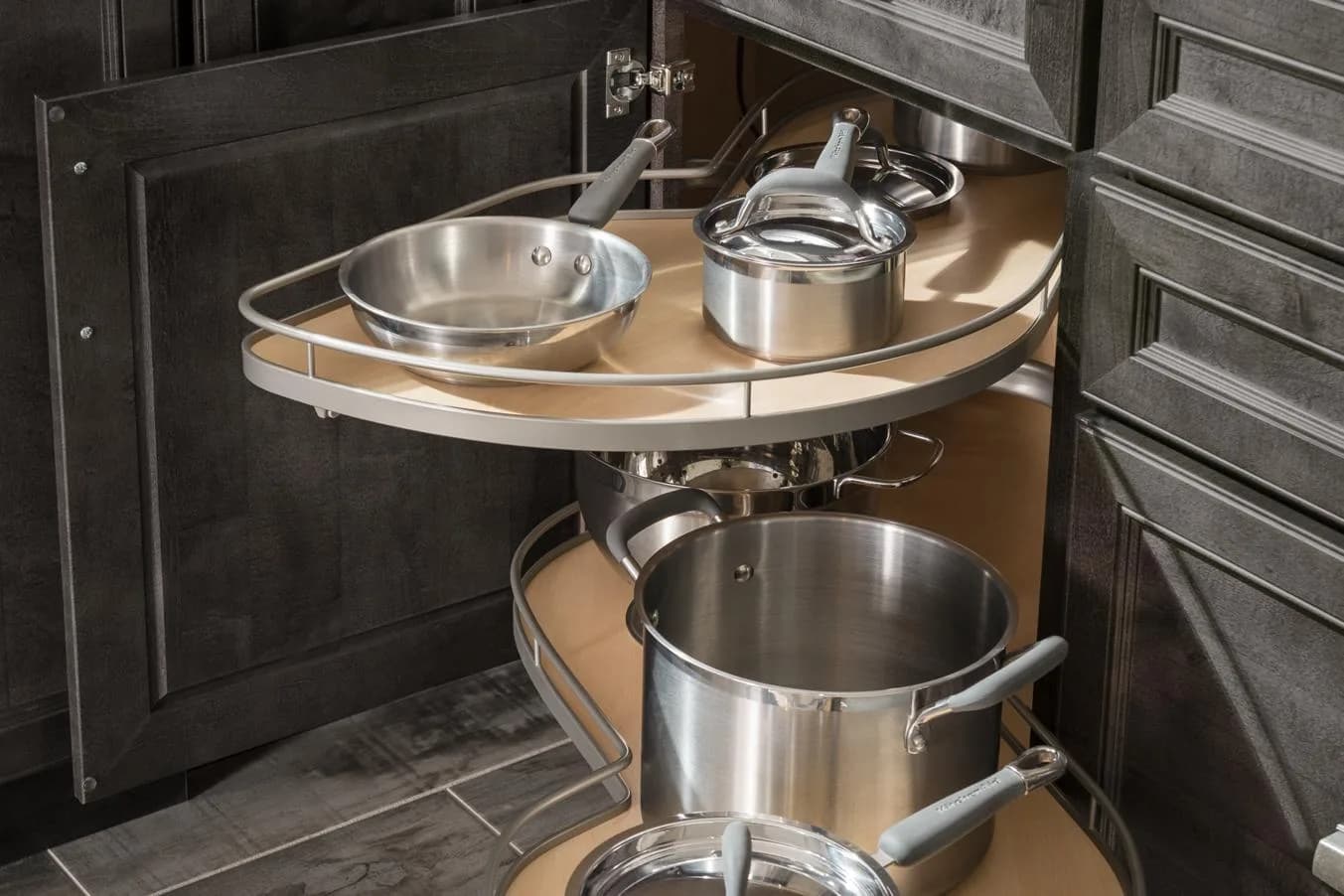
Every L-shaped and U-shaped kitchen has a corner. Two cabinet runs meet, and the space where they meet swallows things. A stockpot goes in. A year later you find it behind a bag of rice you also forgot about. The corner is where kitchen storage goes to die.
There are three real ways to deal with it. A lazy Susan. A blind-corner pull-out. Or an honest dead corner with a blank panel over it. Each one buys you something and each one gives something up. Here is the whole decision, plus two alternates worth naming, so you can settle it before the cabinet order goes in.
Why the Corner Is Hard
It is geometry. A base cabinet is deep. Where two runs meet, that depth doubles into the corner and the back pocket ends up behind the door frame, out of the light and past arm's reach. You have to kneel, reach around the jamb, and feel for what you want. Most people quit doing that after the first month. If you are still drawing the room, our kitchen design guide covers how the corner fits the rest of the plan.
Option 1: The Lazy Susan
A lazy Susan is a spinning tray, usually two of them stacked on a post, set inside a corner cabinet. You open the door, give it a push, and the back of the cabinet comes to you. It is the oldest fix in the kitchen and still the most common one.
The shapes are not interchangeable, and this is where people get it wrong. Rev-A-Shelf, one of the big names in cabinet hardware, lists five: full-circle, D-shaped, kidney-shaped, half-moon, and pie-cut. Each is made for a different corner cabinet.
- Full-circle and D-shaped: made for a true diagonal corner cabinet, base or wall
- Kidney-shaped: made for an angled corner cabinet, base or wall
- Pie-cut: made for an angled corner with the door attached, so the door swings with the tray
- Half-moon: base cabinets only, per Rev-A-Shelf
- Wrong shape in the wrong box means the tray hits the door or leaves a gap you can drop a pot lid through
What You Give Up
Volume, first. A round tray inside a square box leaves the four corners of that box empty. You trade some cubic feet for the ability to actually reach what you keep. For most people that is a good trade. Weight, second. Every tray carries a load rating from the maker, and heavy cast iron sitting on one side of a spinning shelf is exactly what those ratings are about. Read the rating before you plan to park a Dutch oven up there. Spills, third. Anything taller than the lip rides around and tips off into the dead space behind the tray.
Cost is the lazy Susan's strongest argument. One cabinet maker's accessory price guide puts plastic lazy Susans as low as roughly $20 and high-end units at around $300. Those are hardware prices, not cabinet prices, and they move by market and by year. Treat them as a ballpark, not a quote.
Option 2: The Blind-Corner Pull-Out
A blind corner is the other kind of corner cabinet. Instead of cutting across the corner at an angle, one cabinet runs straight and the run beside it covers part of its face. The hidden part is the blind. You can spot one in about two seconds: a diagonal cabinet has a single door set at an angle across the corner, while a blind corner has a flat front in line with the rest of the run and a stretch of that front carries no door at all. A blind-corner pull-out is hardware that reaches into that hidden space, swings the shelves out through the door opening, and hands them to you.
This is the best access money buys in a corner. Häfele sells the LeMans system, made in Germany, with shelves that ride out on a curved arm. Häfele says each shelf carries up to 25 kilograms, which works out to about 55 pounds, and that the system delivers up to 70% more storage area than a base unit with pull-out drawers next to the blind corner. That last figure is the manufacturer's own marketing claim, not an independent test, so read it as a sales number with real engineering behind it.
Rev-A-Shelf builds blind-corner organizers too. The company describes its line as using pivot, pull, and slide motion to reach every inch of the organizer, in wood or in wire, for face-frame cabinets and for frameless ones. Two different makers, one idea: get the shelf out of the hole instead of asking you to crawl into it.
The Mechanism Is What You Are Paying For
A blind-corner pull-out is a machine. Arms, pivots, bearings, and a soft-close damper carry a loaded shelf through a curve twice a day for years. Good hardware glides. Cheap hardware binds, sags at the front corner, and starts scraping the face frame in year two. So shop it like a machine. Load a display unit with real weight and swing it. Listen for grinding. Watch whether the shelf stays level as it comes around. That five-second test tells you more than any spec sheet.
Expect this to be the priciest thing in your corner. The same accessory guide puts Le Mans style corner units at roughly $300 up to about $1,000 for high-end models. Hardware only, again. If that number stings, our kitchen cabinet cost guide sets it against the rest of the job, and we carry special financing, subject to credit approval. Ask us for details.
Here is the flip side people miss. The blind cabinet box itself is the cheap one. A cabinet dealer puts a blind corner box at about half the cost of a lazy Susan corner box, because a lazy Susan cabinet takes close to twice the resources to build. So a blind corner often means a cheaper box and pricier hardware inside it. Keep the two numbers separate when you compare bids. One is the cabinet, the other is what goes in it.
Option 3: The Honest Dead Corner
The third option is to do nothing. Two runs meet, a filler strip and a blank panel close the gap, and the space behind it stays sealed. No hardware. No mechanism. No access. It is the cheapest corner in the kitchen, and it is not automatically the wrong one.
Working designers say so out loud. Kitchen designer Erin Zubot writes that if you have enough storage elsewhere, one way to handle the corner is to "allow it to be dead space and block it off." That is the whole test. If a walk-in pantry or a deep kitchen island already holds what the corner would have held, you are not losing anything you use. Take the dead corner seriously when the layout is tight, when the wall cannot spare the width a diagonal box needs, or when the money is better spent on a drawer bank you open every single day.
Two Alternates Worth Naming
Corner Drawers
Corner drawers pull straight out of the angle on L-shaped fronts. The win is visibility. You look down into an open drawer and see everything at once instead of getting down at eye level and spinning a tray. The catch is height. The drawers are shallow, so they will not swallow a blender or a tall stockpot the way a lazy Susan shelf will. They also tend to be the most expensive corner solution, because the boxes are custom built into the cabinet rather than bought off a shelf.
A Corner Sink
Putting the sink in the corner turns dead space into working space and leaves a longer unbroken run of counter on both sides. The trade-offs are real, though. Corner sinks tend to run smaller, so a big roasting pan becomes a fight. The deep recess at the back is harder to clean. Elbow room gets tight when two people work at once. And a dishwasher door beside it can jam the whole zone when it swings open. Worth naming. Worth a long look at the layout before you commit.
Retrofit or New Cabinet Run?
Some of these you can add later. Some you cannot. Blind-corner pull-outs are the friendliest retrofit, since most are designed to drop into an existing blind cabinet. The catch is clearance. The mechanism needs a specific opening width and a door that swings far enough out of the way. Measure the opening twice, then measure the door swing.
A lazy Susan retrofits only if you already own the right box. A kidney tray needs an angled corner cabinet. A full-circle tray needs a true diagonal. If your corner is a plain blind box, no spinning tray is going to save it. Corner drawers are the hard stop. They get built into the cabinet, so they are a new-run decision, not an upgrade you bolt on later. If you are already weighing stock, semi-custom, and custom cabinets, make the corner call at the same time.
Sizing Check: How Much Wall Each One Needs
Corner cabinets eat wall, and that matters most in a small kitchen. Rev-A-Shelf's own guidance is a good rule of thumb: most base corner cabinets take up 33 or 36 inches of space, while wall corner cabinets usually take up 24 or 27 inches. Set those against the standard cabinet sizes in the rest of your run before you fall in love with a layout.
Blind corners come with their own rule. A common blind corner base runs 36 inches wide with 18-inch double doors, and it has to be pulled about 6 inches off the side wall with a 3-inch filler so the doors and handles on the adjoining run clear each other. Skip that step and two doors fight every time you open them. One more thing to raise with your designer: a diagonal cabinet is symmetric across the angle, so it claims wall on both sides of the corner, while a blind corner tucks most of its depth behind the run next door. In plenty of layouts the diagonal ends up asking for more open wall, but that depends on the cabinet line, so pull the spec sheet for the line you are actually buying.
What We See in Polk County Kitchens
Local housing runs the whole span. We see 1960s and 1970s Winter Haven homes where the original corner cabinet is a plain blind box with nothing in it at all. We see newer builder L-kitchens where the corner shipped with a basic wire tray that has been spinning crooked for a decade. Different eras, same corner, same short list of fixes. The answer comes from the layout, not the age of the house.
Which One Fits Your Kitchen
- Pick a lazy Susan when you already have a diagonal or angled corner box, you want easy reach, and you want the lowest hardware cost
- Pick a blind-corner pull-out when the corner is a blind box, you use that corner weekly, and you will pay for a mechanism that lasts
- Pick the dead corner when a pantry or island already carries the load, or the wall cannot spare the width
- Pick corner drawers or a corner sink only while the cabinet run is still on paper, because both get built in, not added on
Frequently Asked Questions
Can I add a lazy Susan to the corner cabinet I already have?
Only if the box is the right shape. A full-circle or D-shaped tray needs a true diagonal corner cabinet. A kidney tray needs an angled corner cabinet. If your corner is a straight blind box, a spinning tray has nothing to spin inside of. In that case a blind-corner pull-out is the retrofit to look at instead.
Is a blind-corner pull-out worth the money?
It depends on how often you reach into that corner. If it holds pots you cook with every week, yes. The hardware runs several hundred dollars, but it turns a dead pocket into a shelf you actually use. If the corner holds a bread machine you touch twice a year, put that money into drawers somewhere else.
Do you install the hardware, or do I?
Either way works, but corner hardware is fussy about alignment. A pull-out set a sixteenth of an inch out of square starts binding inside a year. The installers we train and certify set these units as part of a cabinet job, and residential work carries our residential labor warranty. Bring us a photo and a tape measure reading and we will tell you what fits before anybody picks up a drill.
The Bottom Line
Three real options, one straight trade. The lazy Susan is the cheapest working fix and the easiest reach, and it gives up the four corners of the box. The blind-corner pull-out gets you the most usable storage and costs the most, and the mechanism is the whole purchase. The blocked-off dead corner costs nothing and gives you nothing, which is the right answer more often than people expect. Match the fix to your layout, then check whether you can add it later or have to build it in now.
Thank you for reading this far. You had plenty of other places to look this up, and we are grateful you spent the time with us. If you want a second set of eyes on your corner, come see us at the showroom at 1507 Havendale Blvd NW in Winter Haven, call (863) 294-7355, or reach out here. We have been helping Winter Haven families since 1962, and a kitchen corner is one of our favorite problems to solve.
Sources
- Rev-A-Shelf, Lazy Susans Info (the five lazy susan shapes, which corner cabinet each one fits, and typical base and wall corner cabinet widths)
- Rev-A-Shelf, Blind Corner Accessories Info (blind corner organizers using pivot, pull and slide motion, offered in wood or wire for face-frame and frameless cabinets)
- Häfele, LeMans Corner Storage (the 25 kg per-shelf load and Häfele's own claim of up to 70% more storage area than a base unit with pull-out drawers)
- Deslaurier Kitchen Cabinetry, The Cost of Popular Kitchen Cabinet Accessories (ballpark accessory-only price ranges for lazy susans and for Le Mans style corner pull-outs)
- Erin Zubot Design, Blind Corner Kitchen Cabinet Ideas (a working kitchen designer's case for blocking the corner off when there is enough storage elsewhere)
- BestOnlineCabinets.com, Blind Corner Cabinet Ideas (a blind corner box costing about half a lazy susan corner box, and the 6-inch pull with a 3-inch filler rule)
More cabinet tips
Have a project of your own?
Free in-home estimates across Polk County.