
Flooring Tips
What Flooring Do Interior Designers Say to Avoid?
Thin-wear LVP, 1mm engineered veneers, high-gloss laminate, cool gray wood. The flooring choices that read wrong a few years later, and what to pick.
- Published
- May 2, 2026
- Author
- Blackburn's Interiors, Winter Haven, FL
- Updated
- August 3, 2026
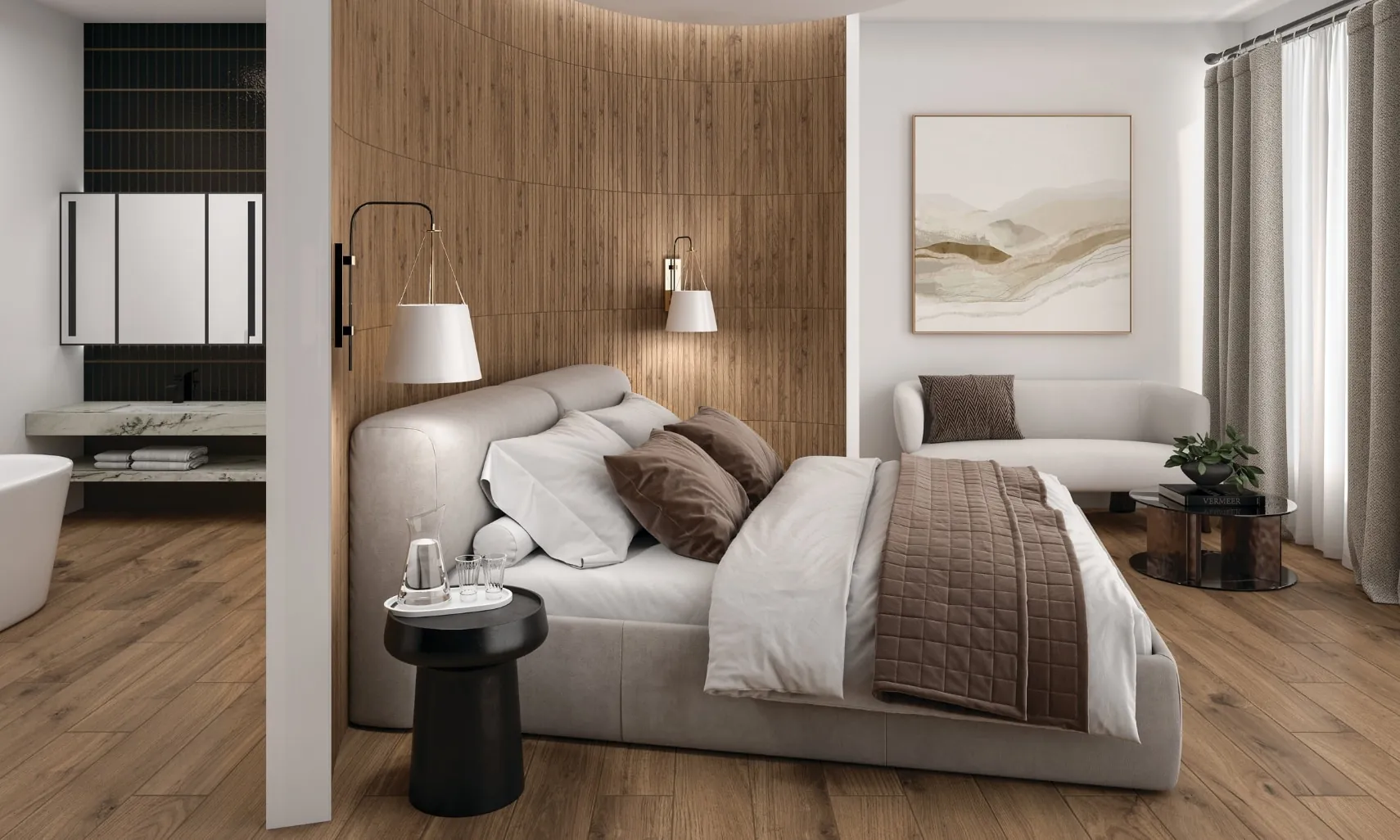
Designers rarely frame it as a ban. They frame it as pattern recognition: "I've seen that floor in fifty homes, and in forty-five of them the owner wishes they'd chosen differently." Same advice, different delivery.
We install flooring every week and see the same mistakes repeat. Here are the choices most designers steer clients away from in 2026, with the specific reasons, not just the headline.
Cheap LVP With a 6-Mil Wear Layer
This is the most common flooring regret of the last five years, and it's accelerating as discount stores push entry-level luxury vinyl plank harder than ever. The floor looks indistinguishable from quality LVP the day it goes in. At $1.99 a square foot, it seems like a steal.
A 6-mil wear layer is roughly as thick as a fingernail. Under moderate foot traffic, not abuse but just normal family life, the wear layer thins through in the high-traffic paths early. The printed wood pattern underneath starts showing. There's no fix. The whole floor goes.
The spec to remember: 12 mil minimum for any residential install. 20 mil for homes with big dogs, active kids, or anyone who moves furniture regularly. The price difference between a 6-mil and a 12-mil floor from a quality manufacturer is typically $1–$2 per square foot installed. That's the difference between a floor that lasts five years and one that lasts twenty.
Designers say it plainly: any LVP under 12 mil is going to disappoint. We agree. Our best LVP brands guide breaks down where each brand lands on wear layer across their catalog.
Engineered Hardwood With a 1mm Veneer
Not all engineered hardwood is the same product. The top layer is real wood, and that part's true across the category. But veneer thickness ranges from roughly 6mm down to 1mm or less on bargain lines, and that gap is the entire ballgame.
A 1mm veneer can't be sanded. One pass with a drum sander and you're through to the plywood core. The floor can't be refinished. It's functionally a laminate with a thin wood face. NWFA guidelines set 2.5mm as the minimum for a viable sand-and-refinish. For two or three full refinish cycles over the floor's life, you want 4mm or better. Anderson Tuftex's premium collections run 4mm to 6mm veneers, which supports multiple refinishes at the roughly 1/32 inch a careful sanding removes.
The question to ask before you buy: "What's the veneer thickness?" If the sales rep can't answer that immediately, the floor probably isn't worth buying. Any quality manufacturer prints it on the spec sheet.
High-Gloss Anything in a Lived-In Home
High-gloss floors look stunning in a magazine shoot with professional lighting and no children present. In a real home, gloss is the enemy of sanity. It reflects light at every angle, which means every footprint, every pet paw, every streak from the mop shows immediately and continuously.
This isn't a preference. It's physics. Gloss finishes amplify surface irregularities rather than hiding them. A matte or wire-brushed finish on the same wood diffuses light and obscures minor surface marks. Families who install high-gloss hardwood or high-gloss LVP in kitchens or family rooms spend more time on floor maintenance than people who chose a matte finish.
The 2026 consensus from designers and trade press alike: satin and matte are the correct residential finish for any room with traffic. High gloss belongs in commercial hotel lobbies, not family homes. For Florida specifically, where fine sand from the lakes tracks in constantly, this matters even more.
The Glossy Yellow Laminate Problem
A specific subset of this: the high-gloss, golden-toned laminate that was popular when the category first arrived in the U.S. in the 1990s. The combination of the yellow warmth, the shiny surface, and the tight-repeat print pattern that reveals itself every few planks creates one of the strongest "dated remodel" signals in any home. Buyers pick it up immediately.
Modern matte laminate looks genuinely good. The category itself isn't the problem. It's the specific finish and color that read dated. If you have it, you're not obligated to replace it tomorrow. But if you're picking new flooring today, steer away from anything with a gloss sheen on laminate.
Cool Gray Wood: The Trend That Peaked
Gray-stained oak and blue-gray LVP dominated the market from roughly 2014 through 2021. It was a deliberate correction from the yellow-toned wood of the early 2000s, and it worked as a trend: fresh, cool, modern. Today, designers across the trade press are calling it the most date-stamped flooring trend of the 2010s, the equivalent of that early-1990s pink-toned oak.
The floordaily.net 2026 designer survey found near-unanimous agreement: honeyed oaks, caramel mid-tones, and gunstock browns are the direction in 2026. The pale Scandinavian blondes and the cool grays are both moving out. Warm mid-tones photograph better, hide dust better in a Florida home (where fine sand is a constant), and carry more staying power for resale.
If you have a gray floor you love, love it. Trends shouldn't force you to replace a functional floor. But if you're picking today and care about how the floor reads in five years, the warm mid-tones are the safer bet. Our hardwood flooring trends post covers the specific colors gaining ground.
Dark Floors Without the Light to Support Them
Espresso and near-black hardwood still looks stunning, in the right room. A formal study with high ceilings and good south-facing light handles a dark floor beautifully. A Florida family room with standard 8-foot ceilings, small windows, and sand from the lakes tracked in from the pool lanai is a different situation.
Dark floors amplify everything on their surface. After a mop, they look pristine for approximately twenty minutes. Then the footprints start, the paw prints accumulate, and the fine dust that's invisible on a light floor shows every grain. Homeowners with dark floors who have dogs or kids either mop obsessively or stop caring. The floor starts to look permanently dirty.
Designers don't ban dark floors. They ask: does this room have the light to carry it? If the answer is yes, go ahead. If the answer is uncertain, a mid-tone warm wood accomplishes the depth and richness without the maintenance tax.
Generic Builder-Grade LVP: Same Floor in Every House
A second LVP problem different from the thin-wear issue: the totally interchangeable plank. Discount contractors use the same two or three SKUs across every job, the same color, same plank width, same low-variation print. You can walk into homes in Winter Haven, Lakeland, and Auburndale built in the same five-year window and see the exact same floor.
Designers call this the "spec house problem." The floor isn't wrong on specs, but it reads generic. It signals that no one made a decision. Someone just ordered the cheapest thing that wasn't carpet.
The fix isn't buying expensive. It's being intentional. A 7-inch plank in a warm mid-tone with natural color variation and a matte finish from Shaw or COREtec's standard residential line costs about the same as the builder-grade default and looks dramatically more considered.
Sheet Vinyl in Main Living Areas
Sheet vinyl still has a place: utility laundry rooms, small bathrooms, under appliances in tight spaces. It's cheap, waterproof, and installs fast. In a main living area in 2026, it reads immediately as budget construction to anyone who walks through.
Modern LVP costs barely more, installs in the same day, and is a qualitatively different product. The case for sheet vinyl in a kitchen or family room doesn't hold up against what click-lock LVP costs today.
Carpet in Wet Rooms
Carpet belongs in bedrooms, family rooms, and stairs. Full stop. We still occasionally pull up old carpet from bathrooms and kitchens, less often than we used to because the building trades stopped installing it there about fifteen years ago, but it still shows up in older homes.
Carpet in a wet room traps moisture at the backing, grows mildew from the bottom up, and develops an odor that nothing short of replacement fixes. In Florida, where humidity accelerates every biological process, this is faster and more severe than it would be in a drier climate. The rule is simple: hard surface in any room where water lives.
The Caveat Designers Always Give
"Avoid this" is context-dependent. Every item on this list can be the right choice in the right room, for the right homeowner, at the right budget. A floor that's wrong for a family of five with two large dogs and a pool can be perfect for a quiet retirement home for two. A trend that's tired in a model home can be genuinely right for a personality-filled cottage.
What designers avoid is specific combinations: bargain spec plus high-traffic room, dated color plus resale-focused renovation, wet room plus moisture-vulnerable material. The mistakes are almost always about mismatch. The right floor in the wrong room, or the wrong spec for the actual use.
What to Pick Instead
The short list for a Florida home that'll hold up and hold its value:
- Whole-home hard surface: COREtec or Shaw LVP with a 12-mil or 20-mil wear layer, warm mid-tone wood look, 7-inch or wider plank, matte finish
- Real wood in dry living areas: engineered white oak or hickory, 3mm or thicker veneer, wire-brushed matte finish, 7-inch or wider plank
- Kitchens, baths, mudrooms: LVP, full stop. Waterproof core is non-negotiable where water lives.
- Bedrooms and family rooms (soft surface): Shaw or Mohawk SmartStrand carpet in a neutral mid-tone with a quality 8-pound pad
- Florida rooms and outdoor-adjacent: porcelain tile in a wood-plank look, PEI 4 or above, rated for outdoor freeze-thaw cycles
If you want a proactive framework for coordinating multiple materials across the whole home, not just what to avoid but how to combine three floors so they feel intentional, our rule of 3 in flooring design post lays out the method.
Walk samples in our Winter Haven showroom before you commit. The difference between a 6-mil and a 20-mil wear layer isn't visible in photos. The color reads differently in your own light than it does under showroom fluorescents. The texture of a wire-brushed finish versus a smooth one only shows up in person.
Contact us for a free in-home measure, or take the flooring quiz for a quick first read on what fits your home. Ask about financing if you'd like to pay over time. It's available with approved credit.
Sources
- National Wood Flooring Association, Engineered Wood Flooring Refinishable Program (the 2.5mm refinishable wear-layer minimum for factory-finished floors)
- Tile Council of North America, Tile Abrasion: ASTM C1027 and Possible Upcoming Changes (the Class IV commercial abrasion classification and the PEI rating nickname, not the freeze-thaw claim)
More flooring tips
Have a project of your own?
Free in-home estimates across Polk County.