
Flooring Tips
Common Flooring Installation Mistakes (and How to Avoid Them)
The most common flooring installation mistakes cost homeowners thousands in repairs. Here is what trained installers get right the first time.
- Published
- May 14, 2026
- Author
- Blackburn's Interiors, Winter Haven, FL
- Updated
- August 6, 2026
Most flooring failures trace back to installation, not the product itself. The plank, tile, or carpet is fine. The steps underneath it were rushed or skipped. We have been installing floors in Polk County since 1973 and the same mistakes come up again and again in service calls. This post names each one plainly so you know what to watch for, whether you hire us or anyone else.
Mistake 1: No Slab Moisture Test
This is the big one in Florida. Almost every home in Winter Haven, Lakeland, Auburndale, and the rest of Polk County sits on a concrete slab. Concrete is porous. It pulls moisture up from the ground as vapor year-round, and "dry to the touch" tells you nothing about what is happening underneath the surface.
The reliable measure is an in-situ relative humidity probe test (ASTM F2170). A probe drilled into the slab and left for 24 hours reads the actual RH at depth. Most hardwood, LVP, and laminate manufacturers require the slab to test below 75 to 80 percent RH before their warranty applies. No documented test result means no valid warranty claim if the floor fails later.
We test the slab on every slab job, after the work is sold and before anything goes down. When the reading is too high, we walk homeowners through three options: apply a topical epoxy moisture barrier, wait for the slab to dry, or switch to a material that tolerates higher RH. Our deeper guide to Florida slab moisture mitigation covers the cost math and the full process if you want more detail.
Mistake 2: Skipping Acclimation
Wood and wood-based products absorb and release moisture from the air around them. If you pull planks off a truck and install them the same day into a climate-controlled Florida home, the material will shift after it settles into the room's temperature and humidity. That shift causes gaps in winter when the air is dry, or buckling in summer when humidity spikes.
How long that takes depends on the product, so the maker's instructions set the time. LVP with a rigid core is more dimensionally stable than wood, but SPC and WPC products still need to acclimate. Our hardwood, laminate and vinyl plank all acclimate at our showroom. On a multi-day job we bring the material out the first day and leave it in your home.
Acclimation is not a waiting game for its own sake. It protects the floor and keeps the warranty valid. Our pre-installation tips page covers the full checklist we ask homeowners to complete before install day.
Mistake 3: No Expansion Gap at the Perimeter
Floating floors move. Hardwood, LVP, and laminate all expand and contract with temperature and humidity changes. If you run planks tight to the wall with no room to breathe, the floor has nowhere to go. The result is buckling: the center of the floor lifts up because the edges are locked in.
Most manufacturers call for about a 1/4-inch gap around the entire perimeter of the room, including at door frames, hearths, cabinets, and any fixed object the floor runs to. The exact number is on your product's install sheet, anywhere from 1/8 to 3/8 inch depending on the floor. The gap hides under base molding and quarter-round, so it is invisible once the trim is reinstalled. Skipping it to save a small amount of time or trim work is one of the most common DIY and quick-hire mistakes we see.
The gap also matters around islands, columns, and floor vents. Every fixed point the floor touches becomes a place where expansion stress concentrates. The installers we train and certify map every fixed object in the room before they start and plan the layout with those gaps built in.
Mistake 4: Poor Subfloor Prep and Flatness
Flooring follows whatever surface it sits on. A dip in the slab becomes a soft spot underfoot. A high spot creates a ridge where locking joints flex and eventually crack. Both problems get worse over time, not better.
The flatness tolerance most manufacturers specify is 3/16 inch over a 10-foot span, and 1/8 inch over 6 feet. The National Wood Flooring Association publishes those same tolerances for concrete subfloors. That sounds precise, and it is. A slab that rolls half an inch across a room (common in older Lakeland and Lake Wales homes) will telegraph through a floating floor from day one.
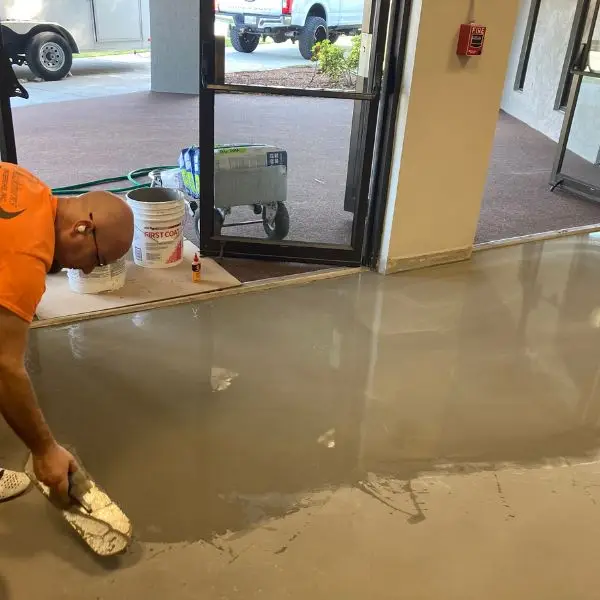
Low spots on concrete get filled with a cementitious self-leveling compound. High spots get ground down. On wood subfloors, we re-set loose screws, replace soft panels, and sand seam humps before the first plank goes down. The subfloor work is not glamorous, but it is the preparation that makes the finished floor look like it was poured in place. Subfloor prep is also required, not optional, for our FIDO subfloor treatment, which seals odors into the slab before the new floor closes it in.
Mistake 5: Wrong Underlayment or Doubled Padding
Underlayment mistakes come in two versions. The first is adding a second pad under a plank that already has one attached at the factory. Most modern rigid-core LVP ships with a foam or cork pad bonded to the back. Stacking a second pad underneath it creates too much cushion. The planks flex, the locking joints work loose, and seams gap or peak. We see it most often when a homeowner or quick-hire crew wants to add extra softness underfoot.
The second version is using the wrong underlayment for the product or the subfloor. Floating laminate over a concrete slab without a moisture-barrier underlayment is an example. The laminate manufacturer's install sheet specifies exactly what is allowed beneath their product, down to minimum thickness and vapor perm rating. Use the wrong foam and the warranty is void.
When planks have no pad attached, a separate underlayment is often required. Match it to the product spec, not to whatever is on sale at the hardware store.
Mistake 6: Installing Over a Failing Subfloor
Soft spots, squeaks, and flex in the subfloor do not disappear when you lay new flooring on top. They get covered up. The new floor then flexes with them, which stresses adhesive joints, glue bonds, and locking connections until something gives.
On concrete slabs, we probe for hollow pockets and check for delamination around drains and transitions where old water damage often hides. On plywood subfloors, we walk the room deliberately and listen for movement before we start. If we find a failing section, we repair or replace it before any material goes down. Installing over a compromised base is how a good product gets a bad outcome.
Mistake 7: Rushing the Job
Flooring installation has steps that cannot be shortened. Adhesive needs to flash off before planks go down. Thinset needs to cure before grout can follow. Acclimation cannot be rushed. Grout needs 24 to 72 hours before the floor sees foot traffic.
Rushed jobs show up in callbacks. Tiles that crack because thinset was too wet when the installer walked on it. LVP seams that lifted because the adhesive had not flashed. Hardwood that buckled because it was installed before it finished acclimating. Every step has a reason. Our flooring installation timeline guide covers realistic day counts by material so you know what a properly paced job looks like.
Mistake 8: DIY Over Slab Without Understanding the Layers
A slab install has more required steps than an above-grade wood subfloor install. Moisture testing, vapor barrier selection, surface prep, and flatness correction all come before the first plank. Many DIY guides skip or minimize these steps because they add cost and complexity.
In Florida, those skipped steps are exactly where failures concentrate. We are not saying DIY is always wrong. We are saying a Florida slab is a harder starting point than most online tutorials account for. If you go the DIY route, at minimum test the slab, follow the product install sheet to the letter, and leave the expansion gap. Our pre-installation tips page is written for homeowners and covers what the slab and the room need to be ready before install begins.
Mistake 9: Sloppy Transitions and Seams
Transitions between rooms, thresholds at doors, and the seam where one material meets another are some of the most visible spots in a home. They are also where work quality is easiest to read. Poorly cut transitions, mismatched heights, or seams that peak at the joint announce a rushed job to anyone who walks through the door.
Matching transitions to the right height matters more than most homeowners expect. When a new floor raises the finished surface height, door clearances can go wrong and transition strips to adjacent rooms can become trip hazards. We measure every threshold at the in-home visit so the transitions are ordered correctly and fit flush on install day.
For hard floors, seams within the field of the floor should be tight and consistent. On tile, grout joints should be even in width from start to finish. On LVP and laminate, locking joints should close without gaps. Sloppy cuts and rushed endings at doorways are easy to avoid when the installer measures twice and cuts once.
Why Trained Installers Matter for Your Warranty
Most flooring product warranties have a professional installation requirement. The manufacturer will not cover a failure if the floor was installed incorrectly, by a pro or by a homeowner. What separates a covered warranty claim from a denied one is documentation: a certified installer, a moisture test on file, a flatness check, the right underlayment.
The installers we train and certify know the specific requirements for every product we carry. Shaw, COREtec, and our other manufacturer partners have particular installation standards, and the installers are trained to those standards. The residential labor warranty we add on top of the manufacturer warranty does not exist unless the job was done correctly from the slab up.
That accountability is a real differentiator. When something comes up down the road, you have a team that knows the job, has the test results on file, and stands behind the work. See what our customers have experienced on our reviews page.
The Bottom Line
Most flooring failures are preventable. Skipping acclimation, ignoring slab moisture, leaving out the expansion gap, rushing cure times: none of these are unavoidable accidents. They are steps that get cut to save time or money upfront and cost far more to fix later.
If you are starting a flooring project in Polk County, the first call is a free in-home measure. We test the slab, check subfloor flatness, and quote the job with all the prep steps included so nothing hides in the fine print. Use our flooring calculator for a rough square footage and budget estimate, then contact us to schedule the measure. We also offer financing options for larger projects, subject to credit approval. Thank you for considering us. We know you have choices in this market, and we do not take that lightly.
Sources
- ASTM International, F2170-19a Standard Test Method for Determining Relative Humidity in Concrete Floor Slabs Using in situ Probes (the in-situ probe standard for slab relative humidity)
- National Wood Flooring Association, Wood Floor Facts: Concrete Subfloors (the one-eighth-in-six, three-sixteenths-in-ten flatness tolerances)
More flooring tips
Have a project of your own?
Free in-home estimates across Polk County.