
Countertop Tips
Quartzite Countertops: The Durable Marble Look Built for Florida
Quartzite is a natural stone, not engineered quartz. Here is what it really is, how to spot a fake at the slab yard, what it needs, what it costs, and why it fits Florida kitchens and lanais.
- Published
- October 15, 2026
- Author
- Blackburn's Interiors, Winter Haven, FL
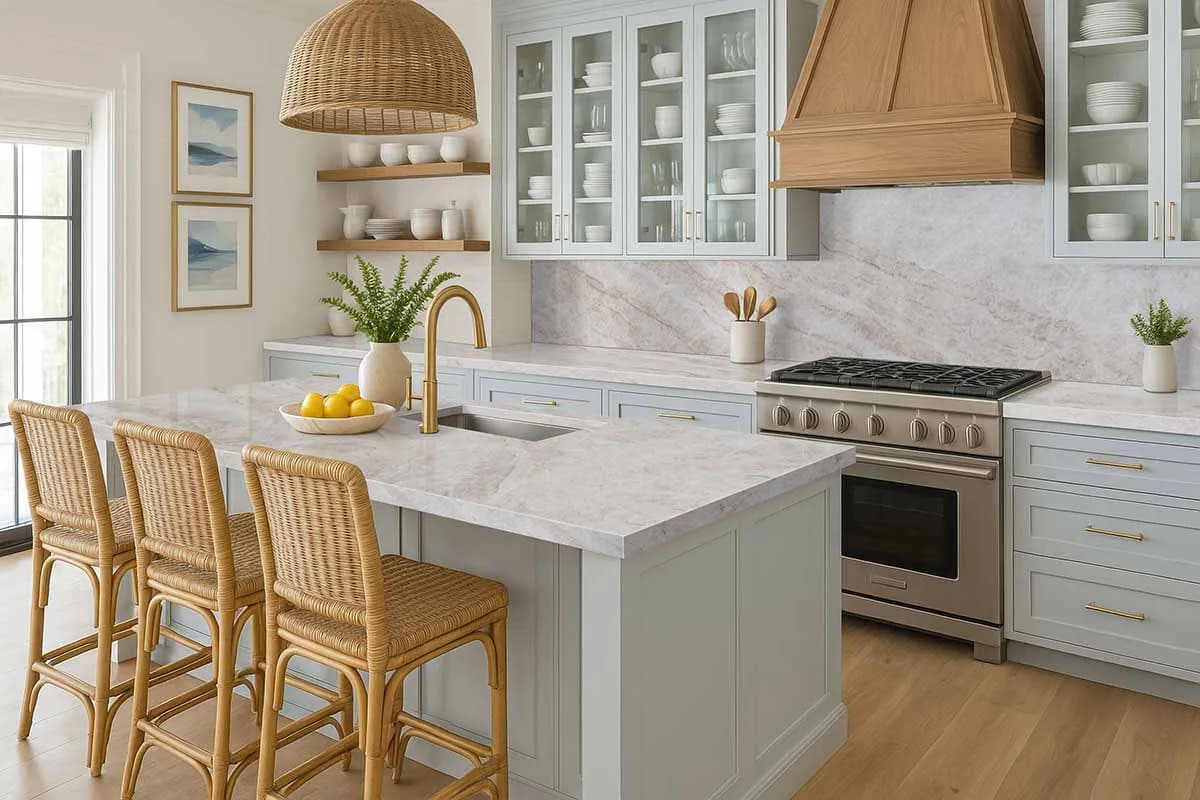
Quartzite is a natural stone, quarried from the earth and made almost entirely of the mineral quartz. That makes it one of the hardest and most heat-resistant counters you can put in a kitchen. It carries the soft veining of marble but stands up to far more daily abuse. This guide covers what quartzite really is, how it differs from engineered quartz, how to spot a fake slab at the yard, what it needs to stay stain-free, and what it costs installed. One thing up front: quartzite and "quartz" are not the same product. The names are one letter apart, and that confusion sells a lot of the wrong stone to good people.
What Is Quartzite, Really?
Quartzite is a metamorphic rock. It starts as sandstone, then heat and pressure deep in the earth fuse the grains into a dense, hard stone made almost entirely of quartz. It is 100 percent natural. Nothing is added. You cut a slab, polish it, and set it on your cabinets.
Engineered quartz is a different thing entirely. It is a man-made surface: crushed quartz mixed with resin and pigment, then pressed into slabs in a factory. The Natural Stone Institute puts it plainly. Quartzite is a stone made of the mineral quartz, and it should not be confused with the manufactured products sold as "quartz surfacing," which are crushed quartz held together with a resin binder. So the short version: quartzite comes out of a quarry, quartz comes out of a factory. Both are excellent counters. They just live by different rules.
Why Quartzite Is So Tough
The mineral quartz is a 7 on the Mohs hardness scale. The Natural Stone Institute describes it as nearly twice as hard as glass and harder than a knife blade. Since quartzite is made almost entirely of that mineral, it inherits that toughness. A knife slid across a real quartzite counter dulls the knife, not the stone. Some sellers round quartzite up to "7 to 8." The verified figure is 7, the hardness of the quartz it is built from, and seven is plenty hard for a kitchen.
It handles heat, too. This Old House rates quartzite as highly resistant to heat, scratches, and etching. That makes it more forgiving of heat than resin-bound quartz. A trivet is still the habit to keep.
The Slab Yard Mix-Up: When "Quartzite" Is Really Marble or Dolomite
Here is the honest catch. Mislabeling is a known, industry-wide problem. Some slabs sold as quartzite are the real deal. Others are marble or dolomitic marble wearing the quartzite label. The Natural Stone Institute says the country of origin, the price, and the stone's name are not reliable ways to tell them apart. This matters because marble is softer and it etches. Drip lemon juice, wine, or vinegar on marble and the acid eats a dull spot into the polish. Dolomitic marble etches a little slower, but it still etches. True quartzite does not etch from normal kitchen acids at all. So a slab labeled "quartzite" that turns out to be marble will not behave the way you were promised.
You will also hear the phrase "soft quartzite." Treat that as a red flag. The Natural Stone Institute is blunt about it: there is no such thing as soft quartzite. A stone marketed that way is almost always marble. Real quartzite is hard, full stop.
Two Simple Tests to Prove You're Getting Real Quartzite
You do not have to take a label's word for it. Two quick tests, done before you buy, will tell you what you are actually getting. Ask the slab yard or your fabricator to run them on the specific slab you like.
The Glass Scratch Test
Drag a corner of the sample across a piece of glass. Real quartzite will bite in and scratch the glass. You will hear it grind and feel it dig. A stone that is not quartzite leaves no scratch, or a faint powdery mark that wipes right off. This one test is the clearest proof of genuine quartzite there is.
The Acid Drop Test
Put a few drops of lemon juice or plain white vinegar on an out-of-the-way corner and wait several minutes. True quartzite shows nothing. The acid does not touch it. If a dull, rough spot appears where the drops sat, the stone etched, which means it is marble or dolomite, not quartzite. Rinse the spot and check it in good light. A reputable dealer will not flinch at either test. You are spending real money on a slab meant to last decades, so it is fair to ask for proof.
Porosity and Sealing: What Quartzite Needs to Stay Stain-Free
Quartzite has one honest trade-off: it is porous. MSI, a major stone supplier, describes the surface as having tiny openings that can absorb spills. Left unsealed, an oil or wine spill can soak in and stain. Sealing fills those pores so spills bead up and wipe away instead.
How much sealing depends on the slab. The Natural Stone Institute notes that dense, highly metamorphosed types like Taj Mahal and Sea Pearl are bonded tightly and shrug off moisture, while less-metamorphosed stones like White Macaubas and Calacatta Macaubas are more porous and benefit more from sealing. Not every quartzite needs the same schedule.
For a practical rule, plan on sealing about once a year, then run a simple water test at the six-month mark. Dense slabs can stretch to two or three years. A high-porosity slab might want it every six months. The trigger is easy to see: when water stops beading on the surface and soaks in a little, it is time to reseal. Quartz, by contrast, is non-porous and never needs sealing, which is one reason some people choose it. Our guide on how to care for quartz counters covers that low-upkeep routine.
Quartzite vs. Quartz vs. Granite vs. Marble
Quartzite vs. Engineered Quartz
Engineered quartz is mostly ground quartz, roughly 90 percent or more by weight, bound with polyester resin and color pigment. It is non-porous, so it never needs sealing, and the color and pattern are consistent slab to slab. The catch is that resin. It can scorch or discolor under a very hot pan, and it is not made for the outdoors. Quartzite is natural, needs sealing, has more variation from slab to slab, and handles heat and sun better. Pick quartz for zero-maintenance uniformity indoors. Pick quartzite for natural stone that can take more heat and go outside.
Quartzite vs. Granite
These two are close cousins. Both are hard natural stone, both need periodic sealing, and neither etches from kitchen acids. The Natural Stone Institute treats them as having similar properties, so we will not claim quartzite is flatly harder than granite. The real difference is look. Granite tends toward speckled, grainy movement. Quartzite leans toward the soft, flowing veins of marble. If you are torn between stones, our quartz vs. granite countertops guide breaks down that decision in more detail.
Quartzite vs. Marble
This is the comparison that trips people up, because good quartzite looks a lot like marble. The difference is durability. Marble is soft and it etches, so a busy kitchen leaves its mark on marble over time. Quartzite gives you that marble-style veining with far more toughness and no etching. That is the whole appeal of quartzite in one sentence: the marble look, built to last.
- Quartzite: natural stone, very hard, heat-resistant, does not etch, porous so it needs sealing.
- Engineered quartz: man-made, non-porous, no sealing, but the resin can scorch and is not for outdoors.
- Granite: natural stone, hard, needs sealing, does not etch, grainy look rather than veined.
- Marble: natural stone, soft, etches from acids, the classic look quartzite imitates without the fragility.
Built for Florida: Heat, Sun, and Lanais
Here is where quartzite earns its keep in Polk County. Natural quartzite is unaffected by weather and UV light, so direct Florida sun does not fade or damage it. Engineered quartz is a different story. Use Natural Stone reports that the resin in engineered quartz yellows in sunlight, and manufacturers say it is best kept indoors. So on a sun-drenched counter, natural stone wins.
That opens up the parts of a Florida home a quartz counter cannot serve. A covered lanai. An outdoor kitchen. A pool bar. True quartzite can live out there. Quartz should not. If you are planning any of those, our guide to outdoor kitchen countertops for Florida walks through your best options. One common-sense aside on our humidity: any natural stone does better when it is sealed and spills get wiped up, so keep quartzite sealed and it will handle a Florida kitchen fine.
What Quartzite Costs Installed
Cost is where you should keep your guard up, because the published ranges are wide and they do not fully agree. This Old House puts quartzite around $55 to $75 per square foot installed. HomeAdvisor runs much higher, roughly $80 to $220 per square foot installed. So a fair, honest range to plan around is about $55 to $220 per square foot installed, depending on how rare the slab is and where you live. Our countertop cost guide sets those numbers next to other materials.
Under the hood, HomeAdvisor splits it into material at roughly $50 to $150 per square foot and labor at about $10 to $40 per square foot. A common, widely available quartzite sits near the bottom. A rare, dramatic imported slab climbs toward the top. Those are national averages, not our prices, and not specific to Polk County, so do not treat any single figure as a quote. If a project runs higher than you planned, ask us about financing. With approved credit, you can spread the cost out over time.
Is Quartzite Right for Your Kitchen?
Quartzite is a strong pick if you love the look of marble but want stone that can take real cooking, and if a once-a-year seal does not bother you. It is a great fit for busy family kitchens and for the outdoor spaces so many Florida homes are built around. If you would rather never seal a thing and you are staying indoors, engineered quartz may suit you better. Come see the full range of countertops in our showroom and put your hands on the real slabs before you decide.
Frequently Asked Questions
Is quartzite the same as quartz?
No. Quartzite is a natural stone quarried from the earth and made almost entirely of the mineral quartz. "Quartz" counters are an engineered product, crushed quartz mixed with resin in a factory. Same-sounding names, two different materials.
Does quartzite need to be sealed?
Yes, most quartzite does. Plan on sealing about once a year and check it at six months with a water test. Dense slabs can go two to three years. Sealing is what keeps spills from soaking in and staining.
Can quartzite go outside on a Florida lanai?
True quartzite can. It is unaffected by UV light and weather, so it holds up on a covered lanai or outdoor kitchen. Engineered quartz cannot, because its resin yellows in the sun and is meant for indoor use only.
How do I know I'm getting real quartzite?
Ask for two tests on the actual slab. Real quartzite scratches glass and does not etch when you drip lemon juice or vinegar on a corner. If it fails either test, it is likely marble or dolomite sold under the wrong name.
The Bottom Line
Quartzite gives you the veined look of marble with the toughness of one of the hardest stones in a kitchen. It resists heat, it will not etch, and it can go where quartz cannot, out in the Florida sun. The trade-offs are honest: it is porous so it needs sealing, some slabs sold as quartzite are really softer marble, and the installed price covers a wide range. Test the slab, seal it on schedule, and get a firm per-square-foot quote before you commit.
Thank you for reading this far. We know you have plenty of places to shop for a counter, and we are grateful you would consider a family-owned shop that has been right here in Winter Haven since 1962. Come see the slabs in person at 1507 Havendale Blvd NW, or call us at (863) 294-7355. Bring your rough measurements and we will template, test the stone with you, and price every line in writing. The measure and the estimate are free, and there is no pressure to buy.
Sources
- Natural Stone Institute, Technical Bulletin: Quartzite Need Not be a Confusing Stone (quartzite is natural stone made of the mineral quartz (not engineered quartz surfacing), the mineral quartz is 7 on the Mohs scale, the mislabeling of marble and dolomite as quartzite, and the glass-scratch and acid-drop tests that tell them apart)
- Use Natural Stone (Natural Stone Institute), Natural Quartzite and Engineered Quartz: What's the Difference? (natural quartzite is unaffected by weather and UV light while engineered quartz's resin yellows in sunlight and is best left indoors)
- This Old House, All About Stone Countertops (quartzite is highly resistant to heat, scratches, and etching, and typically costs about $55 to $75 per square foot installed)
- HomeAdvisor, How Much Do Quartzite Countertops Cost? (quartzite installed cost of $80 to $220 per square foot, with material at $50 to $150 and labor at $10 to $40 per square foot)
- MSI Surfaces, Quartzite Countertops: Pros and Cons (quartzite's porous surface has tiny openings that can absorb spills, so it needs sealing to prevent staining)
- SlabWise, How to Seal Quartzite Countertops (sealing cadence of about once a year, two to three years for dense slabs and every six months for high-porosity stone, resealing when water no longer beads)
More countertop tips
Have a project of your own?
Free in-home estimates across Polk County.