
Countertop Tips
Countertops in Winter Haven, FL: What Holds Up
Quartz resists Florida humidity without sealing. Granite needs annual sealing but handles heat better and looks one-of-a-kind. See what Winter Haven picks.
- Published
- April 2, 2026
- Author
- Blackburn's Interiors, Winter Haven, FL
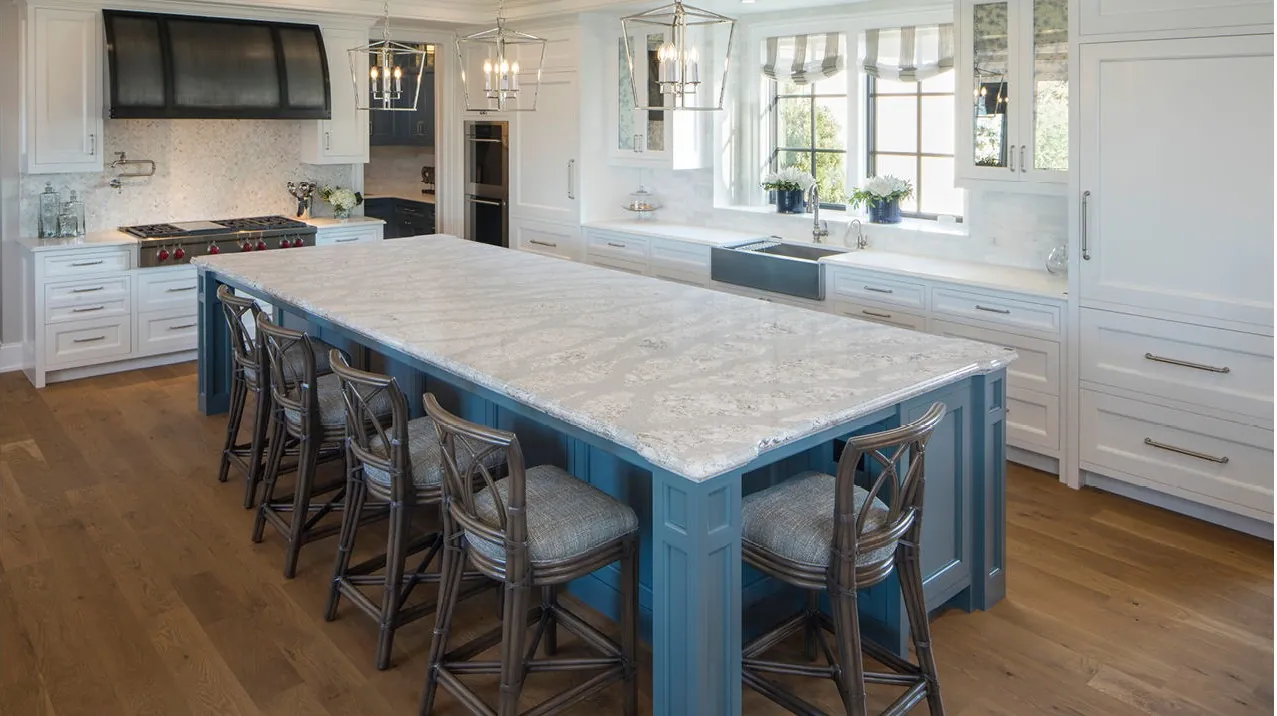
We've been family-owned in Winter Haven since 1962, and we install countertops all over this city: Chain of Lakes lakefront homes, mid-century ranches around the water, newer construction in Cypresswood, vacation homes near LEGOLAND. Every type of kitchen, every type of budget, every type of mistake you can make on a countertop material.
What we've learned is simple. The material that looks great in a magazine and the material that looks great after five years of Florida cooking are not always the same thing. This post covers the honest comparison so you can pick the right slab the first time.
Quartz vs Granite: The Florida Comparison
This is the question we answer more than any other at the countertop showroom. Quartz or granite? Both are beautiful. Both last decades. They behave very differently, and in a Florida kitchen, those differences matter.
Quartz: The Low-Maintenance Workhorse
Quartz is engineered stone: roughly 90 to 95 percent crushed quartz mineral bound with resin and color pigment. The resin makes it non-porous. Nothing soaks in. No oil, no wine, no juice. Quartz never needs to be sealed.
Florida humidity doesn't bother quartz. Moisture can't absorb into the surface. The AC runs hard in the summer. The outdoor humidity follows everyone inside. Quartz doesn't react to any of it. For a kitchen that gets daily use, quartz removes an entire category of maintenance.
The one caveat: quartz contains resin, and resin can scorch under direct heat. Always use a trivet. A hot pan straight from the burner can discolor the surface permanently.
Granite: Natural Stone, Natural Character
Granite is 100 percent natural stone, quarried and cut to size. Every slab is unique. The veining, the mineral deposits, the color variation: no other kitchen in Winter Haven has the exact same countertop. For homeowners who want a one-of-a-kind surface with real depth, granite wins on character every time.
Granite is porous. That's the tradeoff. Moisture, cooking oils, and bacteria can work into an unsealed granite surface over time and leave permanent staining. The fix is simple: seal at installation and reseal annually. A bottle of stone sealer costs around $20 to $40. The job takes 30 minutes. Test it by dripping water on the counter. If it beads, the seal is good. If it soaks in, reseal.
Granite handles heat far better than quartz. That's one real advantage for people who cook a lot. A trivet is still the right habit.
Which One Do Most Winter Haven Homeowners Choose?
In newer construction and kitchen renovations across Polk County, quartz is the dominant choice. Lower maintenance and consistent color across a seam-to-seam slab make it the practical pick for most families. Granite is the choice when the homeowner specifically wants natural stone character or is building an outdoor kitchen (UV over time can fade the resin in some quartz colors; granite is UV-stable).
Both materials typically run $50 to $150 per square foot installed. The price alone rarely decides the choice. The deeper comparison lives in our quartz vs granite guide.
Cambria: When Standard Quartz Isn't Enough
Cambria is quartz, but it's not the same as standard quartz. Made in Le Sueur, Minnesota, it's the only major quartz brand manufactured entirely in the USA. That matters for supply chain consistency and for customers who want American-made materials in their home.
A lifetime limited warranty backs every Cambria slab. Most standard quartz brands carry 10 to 25 year warranties. Cambria's commitment is the full life of the installation.
The design range is wider than most quartz lines. Cambria's collections include designs that mimic rare marbles with realistic veining, low-contrast contemporary patterns, and bold statement slabs. If you've been through our showroom and found that standard quartz feels too safe and too plain, Cambria is usually the next conversation.
Is it worth the price premium over standard quartz? For a kitchen in a lakefront home or a primary residence you're planning to be in for 15 or 20 years, yes. For a rental or a secondary space, standard quartz does the same job at a lower price. We stock both and can show you the comparison side by side.
Chain of Lakes Kitchens: What Works
Winter Haven is built around the Chain of Lakes. Lake Howard, Lake Cannon, Lake May, Lake Shipp, Lake Eloise. Lakefront homes here have kitchens that run hard and face the living area. Guests see the countertop from the living room. The family uses it three times a day. It has to look right and hold up.
Material Choice
Quartz or granite are both correct for a Chain of Lakes kitchen. Quartz handles the daily cooking volume without sealing demands. Granite adds the stone character that reads well in a premium open-plan space. What matters more than material is quality: full slab (no tile), 3 cm thickness, and a fabricator who does tight seams.
Edge Profile
The edge is the part you actually touch. In a lakefront kitchen that's visible from the living area, the edge is also a visible design detail. Eased edges (a barely rounded square) read clean and modern, the most-installed profile in Polk County. Mitered edges, where two pieces of slab bond at 45 degrees to create a thick dramatic edge, work well on large islands and waterfall designs. For traditional lakefront homes, a bullnose or half-bullnose profile reads well with raised-panel cabinetry.
Overhang
A standard countertop overhang is 1 to 1.5 inches. An island designed for seating needs 12 to 15 inches of overhang for comfortable knee clearance. On a lakefront kitchen with a large island and bar-height stools, getting the overhang right matters both for comfort and so the slab doesn't require corbels or supports underneath. We cover the full sizing guide in countertop overhang sizing.
If you're remodeling a lakefront kitchen, pair new countertops with cabinets and flooring for a full room renovation. The countertops page for Winter Haven has more on what we install specifically in this area.
Laminate Countertops: When It Actually Makes Sense
Laminate has a reputation problem. The word still calls up the beige speckled plastic of a 1990s kitchen. That's not what modern laminate is. Brands like Wilsonart and Formica now produce laminate that mimics marble, concrete, and stone convincingly from across a room. The compromises are real, but so is the value in the right situation.
Where Laminate Works
Rental properties, vacation homes, and laundry rooms. The math doesn't justify stone money on a surface a tenant will occupy for two years, or a folding counter that gets used six hours a week. Laminate installs at roughly $20 to $50 per square foot. Quartz and granite run $50 to $150. On a 50 square foot kitchen, that's a real dollar difference.
Budget primary kitchens where the remodel can't wait also make laminate a legitimate choice. Modern laminate in a current pattern, with good cabinets, looks like a finished kitchen. Not a compromise. A kitchen that's done.
Where Laminate Doesn't Work
Heavy-use family kitchens. Lakefront homes and primary residences where resale value matters. Around undermount sinks, where water can get behind the seam and swell the substrate. In any kitchen where you regularly set hot pans down without thinking: laminate scorches at lower temperatures than quartz resin.
Laminate is also not ideal with farmhouse-style apron sinks. The edge at the sink cutout is where laminate fails first. Pair it with a drop-in sink to protect the edge.
We carry Wilsonart laminate alongside our quartz and granite options. Full details in the laminate countertops post.
Come See the Slabs in Person
Our showroom is at 1507 Havendale Blvd NW in Winter Haven. 8,000 square feet. We carry quartz, granite, Cambria, and laminate.
This matters more than it sounds. A 4-inch sample does not show veining. It does not show the way color shifts across a 10-foot slab. It does not show how the material looks under natural light at noon versus 7 PM. You make a different decision with a full slab in front of you than you do with a sample in your hand.
We're right here. We're open Monday through Friday, 9 AM to 5 PM, and Saturday 9 AM to noon. You don't have to order from a website and hope the countertop looks right when it arrives.
Free estimates on every project, and financing for customers with approved credit. Ask about both when you come in, or contact us to set something up. If you're also looking at flooring or cabinets while you're here, we have all three. One showroom, one visit, one set of installers we train and certify.
If you're planning a full kitchen renovation, the cabinets page for Winter Haven and the flooring page for Winter Haven are good starting points. Or reach out about financing, subject to credit approval, to see how a full project can be paid over time.
Common questions
What countertop is most popular in Winter Haven, FL kitchens?
Quartz is the most-installed countertop in Winter Haven today. Non-porous, never needs sealing, and consistent color across the full slab make it the practical choice for most Polk County kitchens. Granite is a close second among homeowners who want natural stone character or are installing in an outdoor kitchen where UV-stability matters. In lakefront and higher-end homes, we install both regularly.
How much do countertops cost in Winter Haven, FL?
We quote on site after measuring. Material, slab thickness, edge profile, sink cutouts, and install complexity all factor in. As a general range, quartz and granite typically run $50 to $150 per square foot installed in this market. Laminate runs $20 to $50 installed. Cambria and premium quartz lines run toward the higher end. Contact us or stop in the showroom and we'll walk through your project with a written estimate.
Does Florida humidity affect granite countertops?
Yes, if the granite is not sealed. Granite is porous. Moisture, cooking oils, and bacteria can work into the surface of an unsealed or under-sealed slab over time and cause staining or bacterial growth. The fix is annual sealing with a quality stone sealer, a 30-minute job once a year. With the seal current, Florida humidity doesn't affect granite. Skip sealing for several years in a row and you risk damage that can be difficult to reverse. Quartz is non-porous by design and requires no sealing.
Can I see countertop slabs in person before I decide?
Yes, and we strongly encourage it. Our showroom at 1507 Havendale Blvd NW in Winter Haven carries full-size slabs you can see and touch. Samples don't show veining or how color reads across a 10-foot run. Seeing the full slab under our showroom light before you commit is the best decision you can make. We're open Monday through Friday, 9 AM to 5 PM, and Saturday 9 AM to noon. No appointment needed, though calling ahead helps if you want to speak with someone specific.
More countertop tips
Have a project of your own?
Free in-home estimates across Polk County.