
Flooring Tips
What We Find When We Pull Up a Failing Haines City Floor
A failing floor almost always names its own cause before anybody says a word. Here is what carpet, laminate, vinyl plank, and tile each tell us in a Haines City home, and what that changes about the floor that replaces it.
- Published
- April 25, 2026
- Author
- Blackburn's Interiors, Winter Haven, FL
- Updated
- September 7, 2026
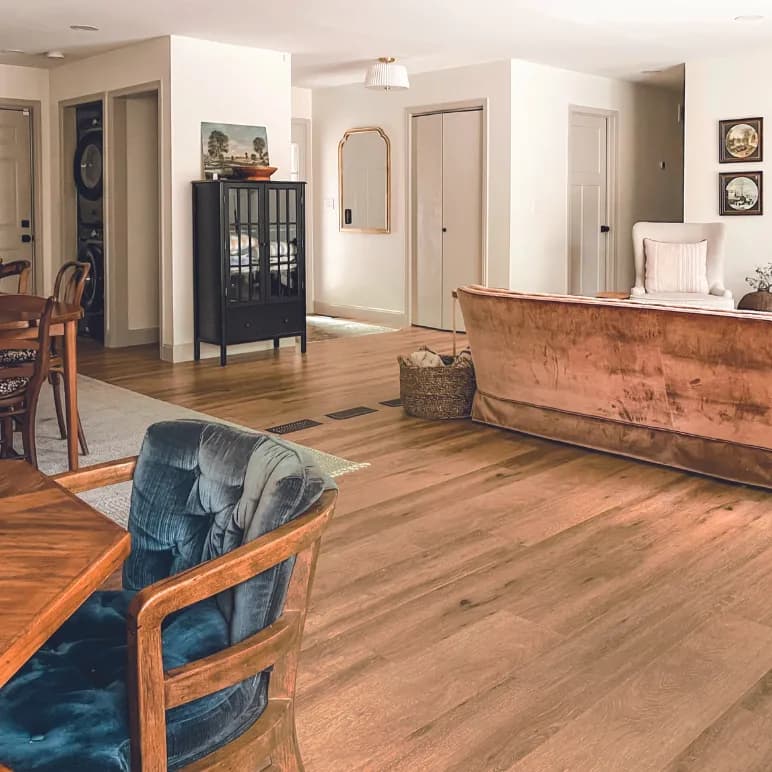
A failing floor almost always names its own cause before anybody says a word. Reading it right is worth more than anything printed on the box the next one comes in.
What we find under a builder-grade floor
The most common job we take in Haines City is a builder-grade replacement: the floor that came with the house, now at the end of its run. A lot of homes here went up in the last fifteen years, so a lot of first floors are coming out around the same time.
The carpet is flattened in the paths people actually walk and close to new under the bed. The laminate is swollen at a seam, almost always near a door or a sink. The vinyl plank has lifted in patches. The tile is fine except where a grout line has opened. Four materials, four different stories, and not one of them is really a story about a bad product.
Carpet rarely wears out the way people picture it. The fiber itself is tough. What gives out is the twist in the yarn, and a loose twist at a low density crushes flat under the same footsteps. A crushed pile reads as worn even when the fiber under it is fine. For a builder-grade floor, the carpet was built to a price, and density is usually the first thing cut to hit it. Our carpet fiber guide gets into that math, and the carpet page for Haines City covers what it means room by room.
Laminate gives out somewhere else entirely. It shows up at a seam rather than in the middle of a board, because the seam is the one place water reaches the fiber core directly. That is the material behaving the way it is built, not proof of a sloppy install. Our Haines City laminate page goes deep on the mechanics and on which rooms qualify. What the failure usually tells us is not that laminate was the wrong material. It is that laminate was in the wrong room.
Vinyl plank has the most preventable failure of the four. It goes down over a slab, and a Florida slab holds moisture long after it looks dry. Plank set over a slab nobody tested can lift, and the product did not fail there. The step before it did. The other thing we see is a wear layer rubbed thin in one bright path, which is a question of how much wear layer the floor got for the traffic it took. Our slab moisture guide covers the test, and the Haines City plank page covers wear layers.
Tile is the one material that rarely fails on its own terms. When a tile cracks or a grout line splits, the tile is usually reporting on the slab under it. It is only ever as good as what it was set on. Our Haines City tile page walks through what an older slab and a newer one each ask for.
What you can read before we ever get there
You do not need a meter to read some of this. Start with the carpet. Look at the lane from the hall to the kitchen, then look at the carpet behind a chair or under the bed. If the lane looks tired and the protected corner still looks close to new, that is crush, not wear. A good cleaning may lift some of it. It will not put the twist back.
On laminate, run a hand across the seams near a door, a dishwasher, or a sink. A seam standing proud of the board beside it, or feeling soft compared to the rest, has already taken on water. On tile, a hairline crack in a grout line is worth noting even when it is small and the tile around it still looks perfect.
Why the same symptom means different things house to house
The age and the kind of house is usually our first clue. In the subdivisions built in the last fifteen years, we are normally pulling up the original floor, and it is the first real test that slab has had. The gated golf communities read differently. Southern Dunes and Lake Henry Estates are both 1990s neighborhoods, so those homes have been lived in for roughly thirty years. Whatever their slabs were going to do, they did it a long time ago. The mid-century streets around Lake Eva go back further still.
That changes what we ask first, not just how old the floor is. On a young slab, an early failure can point back at concrete that was not ready when the floor went down. On a 1990s slab, that question was answered decades ago, so the same lifted corner usually points somewhere else: water that sat too long, or a slow leak nobody caught. Same symptom, different first question.
An original floor that is still flat and still tight at the seams is information too. When a floor that old is still doing its job, that is rarely luck. It usually means the material suited the room and the install was right the first time. We read those as closely as we read the failures, because they tell us what to repeat.
What the diagnosis changes about the next floor
Once we know why the old floor gave out, the replacement gets chosen to answer that cause. If the carpet crushed in a lane, the answer is not another roll of the same thing. It is enough density and twist to survive that same lane. If the laminate swelled at a doorway, the answer might be a different material in that one spot, or it might be moving the transition a few inches so wet shoes never reach a seam. If the plank lifted because nobody checked the slab, the work starts at the slab, before anything is ordered.
The material usually deserves less blame than it gets. Carpet, laminate, plank, and tile can all be good products and still give out in the wrong room or without the prep that room needed. Get the cause right and the next floor lasts, often in the very same material as the one that failed.
That is why we test the slab at the free measure instead of after something has gone wrong. It means the floor going down is built for the room it is actually in rather than the room it looked good in on a sample board.
Thank you for considering us. You have other places you could call. If your floor is showing one of these signs, a crushed lane, a swollen seam, a lifted patch, a cracked grout line, start with a free in-home look instead of a guess. For a sense of what a replacement runs, our 1,000-square-foot cost breakdown is a fair place to start. When you are ready, get a free estimate for your Haines City floor, and we will tell you plainly what we find.
Common questions about a failing floor
How do I tell if my carpet is crushed or actually worn out?
Compare a walking lane to a corner the furniture has protected. If the lane looks tired and the protected spot still looks close to new, the pile is crushed. Crushing comes from a loose twist at a low density giving way underfoot, not from the fiber wearing off the top.
My vinyl plank lifted in one patch and the rest of the room is fine. What does that mean?
Usually that the trouble is in that part of the slab and not in the product. Florida concrete holds moisture long after it looks dry, and when the slab was never tested, that moisture can work up in one spot and lift the floor there while the rest of the room stays flat. We check the slab before a Haines City job starts for exactly that reason. Our slab moisture guide covers how the test works.
The grout in my tile floor has split in one spot. Does that mean the tile is bad?
Usually not. Tile is only as good as what it was set on, so a split grout line is often the floor reporting movement underneath it rather than a flaw in the tile itself. That matters for the replacement, because setting new tile over the same unaddressed condition tends to get the same result.
Can you tell what went wrong before the old floor comes up?
Most of the way, yes. Where the failure shows, the shape of it, and the room it sits in narrow things down fast, and the slab reading at the free measure settles much of the rest. We would rather tell you what we expect to find and then show you whether we had it right.
Is a failed floor the material's fault?
Not usually. Most of what comes up gave out because of what was under it or around it: a slab nobody tested, a seam placed where water lands, a carpet built too thin for the traffic it got. Sorting out which one it was is most of what the free in-home estimate is for.
Our floor is decades old and still flat. Is that just luck?
Rarely. A floor that old and still tight usually means the material suited the room and the install was right. Tell us about it. It points at what to repeat in the rooms that do need replacing.
More flooring tips
Have a project of your own?
Free in-home estimates across Polk County.