
Countertop Tips
Countertops in Lakeland, FL: What Florida Changes About the Decision
Florida humidity shifts the quartz vs. granite math. Here is what Lakeland homeowners actually choose, and why unsealed granite behaves differently here.
- Published
- March 30, 2026
- Author
- Blackburn's Interiors, Winter Haven, FL
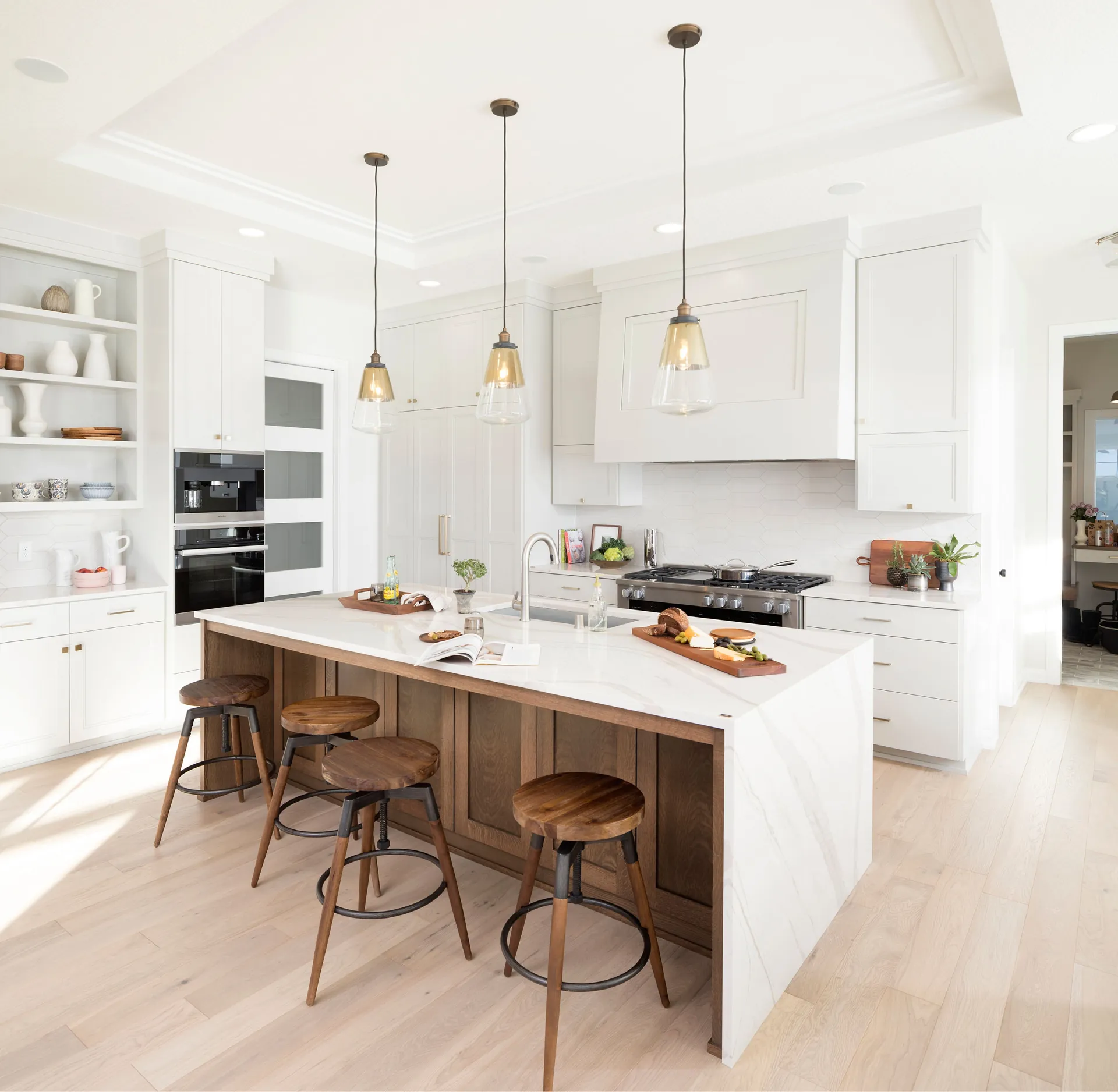
Walk into a national countertop showroom in Ohio and you'll get a standard pitch: quartz is low-maintenance, granite is beautiful, here are the prices. That pitch is fine. But it skips the part that actually matters for a Lakeland kitchen: Florida humidity changes the calculus, and a countertop choice that works fine in Denver or Charlotte may underperform here.
We install countertops across Polk County from our Winter Haven showroom, about 25 minutes from most of Lakeland. Every week we work with homeowners in Cleveland Heights, South Lakeland new construction, mid-century neighborhoods near Lake Hollingsworth, and commercial spaces around downtown. Here's the honest read on what actually matters in a Lakeland kitchen.
Quartz vs. Granite for Lakeland Kitchens
The quartz vs. granite question has a different answer in Florida than it does elsewhere, and the reason is one thing: porosity.
Granite is natural stone. It is porous. In a kitchen with average humidity and moderate cooking, a well-sealed granite counter is excellent. In a Florida kitchen, the stakes on proper sealing go up. Polk County's average summer humidity runs 75 to 90 percent indoors, especially during cooking. A granite surface that goes a season without a fresh seal can absorb ambient moisture, cooking oils, and bacteria at the pores. The result is a faint dark shadow near the stove or sink that doesn't wipe clean.
Quartz is engineered stone: roughly 90 to 95 percent crushed quartz mineral bound with resin. The process eliminates porosity. Quartz has no pores to absorb anything. Wine, oil, coffee, humidity: none of it gets in. You never seal quartz. That is a real maintenance advantage in a Florida kitchen.
Neither material is harmed by Florida indoor humidity in a structural sense. Both can last 50-plus years here. The difference is what happens when maintenance slips, as it does in any house. Quartz forgives a missed maintenance year. Granite does not.
What Lakeland Homeowners Actually Choose
In newer South Lakeland construction and mid-century homes that have been updated, quartz is by far the most common choice. The non-porous, no-maintenance story resonates. Most homeowners in those neighborhoods don't want to think about sealers.
In Lakeland's historic districts, Cleveland Heights, and Dixieland, granite reads well. Traditional and transitional kitchens in older homes suit the natural stone character. The veining and depth of granite match the period of the architecture in a way quartz can't replicate. Homeowners in those neighborhoods tend to be more engaged with the kitchen and willing to maintain the stone properly.
If you want the practical summary: quartz is the easier call for most Lakeland kitchens. Granite is the better call when the design calls for it and the homeowner commits to annual sealing. Both are good. The wrong one is granite that never gets resealed.
Cambria: What Makes It Different from Generic Quartz
Once homeowners decide on quartz, many land on Cambria and wonder whether it's worth the step up from less expensive brands. The short answer: yes, for the right kitchen.
Cambria is the only major quartz brand made entirely in the United States. Every slab is manufactured in Le Sueur, Minnesota. They're family-owned, which matters to us as a family business ourselves. The lifetime residential warranty is transferable when you sell the house, a real value at resale. Most quartz brands offer 10 to 25 years. Cambria offers lifetime.
The design library runs more than 150 patterns, with a strong emphasis on natural-stone looks: Calacatta marble, quartzite-inspired veining, and deep warm tones that generic quartz rarely achieves. If you want quartz that reads as real stone from across the room, Cambria is the brand most often picked for that job.
The price reflects the warranty and the library. Cambria lands toward the upper end of the quartz market. It fits a forever-home primary kitchen where the counter is a 25-year decision. For a rental or a secondary bathroom, other quartz brands at lower price points perform nearly as well for the use case.
We carry Cambria at our Winter Haven showroom. If you're coming in from Lakeland to look at slabs, contact us first and we'll pull the patterns most relevant to your kitchen so you're not wading through 150 samples cold.
Laminate Countertops in Lakeland: When It Actually Makes Sense
Laminate has a reputation problem. The word still calls up the beige-speckled plastic counters of the 1980s. Modern laminate from Wilsonart and Formica in 2026 is a different product. High-resolution digital printing now reproduces marble and stone patterns at near-photographic quality. Premium lines skip the obvious trim strip at the front edge. From across the room, a well-installed laminate counter looks like a real surface.
There are three situations where laminate makes real sense in a Lakeland kitchen.
First: rental and investment properties. Lakeland has a large stock of rental homes and short-term vacation properties. Spending $6,000 on stone counters in a rental that needs a clean, marketable kitchen is hard to justify when a $2,000 laminate install does the job.
Second: laundry rooms and utility spaces. A laundry counter takes almost no heat and light use. Quartz there is overkill. Laminate is the right material for a space that won't be featured in a listing.
Third: tight-budget primary kitchens where the choice is laminate now or nothing for two more years. Modern premium laminate, installed well with the right edge profile, reads as a finished kitchen. It can always be replaced with stone later.
The two honest limitations: laminate scorches at low temperatures, so trivets are mandatory every time. And laminate pairs badly with undermount sinks because water at the seam edge swells the wood substrate underneath. Use a drop-in sink with laminate. Skip undermount.
Edge Profiles, Overhang, and Seams
These three details don't get explained until after most homeowners have signed a contract. Here's the short version before you shop.
Edge Profiles
The edge is the front face of the slab that hangs over the cabinet. Edge profiles range from eased (a barely rounded square) to mitered (two slabs bonded at 45 degrees to look like a thick single piece). Eased is the most popular and is usually included in the base price. Fancier profiles add $5 to $60 per linear foot depending on complexity. For a kitchen with 30 linear feet of counter, that can mean a $1,350 difference between the simplest and most elaborate option.
Match the profile to the cabinet style. Eased pairs well with shaker and slab-door cabinets. Ogee fits formal traditional designs. Mitered suits contemporary and waterfall islands. Our full guide covers every option: countertop edge profile guide.
Overhang
Standard countertop overhang is 1 to 1.5 inches past the cabinet face. Islands commonly use a 12 to 15 inch overhang on the seating side to accommodate bar stools. Overhangs beyond 12 inches on stone require support: corbels, hidden steel brackets, or a waterfall panel on the end. Unsupported stone overhangs crack at the bracket point over time. Ask your fabricator to specify the support plan before fabrication.
Seam Placement
Seams are unavoidable on counters wider than a single slab, which most kitchens are. Where the seam lands matters. Good fabricators place seams away from the center of islands, away from sink cutouts, and in locations where the slab pattern can be aligned to minimize the visible line. A seam directly in front of the sink will bother you every day. A seam at the inside corner of an L-run disappears. Ask to see the seam plan on paper before fabrication starts.
We give every customer a written quote that breaks down slab cost, edge profile, cutouts, and support. We walk through the seam plan before a single cut is made. If you haven't been shown all three of these details before signing, ask for them.
Common Questions
Is quartz or granite better for Lakeland, FL kitchens?
Quartz is generally the safer choice for Lakeland kitchens because it is non-porous and never needs sealing. Florida's high humidity means an unsealed or under-sealed granite surface absorbs moisture and oils in ways that dry-climate homeowners don't see as often. Quartz eliminates that risk entirely. Granite is still an excellent choice for homeowners who love the natural stone look and will commit to annual sealing. If maintenance is a concern, quartz is the more forgiving option in a Florida kitchen.
How much do countertops cost in Lakeland, FL?
We quote on site based on slab choice, edge profile, and kitchen size. Installed countertop pricing varies widely depending on the material, the complexity of the cutouts, the edge profile, and whether support is needed for island overhangs. Laminate installs at a lower price point than stone. Quartz and granite cover a broad range depending on the brand and pattern. Cambria and exotic granite slabs sit at the higher end. We give written quotes before anything is fabricated. We also offer special financing, subject to credit approval, if you want to spread the cost out over time.
Does Florida humidity affect granite countertops?
Yes, more than in dry climates. Granite is porous, and Polk County's summer humidity regularly runs 75 to 90 percent indoors during cooking. A granite counter with a current seal handles this fine. The pores are blocked and moisture has nowhere to go. A granite counter that goes more than two to three years without resealing starts absorbing ambient moisture, cooking oils, and bacteria at the surface. The result is often a faint darkening near the stove or sink. In Florida, annual sealing is the practical standard for granite, not the theoretical best case. Skip it a few years in a row and the stone can stain in ways that require professional polishing to reverse.
Do you carry Cambria countertops in Lakeland?
We carry Cambria at our showroom at 1507 Havendale Blvd NW in Winter Haven, about 25 minutes from most of Lakeland. We're the local source for Cambria in Polk County. You can browse slabs in person, which matters with Cambria: the depth and veining in their natural-stone-look patterns doesn't come through in a 4-inch sample. Bring your cabinet door if you have one, and we'll help you match the slab to your kitchen. Contact us to confirm availability of specific Cambria patterns before making the drive.
If you're planning a full kitchen update, see what we're doing on the cabinets side for Lakeland and the flooring side as well. We do all three in the same showroom, which makes coordinating finishes much easier than sourcing each trade separately.
More countertop tips
Have a project of your own?
Free in-home estimates across Polk County.