
Countertop Tips
Countertop Edge Profiles and Costs
Every common countertop edge profile explained: what each looks like, how much it adds to the price, and which one fits your kitchen style.
- Published
- June 12, 2026
- Author
- Blackburn's Interiors, Winter Haven, FL
- Updated
- August 3, 2026
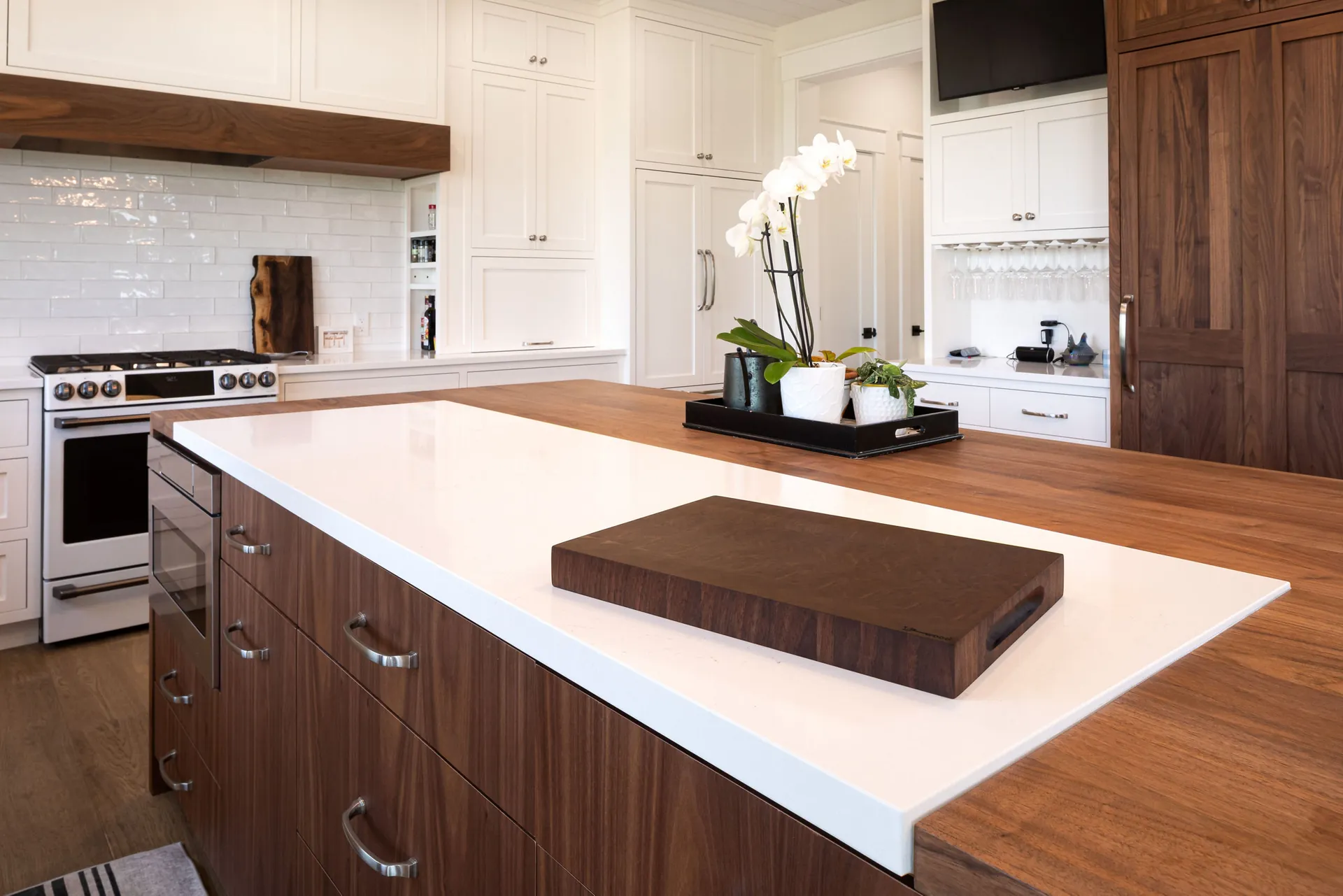
Most homeowners pick a slab in 20 minutes and a sink in five. Then the fabricator asks, "What edge profile?" and the room goes quiet. It feels like a small detail. It isn't. The edge is the part you actually touch, every time you wipe the counter, lean against it, or hand a kid a glass of water. The right profile makes a slab look custom. The wrong one makes a $130-per-square-foot counter feel ordinary.
Here's every common edge profile we offer, what each one looks like, how much it adds to the price, and where each one fits best. Our fabrication partner cuts these every week on the quartz, granite, and laminate tops we sell. The advice below is what we walk every customer through.
Why Edge Profile Matters More Than You'd Think
An edge profile is the shape of the front face of the slab, the part that hangs over the cabinet box and faces the kitchen. Profile choices change three things: how the countertop reads from across the room, how comfortable it feels under your forearm when you stand at it, and how easy it is to clean.
Edges are cut by the fabricator after the slab is templated. The cut adds time and tooling, which is why fancier profiles cost more. The base price almost always includes a simple profile. Anything more decorative is an upgrade, usually $5 to $25 per linear foot depending on the profile and the material.
Eased Edge
An eased edge is a square edge with the corners barely rounded, a very subtle 1/8" radius. From across the room it reads as a clean square. Up close, the rounded corners catch light softly and feel smooth.
Best for modern, transitional, and minimalist kitchens. Eased is the most popular profile on quartz, by a wide margin. Pairs especially well with shaker cabinets, slab-door cabinets, and waterfall islands. Cost: standard, almost always included in the base price.
Bevel Edge
A 45° cut across the top corner of the slab, leaving a clean angled face. The bevel is typically 1/2" tall. Caesarstone puts its own bevel at half an inch. Crisp and contemporary up close, slightly softer than a true square edge from across the room.
Best for contemporary, craftsman, and transitional kitchens. Cost: modest upcharge, typically $5 to $10 per linear foot on quartz and granite.
Bullnose Edge
The top half of the edge is rounded into a half-circle. A full bullnose curves the entire front face from top to bottom. The look is soft, traditional, and friendly, the opposite of an architectural square edge.
Best for traditional and country kitchens, family homes with young kids (rounded edges hurt less on impact), and granite installs that want to show off the natural stone at the edge. Cost: moderate upcharge, typically $10 to $15 per linear foot.
Ogee Edge
The ogee is an S-curve: a concave curve at the top of the slab that flows into a convex curve below. It's the most decorative of the common edge profiles and reads as classic, formal, and detailed from across the room. Up close it casts shadow lines that change as you move around the kitchen.
Best for formal traditional and old-world kitchens, granite paired with raised-panel cabinets, and bathroom vanities in master suites. Less common on contemporary kitchens, because the formal curve fights a clean-line design. Cost: significant upcharge, typically $15 to $25 per linear foot.
Half-Bullnose
Rounds only the top corner into a smooth quarter-circle and leaves the bottom corner square. Softer than eased, less traditional than a full bullnose. A nice middle-ground profile that works in a lot of kitchens. Cost: small to moderate upcharge, typically $7 to $12 per linear foot.
Mitered Edge
Two pieces of slab are cut at 45° angles and bonded together to create the illusion of a much thicker counter, typically 2.5", 4", or even 6" thick. The seam where the two pieces meet is barely visible when fabricated well.
Best for modern and contemporary kitchens, especially waterfall islands and statement prep counters. Cost: significant upcharge, typically $30 to $60 per linear foot. The most expensive standard edge option, but the most striking on the right kitchen. Ask to see examples of past mitered work before you commit, as a poorly made miter can chip or open over time.
Less-Common Profiles Worth Knowing
Pencil Edge
A very small full bullnose, rounded over a 1/4" radius. Subtle, soft, and forgiving. Common on bathroom vanities.
Dupont Edge
A small flat above a rounded face, like a small step at the top edge. Common in upscale traditional bathrooms. Adds detail without going to a full ogee.
Waterfall Edge
Not technically an edge profile. It's an extension. The slab continues down the side of the island at a 90° miter, making the counter look like a single piece wrapping the cabinet. Almost always paired with a mitered edge profile on contemporary islands.
Which Edge Profile Costs the Least?
Eased and the basic square edge are always the cheapest and almost always included in the base slab price. Bevel and pencil profiles are small upcharges. Bullnose and half-bullnose are moderate upcharges. Ogee and mitered edges are significant upcharges. Across a typical kitchen with 30 linear feet of counter, the difference between eased (included) and mitered ($45/ft) is roughly $1,350. That's real money worth budgeting for if you want the dramatic look.
Worth knowing: edge profile pricing is on linear feet of finished edge, not square footage of slab. A small bathroom vanity might have 8 linear feet of edge; a kitchen with an island can have 30 to 40. We give you the full quote in writing before fabrication starts, broken down by slab cost, edge, sink cutout, and labor. Ask about financing if you want to pay over time, subject to credit approval.
Which Edge Profile Is Best for Kids?
Bullnose and half-bullnose are the safest. Rounded edges hurt much less when a toddler's forehead meets the counter at running speed (which it will). Ogee is decorative but the underside of the S-curve still creates a sharp lower corner that catches knees and hips at adult height. Eased and mitered are technically sharp 90° corners, softened only slightly, so they're the least kid-friendly profiles.
If you're remodeling a family kitchen and the counter height runs at toddler-eye level, a soft profile is one of the few decisions that genuinely affects daily safety.
Edge Profile Pairing with Cabinet Style
The edge should agree with the cabinet style. A few combinations that almost always work:
- Shaker cabinets + eased edge: clean, modern, the most-installed combination in 2026 kitchens
- Shaker + bevel: slightly more refined, great for transitional designs
- Slab-door modern cabinets + mitered edge: contemporary and architectural
- Raised-panel traditional cabinets + ogee: classic formal kitchen
- Country/farmhouse cabinets + bullnose: soft and inviting
- Inset cabinets + half-bullnose: sophisticated transitional
We design entire kitchens around the cabinet–counter pairing in our kitchen design 101 guide. If you're starting from scratch, picking the cabinet style first and the edge second usually leads to the cleanest result.
Slab Thickness and Material Affect Profile Options
Most kitchen quartz and granite slabs are 3 cm thick. Bathroom vanities are often 2 cm. MSI calls those the standard thicknesses. The thicker the slab, the more visible the edge profile. On a 2 cm slab, the difference between eased and bevel is subtle. On a 3 cm slab, it's clearly visible from across the room. Mitered edges only really make sense on 3 cm material.
Quartz takes any profile beautifully. Granite handles all profiles, with ogee and bullnose looking especially good at the curved edge. Laminate is more limited, typically a square edge, a beveled edge, or a small bullnose. If you're still picking material, our quartz vs granite comparison walks through the full trade-offs.
Common Edge Mistakes to Avoid
- Picking a decorative profile on a slab with heavy veining: the curves and the veins fight each other and the edge gets visually busy
- Choosing a profile because it's trendy rather than because it fits the kitchen's design language
- Mixing two different profiles in one kitchen: almost always reads as inconsistent
- Ignoring the bottom corner: a sharp bottom edge on a 1.25" slab catches knees and pant pockets
- Picking a heavy ogee on a contemporary kitchen: the formal curve fights every clean line
- Approving a mitered edge without seeing the fabricator's past work: bad miters open over time
Frequently Asked Questions
Which Edge Profile Is Easiest to Clean?
Half-bullnose and full bullnose. The continuous curve has no flat shelves or sharp corners to catch crumbs. Eased is second easiest. Ogee is the hardest because the concave portion of the S-curve traps dust.
Can I Change the Edge Profile After Installation?
Limited. A fabricator can re-cut an eased edge into a bevel on existing installed counters, but it requires careful work in place and is rarely cost-effective. Bigger changes, like eased to mitered, aren't practical without replacing the slab.
What's the Most Popular Edge Profile in Polk County Kitchens?
Eased, by a long way. Easily 60–70% of the kitchens we install in Winter Haven, Lakeland, and across the county get an eased edge. The modern, clean look fits the way most newer homes are designed. Bevel and half-bullnose are tied for distant second.
The Bottom Line
For modern and transitional kitchens, eased is almost always the right pick. For traditional kitchens, bullnose or ogee. For dramatic contemporary or waterfall designs, mitered. Match the profile to the cabinet style and the overall look the kitchen is going for, and the edge will quietly do its job for the next 30 years.
Come by the showroom and run your hand across every profile we offer. The right one usually picks itself once you can feel the difference. Contact us to book a slab visit, or stop in any weekday at 1507 Havendale Blvd in Winter Haven.
Sources
- Caesarstone, Countertop Edges - Different Types for Your Kitchen Design (the half-inch bevel size)
- MSI Surfaces, The Ultimate Granite Countertop Buying Guide: Benefits, Cost, Installation, And Maintenance (the 3 cm kitchen / 2 cm vanity slab-thickness standard)
More countertop tips
Have a project of your own?
Free in-home estimates across Polk County.