
Cabinet Tips
Kitchen Cabinets in Winter Haven, FL: What Our Hometown Taught Us
Kitchen cabinets in Winter Haven, FL, from lakefront kitchens to mid-century bungalows. Here is what works and what most showrooms won't tell you.
- Published
- February 25, 2026
- Author
- Blackburn's Interiors, Winter Haven, FL
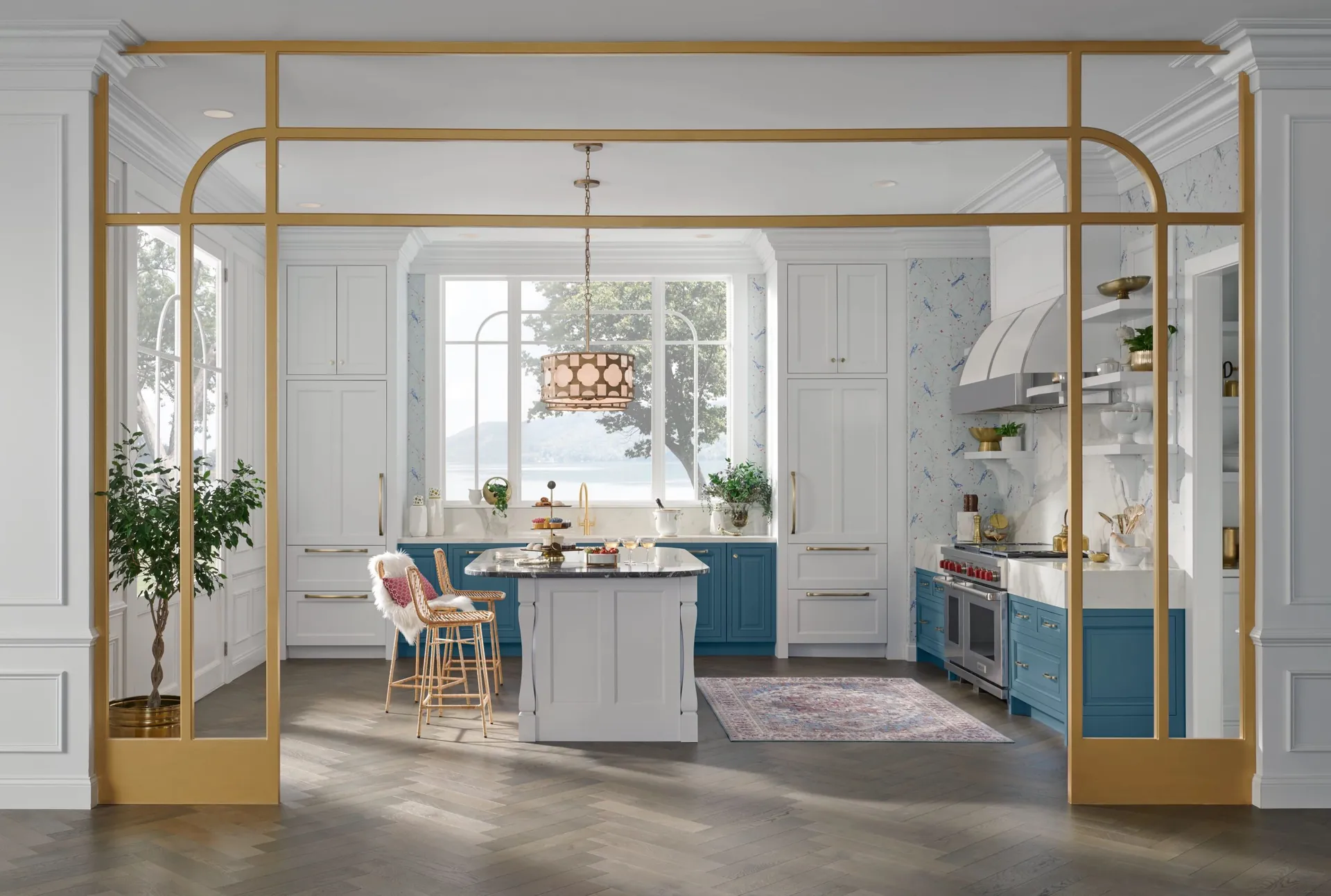
Winter Haven is our home. We've been here since 1962. Our showroom is at 1507 Havendale Blvd NW, about a mile from the Chain of Lakes. We've installed kitchen cabinets in homes on Lake Howard, Lake Shipp, Lake Eloise, and a dozen other lakes in the Chain. We've worked in mid-century bungalows off Central Avenue and in brand-new construction on the south end of town.
That depth of local history means something. We know Winter Haven's housing stock well. We know what cabinet types fit which neighborhoods, what materials hold up in lakefront kitchens versus interior homes, and which mistakes homeowners regret most. Here's what we'd tell any Winter Haven homeowner before they start shopping for kitchen cabinets.
Chain of Lakes kitchens: high expectations, open plans
Homes on Lake Howard, Lake Cannon, Lake May, Lake Shipp, Lake Eloise, and the rest of the Chain of Lakes are among the most sought-after in Polk County. They tend to run larger than average. Many were updated or built to take advantage of the view: open-plan layouts, larger windows, kitchen spaces that flow into living and dining areas without a wall in between.
That open-plan context raises the bar. Cabinets in a closed galley kitchen get judged from one angle. Cabinets in an open-plan lakefront kitchen get seen from every direction, in natural light, next to whatever countertops and flooring and trim the room has. The whole room reads as a composition, and cabinets are the anchor.
Stock cabinets rarely hold up in this context. The size limitations are the first problem. Most stock lines come in three-inch increments. A kitchen that's 14 feet 4 inches along one wall ends up with filler strips that announce themselves. A lakefront kitchen with a large island benefits from sizing that fits the island proportions, not the nearest stock increment.
Semi-custom is the workhorse for Chain of Lakes kitchens. One-inch size increments, a wide range of door profiles and finish options, plywood box construction on quality lines, and lead times that fit most remodel schedules. Wally Blackburn is personally involved in many of the larger lakefront kitchen projects we do. If the kitchen is substantial, expect him to be part of the design conversation.
Custom cabinets make sense when the design requires something semi-custom can't deliver. A kitchen that needs a specific built-in detail, a panel that matches the home's original millwork, or a truly one-of-a-kind layout is a good candidate for custom. The lead time is longer (typically 10 to 16 weeks) and the cost is higher, but the result is a kitchen built for that specific room.
For lakefront kitchens that connect to outdoor living spaces, the indoor-outdoor flow matters. Think about how cabinet finishes and door profiles read from the lanai or the dock. A warm stained wood or a clean painted shaker that carries through to the outdoor kitchen area (if there is one) creates cohesion. We handle countertops and flooring as well, so the whole interior can be designed as a single project.
Mid-century homes: updating the kitchen without losing what makes it special
Winter Haven's mid-century housing stock is concentrated in the neighborhoods closest to the Chain of Lakes. Homes from the 1950s and 1960s on streets near Lake Howard, Lake Cannon, and the central Chain tend to have genuine character: original terrazzo or hardwood floors, wood-frame construction, trim profiles that no home center stocks anymore, and kitchens with quirks that reflect how those homes were actually built.
Those quirks matter when you're choosing cabinets. A mid-century kitchen may have a wall that's out of plumb by a quarter inch over ten feet. That sounds trivial. It isn't trivial when you're trying to fit a 10-foot run of stock cabinets that were built assuming a perfectly square room. The gap at one end, the forced contact at the other, the filler strip that doesn't quite match: all of it reads as a renovation that didn't quite fit.
Custom cabinets handle this cleanly. A custom cabinet maker measures the room as it actually exists, not as it should exist on paper. Boxes are sized for the real wall. Scribes and panel ends are built to absorb whatever out-of-plumb or out-of-level conditions the room has. The kitchen ends up looking like it belongs in the house.
Semi-custom is also a viable path in mid-century kitchens, with the right planning. The key is working with a designer who knows how to use fillers, scribes, and custom panel ends to handle irregular walls. Done well, a semi-custom kitchen in a 1958 Winter Haven home can look entirely intentional. The planning is more involved than a new-construction install, but the result is worth it.
Mid-century kitchens often have low upper cabinets. Ceilings in these homes typically run 8 feet, but some kitchens have upper cabinets that stop at 84 inches with a soffit above. If you're redoing the kitchen, decide early whether to remove the soffit and run cabinets to the ceiling or maintain the original proportion. Both can work. Removing the soffit and going to ceiling height opens the room and reads as modern. Keeping the original ceiling line and adding glass-front uppers on the same run reads as period-appropriate.
Whatever you choose, don't let the remodel strip the character out of the home. A mid-century house with a kitchen that looks like it was spec-built in 2020 is a missed opportunity. We've done plenty of mid-century kitchen updates that feel fresh and livable without losing what makes them interesting. That's the goal.
Newer construction: Cypresswood, the south end, and standard slab
The neighborhoods built out from the 1980s onward on the south end of Winter Haven, including Cypresswood and the subdivisions along Havendale Blvd toward Lake Eloise, are standard Florida slab construction. Drywall over metal stud. Eight- or nine-foot ceilings. Rooms that are reasonably square. Standard door openings. This is the environment semi-custom cabinets were built for.
Semi-custom cabinets in newer Winter Haven construction give you more than stock at a price that makes sense. One-inch size increments mean no awkward filler strips. Real door and finish choices. Plywood box construction on quality lines. A 4 to 8-week build and delivery window that fits a typical remodel schedule.
Before you choose any cabinet for a newer home, ask one question about the box construction: is it plywood or particleboard? The answer matters more in Florida than in most states. Plywood box construction handles the humidity cycles that Polk County runs through every year. Particleboard does not. Quality semi-custom lines publish this on their spec sheets. Budget lines often won't give you a straight answer. If the salesperson can't tell you what the box is made of, that's worth knowing before you sign.
Soft-close hinges and full-extension drawer glides are worth paying for on any cabinet tier. They cost a small amount more at purchase. They last significantly longer than budget hardware and don't need adjustment after the first Florida summer. Ask about them explicitly if they're not in the base spec.
For newer homes on the south end, the one-stop approach matters even more than it does for custom-home projects. Standard construction means the countertop fabricator and the flooring installer can both work from the same measurements. Coordinating all three surfaces on one schedule from the start, rather than sequencing them through three different contractors, is the simplest way to keep a full kitchen remodel from stretching into a six-month ordeal.
Florida humidity and cabinet materials in Winter Haven
Winter Haven's lakefront character makes humidity more relevant here than in most Polk County markets. Homes on the Chain of Lakes sit in close proximity to open water. Summer humidity runs 75 to 90 percent for months. Storm systems push it higher. And the proximity to lake surfaces means the air near the water stays heavy for longer.
The cabinet spec that holds up in this environment is straightforward. Plywood box construction is the foundation. Plywood resists moisture, holds screws well, and tolerates small leaks (under a sink, behind a refrigerator, near a dishwasher) far better than particleboard. Particleboard swells when it gets wet and does not recover. The damage is permanent. In a lakefront home that has additional ambient humidity to deal with all year, particleboard box construction is a risk that isn't worth taking.
Door construction matters too. Solid wood doors move with humidity. A solid wood shaker door 14 inches wide can grow several millimeters across a Florida summer. On inset cabinets with a tight reveal, that movement causes sticking. The better option for most Winter Haven kitchens is engineered core doors: MDF or plywood core with a real wood veneer on the face. The door looks like solid wood, takes stain the same way, and moves far less across the seasonal humidity swings.
Painted MDF doors are the standard choice for painted finishes. They take paint beautifully, move less than solid wood, and hold up well in Florida conditions as long as the factory applies the finish to all six surfaces: both faces, both side edges, top and bottom. An MDF door where only the visible faces are painted will absorb steam from a dishwasher or stove and swell at the exposed edges.
Factory-applied conversion varnish or catalyzed lacquer is the right finish spec for a Florida kitchen. These are two-part catalyzed finishes applied in a controlled factory environment. They cure hard, resist moisture, and don't break down under the repeated temperature and humidity swings that Polk County runs. Field-applied finishes, applied on-site after installation, can't match the durability of factory finishes in this climate.
For a complete breakdown of what holds up and what fails in Florida kitchens, see our Florida humidity and cabinet materials guide.
Common questions
What kitchen cabinet type is most popular in Winter Haven, FL?
Semi-custom cabinets are the most common choice in Winter Haven across all neighborhood types. They offer real size flexibility, a wide range of door and finish options, and plywood box construction on quality lines, at a price and lead time that makes sense for most kitchen remodels. Custom cabinets are the right choice for lakefront homes with complex layouts or for mid-century kitchens with non-standard wall conditions. Stock cabinets work for rentals, flips, or secondary spaces where budget is the primary driver. Door style varies by neighborhood: shaker and transitional profiles are the most common in newer construction; inset and more traditional door profiles come up more often in mid-century homes near the Chain. Come into the Winter Haven showroom and we'll show you door samples in the context of your home's style.
How much do kitchen cabinets cost in Winter Haven, FL?
We quote on site because the price depends on your kitchen's size, the cabinet tier, the door style, the finish, and the modifications your specific layout requires. As a general frame: stock cabinets typically run $80 to $200 per linear foot installed. Semi-custom runs $200 to $500 per linear foot installed. Custom starts around $500 per linear foot and goes up from there for specialty materials, built-ins, and complex installs. Most full Winter Haven kitchen cabinet projects we complete fall in the $14,000 to $40,000 range for cabinets before countertops and flooring, depending on the size and tier. Lakefront kitchens with larger layouts and custom work run higher. The free estimate gives you a real number for your kitchen. Schedule yours here. Special financing is also an option, with approved credit. See our financing page for details.
Do you offer cabinet design consultations at your Winter Haven showroom?
Yes. Our showroom at 1507 Havendale Blvd NW is 8,000 square feet, and the cabinet section includes full door samples, finish options, and box construction samples you can handle in person. Matthew Rodriguez leads the sales side and does the cabinet design consultations. For larger or more complex projects, Wally Blackburn is typically involved in the design conversation. The initial consultation and in-home estimate are free. We don't charge a design fee to get a written quote. Stop by during business hours (Monday through Friday 9 AM to 5 PM, Saturday 9 AM to noon) or contact us to schedule a visit.
What's the difference between semi-custom and custom cabinets?
Semi-custom cabinets are built in a factory to a specific set of standard sizes, but with enough flexibility in those sizes (typically one-inch increments) and enough options in door style, finish, and interior configuration to fit most kitchens well. Lead time is usually 4 to 8 weeks. Custom cabinets are built from scratch for your specific kitchen: any size, any configuration, any material or detail. Lead time is typically 10 to 16 weeks. The price difference is real but not always as large as people expect: quality semi-custom with all the right specs can approach the cost of entry-level custom. The practical difference comes down to how unusual your kitchen is. A standard-dimension kitchen in a newer home is a perfect semi-custom candidate. A lakefront kitchen with complex corner conditions, a non-standard layout, or millwork details that need to match the original house is a stronger case for custom. Our custom vs. semi-custom vs. stock cabinets guide walks through the full comparison if you want more detail before your estimate.
More cabinet tips
Have a project of your own?
Free in-home estimates across Polk County.