
Flooring Tips
How We Decide What Floor Goes Down in an Auburndale Home
Before we recommend a floor in an Auburndale home, we look at what is already down, which doors see water, and what the slab reads. Here is how each answer changes the room.
- Published
- April 5, 2026
- Author
- Blackburn's Interiors, Winter Haven, FL
- Updated
- September 7, 2026
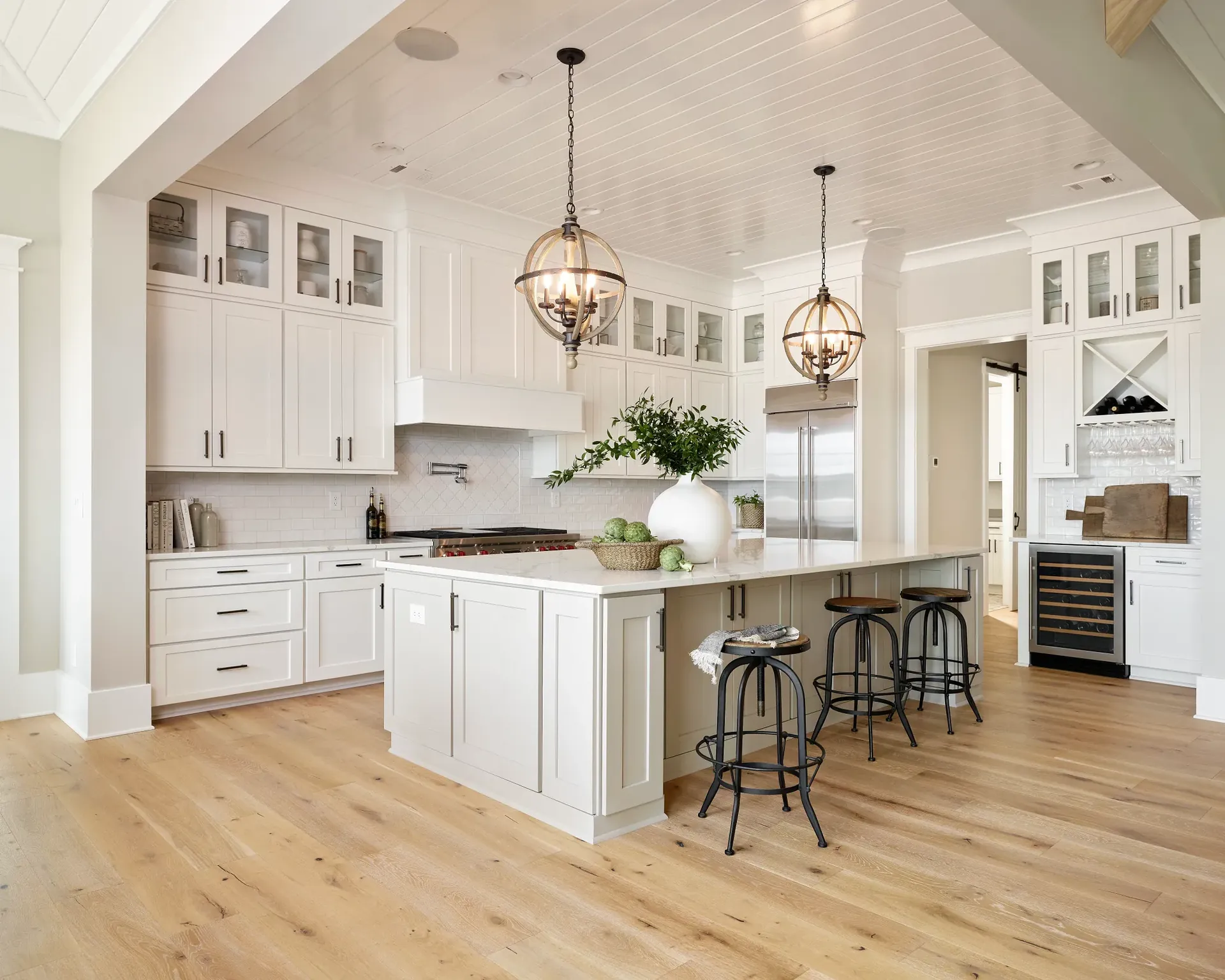
Before we recommend a floor for an Auburndale home, we ask four questions: what is already on the floor, which doors see water, what the slab reads on a meter, and what the house is built on. Those answers move the recommendation more than anything on the sample rack does.
What is already on the floor
Downtown, on the older streets around Lake Lena, the first thing we look at is what is under our feet and how sound it is. A flat, solid surface can often be floated over, and that is where luxury vinyl plank tends to come up first, because it rides above what is already there instead of bonding to it. Tile works the other way. It grips whatever is under it, so a tile job usually starts by taking the old floor out, all of it, not just the parts that show.
A newer house out toward Hills of Arietta or The Reserve at Van Oaks is a shorter conversation. Whatever the builder put down is usually the only floor that room has ever had, so there is one layer to deal with instead of a stack of them. The concrete underneath is the same either way. The prep is not, and prep is where a job turns easy or hard. That is worth knowing before you fall for a sample.
Which doors see water
Lake Ariana sits in the middle of town. Lake Juliana borders the north side. Lake Myrtle is out east by the sports park. None of that decides your whole house. It decides one door at a time. The door that opens toward the water takes wet feet, sand, and whatever comes back up from the dock, and a waterproof floor belongs on the other side of it. Luxury vinyl plank is the usual answer there.
A bedroom on the far side of the same house is a different room with a different job. Nothing wet walks into it. That room can carry engineered hardwood or carpet, once we know what the slab under it is doing. Neither choice is about which floor looks nicer. It is about what each room has to survive.
Water does not only come from a lake, either. A door in from the garage, a lanai slider, the path out of the laundry room: those take on more water than most people count. We walk all of them. It is why a lakefront plan in Auburndale often ends up with more than one floor in it, and why the line between one floor and the next tends to fall right where the wet traffic stops. That is not indecision. That is the plan doing its job.
Every install includes our FIDO subfloor treatment, which neutralizes bacteria and odor in the concrete before the new floor goes down. In a house near the water, where doors stand open half the summer and wet dogs come through them, that step does real work. We do not skip it.
What the slab reads
Here is the part that surprises people. A slab that looks dry can still read high on a moisture meter. Concrete keeps drawing moisture up out of the ground, and it goes on doing that long after a floor feels dry to the hand. What the meter says, not what the room looks like, is what decides whether a wood-based floor is safe in it. We test before we recommend, not after you have picked a color.
There is no one number every floor has to pass. The limit belongs to the product you choose, and two manufacturers can set it differently for the same room, which is why we read the spec for the floor you actually want instead of quoting a single number to everybody. Our slab moisture guide lays that out, with the sources behind it.
The reading lands hardest on wood. Engineered hardwood is the material a high number can rule out of a room. Tile takes that same number in stride, because it does not react to slab humidity the way a wood floor does. Vinyl plank sits in between, waterproof on top, and still worth measuring under.
A high reading is not a dead end, either. It is a line item, and that same guide walks through what fixing it involves. We would rather hand you that news at the measure than after the floor is down.
What the house is built on
Most Auburndale homes sit on a poured concrete slab, and everything above here assumes yours does. That is not the only way a house gets built in this town. The Hamptons Golf & Country Club, off US-92, is a gated 55-and-up manufactured-home community, and those homes are put together another way entirely. No poured slab. Wood decking underneath instead, and on a double-wide, the marriage line where its two halves were joined. Neither one turns up on a moisture meter, and neither one acts like concrete.
We put this question last because it is the rare one. In a house it comes first. What the floor is sitting on decides whether the other three questions even apply, and it is a bad thing to learn late.
Put the four together and you get a plan for the house, not a pick off a rack. What is already down changes how the job starts. Which doors see water changes what goes in near them. What the slab reads changes whether wood is safe anywhere in the house. What the house is built on decides whether the slab question matters at all. Most Auburndale homes only need two or three of those answers. A few need all four, and we would rather ask than assume.
Ready when you are
The best next step is a free in-home measure. We look at what is already on your floor, test the slab, and walk every door that water comes through, and then we tell you what we would put down and why. We put no price on anything here, so if you want Polk County ranges by material, our cost guide has them.
See what we do in Auburndale, or ask us for a free estimate. Installers we train and certify handle every install we schedule, and residential jobs carry our residential labor warranty. There are other flooring companies you could call in this town. We know that, and we are grateful you read this far. No obligation, no hard sell.
Common questions
Should we pick a floor first, or have you look at the house first?
Look at the house first. Picking a color is the fun part, and it is easy to do standing in the showroom, but the house is what decides which floors can actually go in which rooms. Pick first and you risk getting attached to something one of your rooms cannot take. We would rather start where the answers are, and then go pick the pretty part with nothing hanging over it.
What if the slab reads high but the room never sees water?
Those are two separate questions, and only one of them is about the room. A high reading comes up out of the ground, so it can turn up in a bedroom in the middle of the house as easily as in a room by the door. It narrows what can go over that spot, wood most of all. It does not tell us anything about your doors. We answer them one at a time, because they answer differently.
We are a few streets back from Lake Ariana. Does the door question still apply to us?
It does. Every house has doors that take on more water than the rest, and most of them are nowhere near a lake. The door in from the garage. The lanai slider. The one the dogs come through after a rain. We walk all of them at the measure, not only the ones with a view, and the room-by-room thinking works the same whether the water is a lake or a hose.
Should we pull up the old floor before you come out?
Please leave it down. What is on the floor now tells us things a bare slab cannot: how flat the room is, how the last floor was put in, and whether a new one can go straight over it. Pull it up early and we lose all of that. If the job needs the old floor out, taking it out is our work, not yours, and it is in the quote.
We already know what we want. Do you still walk the house?
Yes, and most times the walk backs up your pick. It is not there to talk you out of anything. It is there so we can tell you if one room is going to fight the floor you chose, while that is still cheap to fix. If it all checks out, we say so and we get you on the schedule.
More flooring tips
Have a project of your own?
Free in-home estimates across Polk County.